



Abortion
Abortion is the deliberate termination of a pregnancy, usually before the embryo or fetus is capable of independent life.
Abortions are performed either surgically or medically. A medical abortion - in which the woman takes two drugs 48 hours apart - is approved only during the first nine weeks of pregnancy.
AIDS
Acquired Immune Deficiency Syndrome
Air Force One
Call sign given to the plane on which the U.S. president flies.
Other ways the president travels are on Marine One - call sign for the presidential helicopter - and in the presidential limo - known as The Beast.
For more, read the Business Insider story.
Amicus Curiae
A brief in a court case filed by someone who is not a party to the case, but who believes...
o They have relevant information that might not be brought up by the parties involved, yet might help the court arrive at a decision.
The term amicus curiae is Latin, which translates to Friend of the Court.
Arbitration
A means of resolving a dispute between two parties.
Arbitration decisions typically are arrived at by a panel of three people (arbitrators) - one picked by each of the parties and a third picked by those two.
A feature of arbitration is that there generally is no compromise. The arbitrators must vote for one party or the other.
Arizona SB-1070
2010 Arizona law requiring police to determine the immigration status of someone arrested or detained when there is "reasonable suspicion" they are not in the U.S. legally.
About half of the remaining states later introduced similar laws.
Articles of Confederation
The document that defined how the U.S. government operated prior to March 4, 1789 when the government began operating under the Constitution.
Block Grant
A large amount of money from the federal government to a state or regional government for a specified purpose.
The purpose usually is general (such as law enforcement, community development, transportation, health services), with the regional government deciding how to spend it in a way consistent with the purpose.
Boycott, Divestment, and Sanctions (BDS)
A movement to boycott companies in Israeli settlements in areas claimed by Palestinians or who have contracts with the Israeli military.
Several states have proposed or enacted legislation (in various forms) against the movement, from condemning it to prohibiting the state from doing business with companies who observe the boycott.
These states include...
o Arizona
o California
o Colorado
o Florida
o Georgia
o Illinois
o Indiana
o Iowa
o New Jersey
o New York
o Ohio
o Pennsylvania
o South Carolina
o Tennessee
o Virginia
The American Legislative Exchange Council (ALEC) has issued a strong policy statement against the movement - supporting those state governments' efforts to oppose it.
Click here to read the ALEC policy statement.
Bridgegate
Term used to label a 2013 political scandal in New Jersey in which toll lanes leading to the George Washington Bridge were closed for several days - resulting in traffic gridlock in Fort Lee, NJ.
The closures were alleged to be retaliation against Fort Lee Mayor Mark Sokolich for not supporting Gov. Chris Christie's re-election. Three associates of Christie - including his deputy chief of staff - were convicted of felony charges related to the incident.
For more on what involvement Christie may have had in the affair, read the New York Times story.
Census
A survey taken of Americans every 10 years to determine the number and characteristics of Americans.
The most significant census data is the distribution of where American's live by state, which is used to determine the number of representatives in Congress each state receives.
The census is mandated in Article 1, Section 2 of the Constitution.
Civil Rights
The rights of every citizen to be treated equally regardless of their characteristics... such as ethnic background, gender, and religion.
Class Action Lawsuit
A lawsuit filed on behalf of a group of people. Many of the plaintiffs will not participate in the suit itself. In fact, they may not even be aware of the lawsuit.
A common use of a class action lawsuit is when a company has engaged in a fraudulent or dangerous practice that affects a large number of its customers. Each consumer might have been affected in a tiny way (for example, adding a penny to a utility bill), yet when combined over all customers the practice resulted in a large profit for the company.
Class action lawsuits typically result in a settlement - where the company agrees to pay a certain amount that will be divided (after taking out fees charged by the attorneys) among all affected customers (referred to as members of the class).
You may receive a letter or email informing you that you are a member of the class. As a member of the class, you agree to accept the settlement, and give up your right to sue the company at a later date. The letter will inform you of your options, which typically include...
o If you must file a claim to receive your share of the settlement, you'll be told how to do that.
o You can challenge the settlement if you do not believe it is fair.
You also can request to be removed from the class. If you do this, you will not receive any part of the settlement. However, you will retain your right to sue the company
Closely-Held Corporation
A corporation in which 5 (or fewer) individuals own more than half of its stock. Their shares are not publicly traded.
Closely-held corporations can be any size. They account for approximately half of all private jobs in the U.S. Large closely-held corporations include...
o Mars - owner of candies such as M&M's, Snickers, Dove chocolate, Uncle Ben's rice products, and pet food companies Nutro, Pedigree, and Greenies.
o Dell - maker of computers.
o Hobby Lobby - a retail crafts chain with more than 20,000 employees and $3 billion annual revenue.
In the 2014 Supreme Court case Burwell v. Hobby Lobby, the court ruled that closely-held corporations could claim religious exemptions to federal laws
Conflict of Interest
A Conflict of Intersest arises when someone has two interests that cannot necessarily be helped by the same solution.
For example, let's say you are the administrator of the Environmental Protection Agency (EPA), who is responsible for ensuring (through regulations) that coal-fired power plants do not emit excessive amounts of pollution into the air.
If you also happen to own a coal-fired power plant, those regulations could cost you money in needed upgrades or fines.
Your two interests conflict.
This does not mean the best decision always would be the one that hurts your company's profits. Nor does it mean that you would be unable to make decisions that are best for the Americans - even if at the expense of your company. But it would cast doubt on the public's trust in your decisions should they favor your company.
Since our government is founded on the concept of honest representation, even the appearance of a conflict of interest often can be a problem.
Demand Response
A program for reducing energy consumption by offering consumers a lower price if they reduce their energy use during peak demand times.
This can help the utility company avoid power outages due to heavy demand and keep them from having to buy expensive power on spot markets.
For more, visit the Department of Energy website.
Disparate Impact
U.S. anti-discrimination laws protect from two forms of discrimination in areas such as employment or housing...
o Disparate Impact: The discrimination is not explicit or intentional, but it results in a disproportionate disadvantage for certain classes of people.
Distressed Asset
Something that is offered for sale at a price significantly below value because the owner needs to sell it quickly.
Dogma
Positions or beliefs obtained from a figure of authority - such as a parent, religious leader, teacher, or book - which is contradicted by verifiable evidence or for which verifiable evidence does not exist.
Related term: scientific method
Doughnut Hole
A general term used to describe a gap in eligibility for a benefit.
For a simple hypothetical example, a prescription drug benefit might pay for drugs up to $2,000. But if it also pays for drugs in excess of $4,000, your maximum out-of-pocket expenses would be $2,000 (the amount over $2,000 but less than $4,000). This gap - where you would pay - is referred to as a doughnut hole.
Drone
An unmanned aircraft. Drones are used by the military, companies (for example filmmakers and surveyors), and individuals. They can be either autonomous - controlled by a computer program without human control or manned - remotely controlled by a pilot.
Drones also are referred to as UAVs (Unmanned Aerial Vehicle) and UASs (Unmanned Air Systems).
For more on how drones may be used in the United States, read the Federal Aviation Administration factsheet.
e-Cigarette
Short for electronic cigarette. E-cigarettes are small electronic devices used like a cigarette - in which the person inhales a vapor made from nicotine and/or flavored liquid. They differ from cigarettes in that e-cigarette vapor is produced electronically rather than by burning tobacco.
For more, read this National Institute on Drug Abuse publication.
Emoluments
In the Constitution, emoluments refers to benefits from holding office - such as compensation, privileges, or certain advantages.
Emoluments are mentioned twice in the Constitution...
Foreign Emoluments
Article 1, Section 9 states...
No Title of Nobility shall be granted by the United States: And no Person holding any Office of Profit or Trust under them, shall, without the Consent of the Congress, accept of any present, Emolument, Office, or Title, of any kind whatever, from any King, Prince, or foreign State.
Domestic Emoluments
Article 2, Section 1 states...
The President shall, at stated Times, receive for his Services, a Compensation, which shall neither be increased nor diminished during the Period for which he shall have been elected, and he shall not receive within that Period any other Emolument from the United States, or any of them.
Enron
Energy company created in 1985 and dismantled due to bankruptcy in 2001. Before declaring bankruptcy, Enron used fraudulent accounting practices to make it appear to be profitable. Accounting firm Arthur Anderson helped enable the deception by approving Enron's financial reports.
The Enron case was one of the prime motivations for the 2002 Sarbanes-Oxley Act.
For more, read this Investopedia article.
Entitlement
Entitlement programs are those that receipients have a legal right to benefit from, provided they meet the program's qualifications. These programs include Social Security, Medicare, Medicaid, unemployment compensation, food stamps, and most Veterans' Administration programs. On a much smaller scale, they include things like the salaries of Congress and the President.
Spending for these programs is referred to as mandatory spending, as opposed to programs which are legislated each year and are referred to as discretionary spending.
Ex Officio
An ex officio member of a board, committee, etc. is one who is part of it by virtue of holding another office.
Externality
A term used in economics to describe a consequence to some party that did not cause - and had no choice in whether to incur - the effect.
An externality can be positive (external benefit) or negative (external cost).
One example would be a factory that dumps pollutants into a river, while a second factory downstream requires clean water for its operations.
A few things can happen...
o The upstream factory could mitigate the problem it caused, by either reducing the amount of pollutants it dumps into the river or paying to clean the water. In this case it would be internalizing the cost.
Federal
The United States is a made up of multiple governments. There is one national government, consisting of...
o The President (and government agencies)
o The Supreme Court (and lower national courts)
Each state and territory also has its own government. Within each state, counties and cities have governments. So do school districts.
The national government is referred to as the federal government. Most things labeled as federal relate to the country as a whole.
Lobby99 typically addresses only federal government - only addressing state and lower issues when they might affect the country as a whole.
Federal Lands
Land owned by the federal government (in other words, American citizens). Federal lands make up about 1/5 of the United States.
Different types of federal lands are managed by various agencies of the Department of the Interior.
Federalist Papers
A collection of 85 essays written in 1787 and 1788 to persuade Americans to ratify the Constitution. They explain the reasoning behind certain parts of the Constitution.
They are generally assumed to have been written by James Madison, Alexander Hamilton, and John Jay.
Click here to learn more about the Federalist Papers and to read them.
Felony
A serious crime (as opposed to less serious crimes such as misdemeanors and infractions).
Different jurisdictions define felonies differently. Federal laws that are punishable by more than a year in prison are classified as felonies. Each state has its own definition.
Free Trade Agreements
(Coming)
G20
Informal group of 20 countries (19 + the European Union), along with representatives of the International Monetary Fund (IMF) and the World Bank.
Combined, the G20 represents two-thirds of the world's population and 85 percent of the world's Gross Domestic Product (GDP).
G20 is short for Group of 20.
For more on what the G20 does, read this Telegraph story.
Gender
It is common in our culture to identify a person's gender by their body features. When someone is born, those features are used to assign that person a gender on their birth certificate. That is not always correct, however.
Research shows that the gender a person feels they are can differ from the gender their body makes them appear. A person's gender identity is which gender a person identifies themselves as, regardless of their physical attributes.
Those who identify themselves as a gender different than their assumed gender at birth are labeled transgender. They may appear to be the gender on their birth certificate, or they may appear to be the gender they identify as.
Several studies estimate there are approximately 700,000 transgender people in the United States, though neither the U.S. Census Bureau or Centers for Disease Control and Prevention (CDC) obtains this information.
For more, read the FiveThirtyEight.com story.
For a perspective of this complex subject by people who are transgender, read this article written by Lobby99 Director Barry Shatzman in 2005 after the killing of a transgender teen.
General Fund
When a government receives money from taxes or fees, some of that money might be designated for a specific use. For example, there is a tax on gasoline that goes directly into the Highway Trust Fund.
Other money is put into a fund that can be used for any purpose Congress decides to allocate money for (via a bill signed by the president). This fund is called the General Fund.
Global Positioning System (GPS)
A set of satellites in fixed positions about the earth that allow devices to track their location based on signals from them.
A device that can track its location based on signals from these satellites is said to be GPS-enabled.
Great Depression
(Coming)
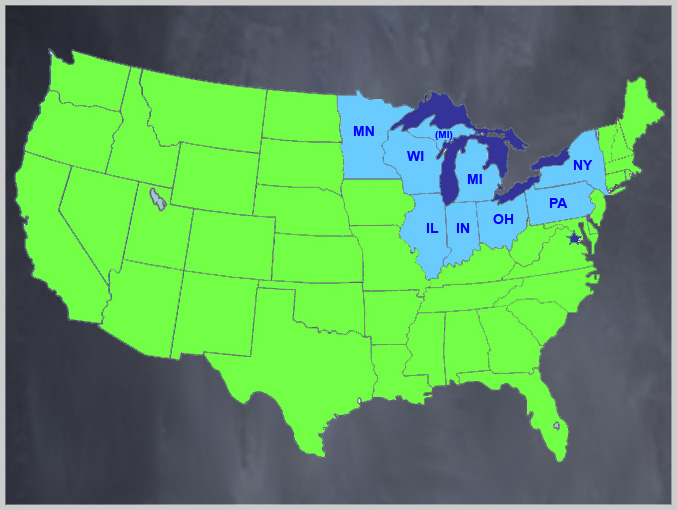
Great Lakes
A group of five large freshwater lakes on the United States - Canada border. They contain a fifth of the Earth's surface fresh water.
The lakes are..
o Lake Superior
o Lake Erie
o Lake Ontario
Great Recession
(Coming)
Green Card
An identification card for non-U.S. citizens showing they are allowed to permanently live and work in the country. They are issued by the Department of Homeland Security. Green card holders are referred to as permanent residents.
A few facts about green cards...
o They can be revoked
o They must be carried at all times
o They are not green (they used to be)
Hacking
An unauthorized attempt to exploit a computer system for an illicit purpose.
HIV
Human Immunodeficiency Virus - the virus the causes AIDS.
It can be transmitted through sexual contact, blood (transfusions, needle sharing), or from a mother to child - either in the uterus or through breast milk.
A person infected with the virus will have it for the rest of their life, though they might not develop AIDS.
Impeachment
(Coming)
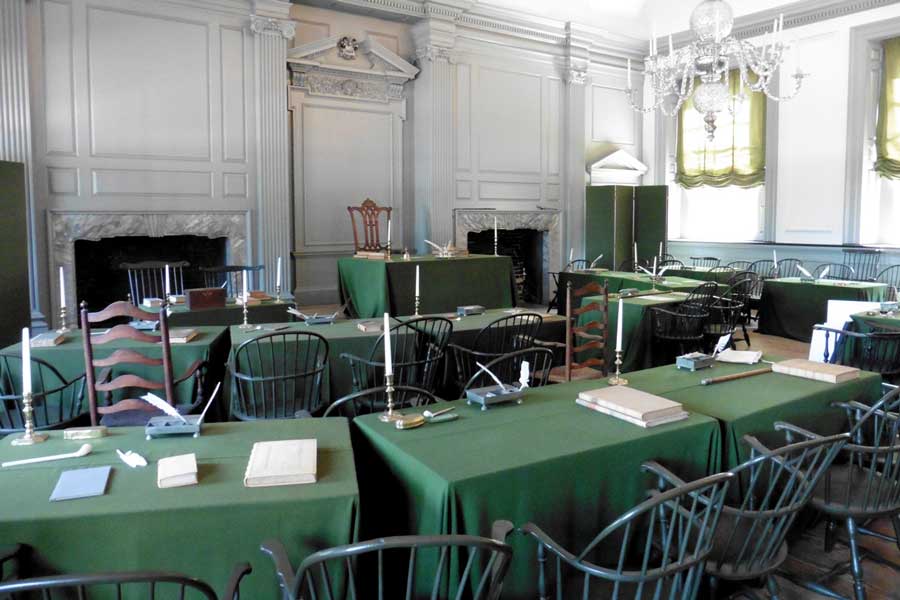
Independence Hall
Building in Philadelphia, Pennsylvania where both the Declaration of Independence and the Constitution were debated and adopted.
Infrastructure
(Coming)
Inspector General
An official responsible for investigating an organization or activity.
International Monetary Fund (IMF)
(Coming)
Internet Service Provider (ISP)
(Coming)
Jim Crow laws
Laws passed in southern U.S. states that established different rules for blacks and whites. They affected most aspects of life, including voting and where people of color could live, eat, and use public facilities such as transportation, schools, and parks.
The Jim Crow era began in the late 1800s. This type of explicit discrimination ended with a succession of Supreme Court decisions and laws, including...
o The 1964 Civil Rights Act
o The 1965 Voting Rights Act
For more on Jim Crow laws, read this article.
LGBT
Acronym for Lesbian, Gay, Bisexual, and Transgender. Other initials often are added for various alternative labels of sexuality.
A term generally used when referring to those seeking civil rights on the same level as those who are heterosexual.
Monopoly
A situation in which there is only one entity that provides a service or product - thus they have no competition.
For the purposes of our discussions here, there are two basic types of monopolies...
o Public monopolies (such as those run by a government) exist to serve the people. They have the opposite goal... to provide the best "product" at the lowest price.
Of course public monopolies don't always do the best job, but there's nothing to substantiate that professionals employed by a private company would do any better of a job than professionals employed by the government. They merely have different employers
Montana Voter and Candidate Pledge
A statement of policy written by conservative activists in Montana. They ask candidates for state office to sign it.
Among the policies that those signing the document agree to...
o Sell state lands... with the revenue used to reduce income and property taxes.
o Privatize entitlement programs and state pensions and remove them from the state budget.
o "Remove all Federal, U.N., and foreign influences from Montana public education", while moving toward charter schools, home schooling, educational savings accounts, and "alternate teacher certification".
o Oppose agencies of the Department of the Interior (DOI), including the Bureau of Land Management (BLM), "United States Park Service", and the U.S. Fish and Wildlife Service (FWS).
The pledge's first paragraph is an agreement to resign their office if they "fail to keep their promise of fidelity to the terms of this Pledge."
For more about the Montana pledge, read the Missoulian story.
Click here to read the document
Mortgage Backed Security
When an investment bank or Government Sponsored Enterprise buys a bundle of mortgages from a lender, they in turn sell shares of those mortgages to investors. These investments are backed by the value of the property the mortgages are for. They therefore are called mortgage backed securities.
Theoretically, they are safe investments because they are made up of many mortgages. If only a few borrowers defaulted, there still would be enough pay investors their profit.
A few things happened however, that contributed to 2006 mortgage crisis (this is not the complete story, but we're presenting a small slice of it here to help understand mortgage backed securities)...
o The bad loans were packaged into mortgage backed securities. Rating agencies (who are paid by the investment banks) rated the securities highly.
o Many borrowers whose mortgages were part of the security could not make their payments, while property values fell. Therefore the securities that investors bought became worthless.
National Monument
An area of land - considered to be of archeological, scientific, or historic interest - owned by and protected by the federal government.
The 1906 Antiquities Act gave the president the authority to designate federal lands as national monuments.
They are similar to national parks, except national parks are designated by Congress.
Lands designated as national monuments cannot be leased for activities such as mining, drilling, logging, or ranching. However, if these activities were taking place at the time a president declares the land a national monument, they normally can continue.
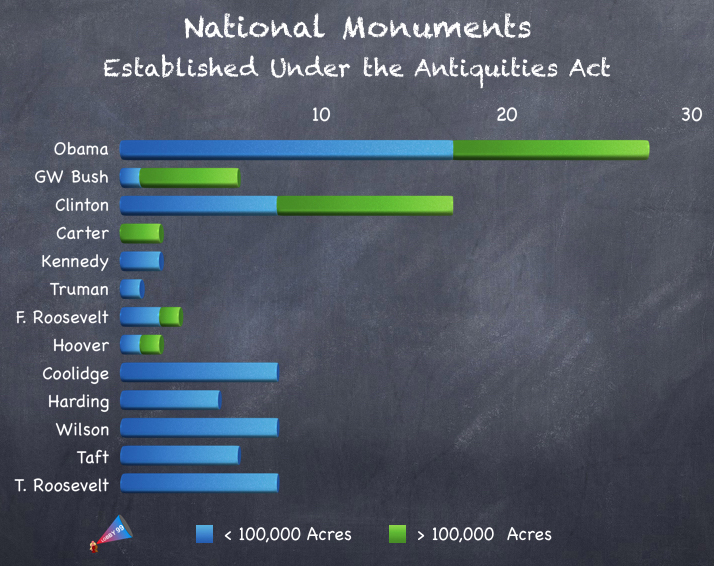
Data Source: National Parks Conservation Association (via fivethirtyeight.com)
National Monument: Bears Ears
A 1.35 million acre area in Utah. Indigenous people lived on the land for thousands of years, leaving artifacts that date back 5,000 years. It also is a recreational visitor attraction.
Bear Ears also leases land for grazing and oil and gas extraction.
In Dec. 2016, President Barack Obama invoked the Antiquities Act to designate it a national monument. That means existing leases can continue, but no new leases can be issued.
In 2016, Rep. Rob Bishop introduced an alternative plan that would allow for mineral extraction, energy development, and road construction at Bears Ears.
For a local look at Bears Ears National Monument, read this Telluride News story.
Referenced by...Trump orders review of National Monuments (2017-Apr-26)
National Monument: Grand Staircase-Escalante
A national monument in Utah.
It was established in 1996 by President Bill Clinton under the 1906 Antiquities Act.
Click here for a look at Grand Staircase-Escalante National Monument.
National Park
An area set aside by the federal government for conservation.
National parks are designated by Congress, as opposed to national monuments, which are designated by a president.
Net Neutrality
In simplest terms, net neutrality is your ability to reach any online service you want without interference from your internet provider.
Non-Governmental Organization (NGO)
A not-for-profit organization that operates independent of any country.
Many NGOs perform humanitarian work.
For more, visit www.NGO.org.
Nonprofit Organization
An organization that operates to work toward some cause, rather than to make a profit. To become a nonprofit, an organization must become certified by the IRS.
A few typical features of nonprofit organizations...
o All money they receive must be used in a way that's consistent with the organization's stated cause, including paying employees and consultants.
o Any money not spent cannot be distributed to executives or others. It must remain in the organization to be used toward the organizations's cause.
o They must file an annual report on their major expenses - including the salaries of their highest paid executives.
There are several categories of nonprofits - named for the section of the tax code that defines them. Common ones include...
Charities are 501(c)(3) nonprofits. Donations to these nonprofits usually are tax-deductible. They are restricted in the types of political activity they can engage in - which is typically limited to advocating causes directly related to their organization's mission.
o 501(c)(4)
A nonprofit organization whose major activities involve lobbying and advocacy. Although 501(c)(4) nonprofits are exempt from paying federal taxes, donations to them are not tax-deductible. A 501(c)(4) nonprofit organization is expected to operate primarily for promoting social welfare. Although influencing elections is not considered to be part of that, IRS rules are vague and enforcement has been minimal.
Lobby99 is a 501(c)(4) nonprofit. Lobby99 does not endorse or support any candidate or political party in any way. Rather, we advocate for policies that would benefit the overwhelming majority of Americans and explain issues. We also make it easy to see how well your elected representatives are actually representing your interests, in order to help you decide your vote. This is in accordance with the strictest definition of social welfare.
Nonprofits are surreptitiously used by some to channel anonymous campaign contributions to a Super PAC working toward a candidate's election. To understand how this happens, watch this 2-minute video...
Ombudsman
A representative of an organization (either public or private) who represents the interests of the organization's constituents (such as internally investigating a complaint about how the organization operates).
Opposition Research
Investigations against a political opponent to find information that can be used against them in a campaign.
Pension Smoothing
When a company puts money into a pension that eventually will pay its retirees, it doesn't put in all the money it will need. That's because it is assumed that the money will earn interest, so that by the time the pension needs to pay retirees, it will have grown into the needed amount.
The amount a company needs to put in is determined by the interest rate the company expects to earn on the money. If it assumes it will receive a higher interest rate, it can put less into the pension. To ensure that a company puts enough into a pension to cover its future obligations to retirees, the government determines the maximum interest rate a company can assume.
Pension Smoothing is a government policy that effectively allows a company to assume a higher interest rate for a certain number of years, so it does not need to put as much into its pension. It makes up for this by requiring greater contributions in later years, so theoretically the amount contributed eventually would be sufficient.
Why is this done?
Congress has used pension smoothing twice in recent years to pay the federal government's portion of transportation projects. Because companies pay less into their pensions, they have higher profits and therefore pay more in taxes.
Who else benefits?
Higher profits for a company can mean greater compensation for that company's executives.
So what's the problem?
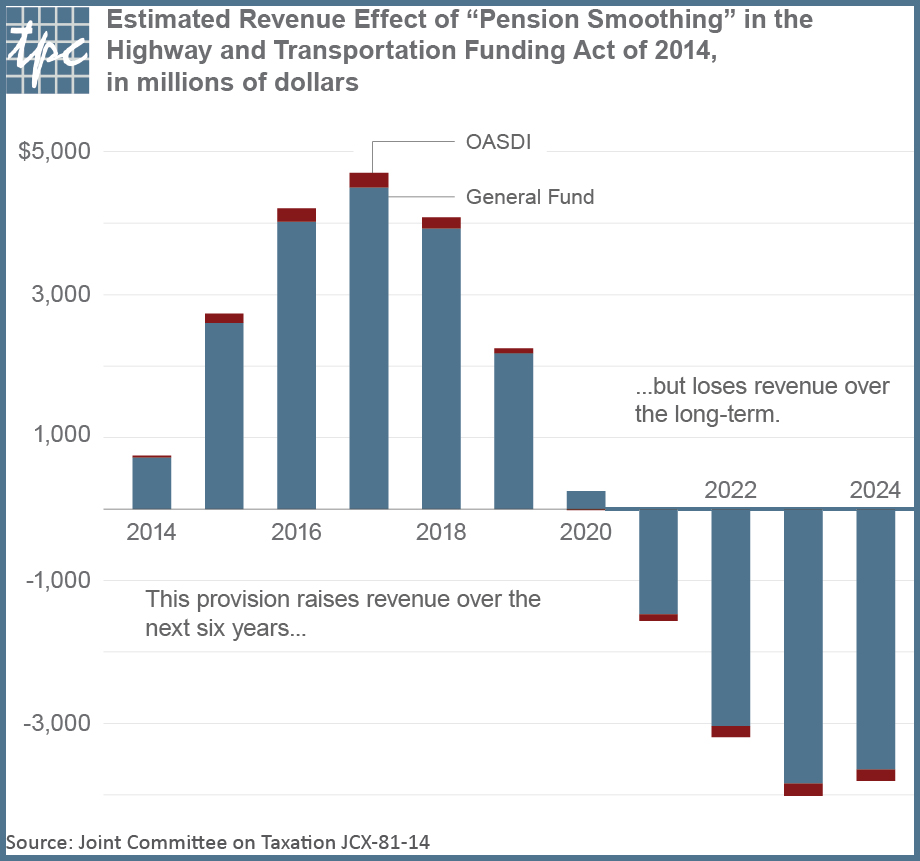
There are several problems associated with Pension Smoothing. One problem is that even though tax revenues increase in the early years of a Pension Smoothing program, they decrease in later years as companies must make up the difference by paying more into pension plans - therefore lowering their taxable income (and taxes). If those reduced revenues aren't made up by some other means (for example by higher corporate or individual tax rates), government services will need to be reduced.
This chart shows the estimated effect of pension smoothing as called for in the 2014 Highway and Transportation Funding Act.
Another problem comes up if the company becomes bankrupt before it can pay the higher contributions. Its pension fund will not have enough to pay the pensions it owes. See our discussion of the Pension Benefit Guaranty Corporation for more on how this would be resolved (hint... it may be you who pays for it).
People-to-People
A way for individuals to plan their own trips to Cuba.
Even after President Barack Obama legalized travel to Cuba in 2015, travel for tourism still was prohibited. But an U.S. citizen can plan people-to-people visits - ostensibly to learn about Cuban life and discuss American life with Cubans. Though there is an expectation that the traveler would keep logs of their business activities and who they talk with there, there is no indication that this requirement would be enforced.
For more, read this Washington Post article.
Referenced by...Trump reinstates Cuba travel restrictions (2017-Jun-25)
Americans now allowed to visit Cuba (2015-Jan-15)
Per Capita
For each person
In terms of government programs, it could mean for each person eligible for that particular program.
Privatization
(Coming)
Public Domain
A term generally used for a work (such as a book or song) which nobody legally can deny permission to use.
Public Money
Money controlled by the government. The only way for a government (federal, state, local) to obtain money is through a tax or fee, and that money is meant to be used only in the public's best interests.
Public Policy
Government policies (such as laws and regulations) that affect the general public.
Congress, the president, the Supreme Court, and federal agencies all create or define public policies for the United States.
Public vs. Private
In terms of policy, public and private differentiate who pays for and manages something.
For example, in public sector jobs, employees are paid with public money. In a private sector job, employees are paid from a company's money.
The differences become less clear in other areas.
Public schools are run and paid for by governments (i.e. public money). Private schools are companies and are paid for by students' families. However, charter schools are privately owned, yet are paid for with public money.
Public colleges are run by governments, but are partially paid for by students' tuition.
Public prisons are run and paid for by governments. Private prisons are run by corporations, but are paid for by governments.
Public Works Projects
Projects that create infrastructure or public benefit - such as roads, parks, water supplies - paid for with public money.
Robocalls
Phone calls made by an automated dialer which play a recording when you answer.
They most often are used by telemarketers and political campaigns, but also are used for public service or emergency announcements.
Scientific Method
A way of arriving at positions or theories by verifying or rejecting hypotheses based on reproducible evidence.
Related term: dogma
Senior Citizen
Typically someone 65 years of age or older.
The exact age might vary based on who is using the term. However, the term usually is used to classify people with common issues or who are eligible for certain benefits.
Social Media
An interactive environment (such as a website) that allows someone to share content (such as writings and photos) and allows others to respond.
Socialism
A way of organizing a society so that major industries are owned and controlled by the government (i.e. common ownership).
The United States contains a mixture of privately owned and socialized industries.
o Housing, gasoline, energy, internet, and the media are predominantly run by private corporations, though there might be government oversight. Most health care in the United States (other than the VA) is provided by private companies.
Special Counsel
(Coming)
SSI (Supplementary Security Income)
(Coming)
Subsidy
Financial assistance used to help pay for something considered desirable (by whoever is providing the subsidy).
For example, under the Patient Protection and Affordable Care Act (Obamacar) the federal government provides subsidies to help those with low enough incomes pay for health care insurance.
Tax Audit
(Coming)
Think Tank
An organization that studies, reports on, and advocates for public policies. They can be non-partisan or they can subscribe to some political agenda. They also are referred to as policy institutes, research institutes, or advocacy groups.
When evaluating a policy reported on by a think tank, it is important to understand the political leanings of the organization.
Veteran
The standard definition of a veteran is someone who has a long experience in any particular field.
However, we typically use the term to refer to someone who has served in the U.S. military (including those still serving).
Virtual Private Network (VPN)
Technology that allows someone to communicate over the internet - which is public - as if they were using a private network.
This allows their communications to be encrypted, as well as masking their internet identity.
Weapon of Mass Destruction
A term used to describe a weapon capable of killing many people at once and causing widespread destruction.
Examples would be nuclear, chemical, and biological weapons.
Whistleblower
A person who exposes illegal or unethical actions of an organization (typically one they work for).