



1033 Program
Provision of the 1997 National Defense Authorization Act that allows the federal government to transfer surplus military equipment to local law enforcement agencies.
It is Section 1033 of the bill.
527 Organization
A tax-exempt organization created to influence a particular issue or public policy at the federal, state, or local level.
These organizations can raise unlimited money from individuals, corporations, or labor unions. They must, however, disclose all contributions and expenses to the IRS.
Political parties and Super PACs both are examples of 527 organizations. The name 527 comes from the section of the tax code that governs these groups.
Watch this 2-minute video to see how SuperPACs combine with nonprofit organizations to allow for unlimited anonymous campaign contributions.
Abortion
Abortion is the deliberate termination of a pregnancy, usually before the embryo or fetus is capable of independent life.
Abortions are performed either surgically or medically. A medical abortion - in which the woman takes two drugs 48 hours apart - is approved only during the first nine weeks of pregnancy.
Acosta, Alexander
Secretary of Labor under President Donald Trump
Acosta was dean of the Florida International University law school. A graduate of Harvard Law School, he clerked for Supreme Court Justice Samuel Alito when he was a judge on the 3rd U.S. Circuit Court of Appeals. He served on the National Labor Relations Board under President George W. Bush, as the head of the Justice Department's Civil Rights Division, and as U.S. attorney in Miami.
The son of Cuban immigrants, Acosta serves on the American Bar Association's Commission on Hispanic Legal Rights and Responsibilities. He has defended the rights of Muslim Americans, including criticizing France when it introduced a ban on certain religious attire.
While at the Justice Department, Acosta wrote a letter to a federal judge in Ohio supporting a Republican voter caging effort just before the 2004 presidential election. Bush won Ohio.
When running the Justice Department's civil rights division, he was found by the department's inspector general to have ignored warnings about a subordinate accused of illegally using political affiliations to vet potential civil rights attorneys.
As U.S. attorney for Southern Florida, Acosta gave a plea deal to billionaire investor and political donor Jeffrey Epstein, who was accused of having sex with dozens of underage girls. Under the plea, Epstein served about a year in prison. Epstein was a member of Mar-A-Lago - Trump's Florida home and golf club.
For more, read the Guardian story.
For more on Acosta's support of voter caging, read the McClatchy DC Bureau story.
For more on Acosta's issue with politically-motivated hiring at the Justice Department, read the Guardian report.
Trump cabinet members to speak at ALEC event (2017-Jul-19)
Senate confirms Alexander Acosta for Secretary of Labor (2017-Feb-16)
Adams, John
Second president of the United States.
Administration
The president and agencies of the Executive Branch.
The president is responsible for carrying out laws passed by Congress. This is done through various agencies - referred to collectively as the administration. The president appoints the head of each organization (Senate approval is required). Virtually everyone else working for these agencies is a career professional who maintains their position from one president's administration to the next.
Administrative Procedures Act (APA)
Law enacted in 1946 that governs how federal agencies propose and enact regulations.
It applies to both executive departments and independent agencies.
Affirmative Action
(Coming)
AFL-CIO
Website: www.AFLCIO.org
Agency for Toxic Substances and Disease Registry (ATSDR)
Agency of the Department of Health and Human Services (HHS) that responds to environmental health emergencies; investigates potential environmental health threats and conducts research on the health impacts of hazardous waste sites.
Website: www.atsdr.cdc.gov.
AIDS
Acquired Immune Deficiency Syndrome
Air Force One
Call sign given to the plane on which the U.S. president flies.
Other ways the president travels are on Marine One - call sign for the presidential helicopter - and in the presidential limo - known as The Beast.
For more, read the Business Insider story.
Air Navigation Service Provider (ANSP)
(Coming)
Air Traffic Control
Each day, almost 100,000 airplanes fly in the skies over the United States. Air traffic controllers work at airports and en-route centers to keep them all a safe distance from each other.
At U.S. airports air traffic controllers also control all ground traffic at airports to keep runways and planes that are taxiing safe.
Airport and Airway Trust Fund (AATF)
A government fund that pays for approximately 70 percent of the Federal Aviation Administration's annual budget (the rest comes from the General Fund).
The AATF gets its money from taxes charged to airlines and passengers, including...
o Taxes on international arrivals and departures
o Taxes on air cargo
o Taxes on flights between the U.S. mainland and Alaska or Hawaii
o Taxes on fuel
Alito, Samuel
Supreme Court justice since 2006.
Alternative Minimum Tax
The amount of federal income tax you pay is based on the amount of income you receive minus any amounts you may legally deduct (for example medical expenses and mortgage interest). This system makes it possible for someone to have a very high income, yet pay very little in taxes by claiming a very large amount of deductions.
This is where the Alternative Minimum Tax (AMT) comes in. It essentially is a separate tax structure for those earning more than a certain amount (in 2013 that amount was $52,000 for single taxpayers and $80,000 for married couples). In calculating your AMT (if you make more than those amounts), most deductions are no longer allowed, meaning you will be taxed on a higher amount. To compensate, the maximum tax rate using the AMT structure is 28 percent.
You don't have a choice of which tax structure to use. You must use whichever would result in the higher amount of tax.
Due to inflation in previous years, people's income grew, while the threshold for the AMT did not grow as fast. That meant that more people found themselves needing to pay the higher Alternative Minimum Tax, even though their effective income had not increased. The American Taxpayer Relief Act fixed this by permanently allowing the threshold to increase with inflation.
Alternative Right (Alt-Right)
Self-proclaimed groups and individuals with the core belief that their white (and often male) identity is threatened by the social gains of other cultures.
Much of their messaging takes place on social media.
They commonly are known as the alt-right.
To learn more, visit the Southern Poverty Law Center website.
For more, read this Guardian editorial.
American Bar Association (ABA)
Website: www.AmericanBar.org.
American Civil Liberties Union (ACLU)
The U.S. Constitution guarantees certain civil liberties to all Americans. These include...
o Your right to practice your religion
o Your right to the same treatment by the law as every other citizen
o Your right to privacy
o Freedom of the press
The ACLU is a nonprofit organization that works to protect these individual rights. They work both by lobbying Congress and by challenging violations of civil liberties in the court system. The organization has been the center of controversy at times by defending those rights for groups whose views are generally considered to be objectionable, though not unlawful.
For more about about the ACLU, visit their website at www.ACLU.org.
American Enterprise Institute (AEI)
A conservative think tank.
Website: www.AEI.org.
American Federation for Children
A dark-money group that supports school voucher programs and charter schools nationwide.
AFC is a member of the American Legislative Exchange Council (ALEC), and has worked with the group to draft model legislation.
For more on the American Federation for Children, read the Sourcewatch report.
Website: www.FederationForChildren.org.
American Legislative Exchange Council (ALEC)
The American Legislative Exchange Council (ALEC) drafts model legislation that state legislators can quickly turn into legislation.
ALEC is funded by large corporations, and the laws it recommends typically support those corporations, often at the expense of the overwhelming majority of Americans.
Website: www.ALEC.org.
For learn about where ALEC comes from and what it does, read Who is ALEC? - our discussion.
To read about ALEC's close affiliations with the Trump administration, click here.
To follow ALEC's recent activities, visit AlecExposed.org.
Click here to read a comparison between ALEC and the National Conference of State Legislatures (NCSL)
American Medical Association (AMA)
Website: www.ama-assn.org.
Amicus Curiae
A brief in a court case filed by someone who is not a party to the case, but who believes...
o They have relevant information that might not be brought up by the parties involved, yet might help the court arrive at a decision.
The term amicus curiae is Latin, which translates to Friend of the Court.
Annual Percentage Rate (APR)
The annual percentage rate of a loan basically tells you how much that loan would cost you in a year, even if it is paid off sooner or later. It's the percentage of the amount borrowed that you would pay in a year.
Here is a simple example...
If you borrow $100 with 5-percent interest and the loan is for a year, your APR would be 5 percent. However, if you borrow the same $100 with the same 5-percent interest, but it's due in one month, the APR would be 60 percent (5 percent times 12, because it would cost you $5 for the same $100 every month).
Similarly, if a credit card has a monthly interest rate of 1.5 percent, the APR actually would be 18 percent, because you would be paying 1.5 percent each month for 12 months (1.5 x 12 = 18).
APR is useful in comparing loans because you're comparing how much each loan would cost over the same period of time.
Other common situations make the calculation more complicated. What's important for the purposes of our discussions is the basic understanding provided above.
Anti-Defamation League
Website: www.ADL.org.
Antiquities Act
Law enacted in 1906 allowing the president to designate national monuments on land controlled by the federal government.
When a president designates land as national monument, new uses of the land (such as mining, drilling, logging, and ranching) are prohibited. However, if those activities already had been taking place, they likely would be able to continue.
Appropriations & Authorizations
Congress determines how Public Money is spent by the federal government. It is a two-step process.
First, Congress must pass an appropriation bill to specify the maximum amount that an agency or program can receive.
To actually spend the money, Congress must pass an authorization that directs ways in which the money should or should not be used.
Arbitration
A means of resolving a dispute between two parties.
Arbitration decisions typically are arrived at by a panel of three people (arbitrators) - one picked by each of the parties and a third picked by those two.
A feature of arbitration is that there generally is no compromise. The arbitrators must vote for one party or the other.
Arctic National Wildlife Refuge (ANWR)
(Coming)
Arizona SB-1070
2010 Arizona law requiring police to determine the immigration status of someone arrested or detained when there is "reasonable suspicion" they are not in the U.S. legally.
About half of the remaining states later introduced similar laws.
Army Reserve
One of the country's reserve military forces.
Similar to the National Guard, but the Reserves are under the direct authority of the military - and not subject to be called to duty by a state's governor.
Website: www.usar.army.mil.
Articles of Confederation
The document that defined how the U.S. government operated prior to March 4, 1789 when the government began operating under the Constitution.
Associated Press (AP)
A nonprofit news cooperative whose syndicated reports appear in newspapers and news websites. Most local newspapers that report national and world news merely run stories from the AP, rather than providing coverage by their own reporting staff.
Association of American Physicians and Surgeons
An organization of physicians. The group claims to be non-partisan, yet much of its writing advocates for policies generally associated with those who label themselves conservative.
According to a 2009 Mother Jones magazine report...
o An article on the group's website "speculated that Barack Obama may have won the presidency by hypnotizing voters, especially cohorts known to be susceptible to 'neurolinguistic programming' - that is, according to the writer, young people, educated people, and possibly Jews."
In an article published in the Journal of American Physicians and Surgeons (Fall 2015), former AAPS President Richard Amerling suggests, "The abortion industry and Planned Parenthood originated in the population control and eugenics movements," and supports a view that a major reason for abortion is a desire to protect insects, fish, and animals.
One article on the group's website states "The Planned Parenthood doctors make Dr. Joseph Menegle, Hitler's 'Doctor of Death' look like an angel of mercy by comparison."
Website: www.AAPSonline.org.
Note: Lobby99 does not associate any value judgement with labels such as "liberal" or "conservative" - we merely use the term here to point out a leaning the group does not acknowledge. In fact, while Lobby99 considers itself to be nonpartisan and evidence-based, some would label the policies we advocate as being generally associated with those who label themselves liberal.
Attorney General (AG)
The U.S. Attorney General is the chief law enforcement officer and attorney of the government, and head of the Department of Justice (DOJ).
Balanced Budget
A balanced budget simply means having revenue that is at least equal to expenses - so that everything can be paid for without causing a deficit.
This inherently is a good thing, though several factors of how a government operates (such as needing to budget expenses for the upcoming year before it's known how much tax revenue will be received) make a strict balanced budget unfeasible to at least some degree.
In terms of the federal government, there are two issues with the way a balanced budget is discussed...
o There have been proposals for a Constitutional amendment that would require a balanced budget. This would put restrictions on Congress (or even future Congresses) in times when emergency spending could be required. Also, Congress already has the ability to create a budget that would not incur a deficit. An amendment to the Constitution is not required.
A balanced budget Constitutional amendment is the subject of model legislation by the American Legislative Exchange Council (ALEC).
Ballot Measure
The United States is not a strict Democracy. As defined by the Constitution, public policies typically are enacted by people we vote to represent our interests, rather than by a direct vote of people.
This is similar at every level of government - federal, state, and local.
Ballot measures are a way of circumventing the process defined by Constitution and providing citizens the power to affect public policy by a direct vote.
Types of ballot measures include...
o Initiative: A group of citizens propose a policy. They then petition for the proposal to appear on a ballot. If the petition receives enough signatures, citizens will vote directly on whether to enact the policy.
o Amendment: Citizens of a state vote on a proposed change to that state's constitution.
o Recall: Citizens vote to remove an elected official from office. The group initiating the recall must collect enough signatures on a petition in order for the recall election to take place.
Bankrate.com
Bankrate.com is a website that reports on rates and consumer policies offered by about 5,000 banks in the United States.
You can visit their website at www.BankRate.com.
Basis
In financial transactions, the basis is the amount you paid for something that you're now selling.
If you sell an investment such as stock or real estate, your tax liability is determined by your profit (how much you sold it for minus the basis).
Bill
A proposal for a new law. Examples of a bill might be...
o Explicitly making something illegal (or legal)
o Naming a federal facility such as a building or airport.
For the most part, a bill can be first proposed in either house of Congress (the Constitution stipulates that bills allocating money must originate in the House of Representatives)
If both houses of Congress approve identical versions of a bill, it then is up to the president to decide whether to allow it to actually become a law. The president can approve it by signing it, or reject it by vetoing it.
Bill Number
An identifier for each piece of legislation proposed by Congress.
Bill numbers are comprised of a letter code followed by a sequential number.
o S: A bill originating in the Senate
o CR: A Concurrent Resolution
o HJRES: A Joint Resolution originating in the House
o SJRES: A joint resolution originating in the Senate
Bill of Attainder
A bill that imposes a punishment on specific individuals or members of a group.
This violates Article 1, Section 9 of the Constitution.
Bill of Rights
The first 10 amendments to the U.S. Constitution. They provide citizens with basic protections from the federal government.
Black Lives Matter
(Coming)
Blackwater USA
(Coming)
Block Grant
A large amount of money from the federal government to a state or regional government for a specified purpose.
The purpose usually is general (such as law enforcement, community development, transportation, health services), with the regional government deciding how to spend it in a way consistent with the purpose.
Blue Dog Democrats
(Coming)
Bork, Robert
(Coming)
Bot
In general, a bot is a computer program that performs simple repetitive tasks at a much faster rate than a human could. It is derived from the word robot.
Lobby99 has discussed bots in terms of those that are used by ticket brokers to buy up large amounts of tickets to an event - often within minutes of the tickets going on sale. The broker then will resell the tickets for a profit.
Boycott, Divestment, and Sanctions (BDS)
A movement to boycott companies in Israeli settlements in areas claimed by Palestinians or who have contracts with the Israeli military.
Several states have proposed or enacted legislation (in various forms) against the movement, from condemning it to prohibiting the state from doing business with companies who observe the boycott.
These states include...
o Arizona
o California
o Colorado
o Florida
o Georgia
o Illinois
o Indiana
o Iowa
o New Jersey
o New York
o Ohio
o Pennsylvania
o South Carolina
o Tennessee
o Virginia
The American Legislative Exchange Council (ALEC) has issued a strong policy statement against the movement - supporting those state governments' efforts to oppose it.
Click here to read the ALEC policy statement.
Branches of Government
The Constitution defines our government as consisting of 3 branches - each intended to "check and balance" the other two.
Legislative
Congress. Congress writes laws that govern everything from tax rates to how tax money is spent.
Of the 3 branches, the legislative branch is the one most likely to have a direct effect on your life. Your representative represents you and the Congressional District you live in - approximately 700,000 people.
Executive
The US president and various agencies responsible for carrying out laws passed by Congress.
The president appoints the head of each agency (Senate approval is required). Virtually everyone else working for these agencies is a career professional who maintains their position from one president's administration to the next.
Judicial
The system of courts that determine if a law is consistent with or violates the Constitution.
The most well-known of the court system is the Supreme Court. The Supreme Court is the final authority on whether a law violates the Constitution. The court does not actively seek laws to judge. Rather, it decides cases that are brought to it by challenges to a law ruled on by a lower court.
Supreme Court justices are appointed by the president (Senate approval is required), and have lifetime terms.
For more, see our pages on the...
o Legislative Branch
o Executive Branch
o Judicial branch
Brennan Center for Justice
A nonpartisan public policy institute. For more visit www.BrennanCenter.org.
Bridgegate
Term used to label a 2013 political scandal in New Jersey in which toll lanes leading to the George Washington Bridge were closed for several days - resulting in traffic gridlock in Fort Lee, NJ.
The closures were alleged to be retaliation against Fort Lee Mayor Mark Sokolich for not supporting Gov. Chris Christie's re-election. Three associates of Christie - including his deputy chief of staff - were convicted of felony charges related to the incident.
For more on what involvement Christie may have had in the affair, read the New York Times story.
Britain: MI-6
The British foreign intelligence agency (MI stands for Military Intelligence). The official name of MI6 is the Secret Intelligence Service (SIS).
Website: www.sis.gov.uk.
Brookings Institution
Website: www.brookings.edu/a>.
Brown v. Board of Education
1954 Supreme Court ruling that public schools segregated by race are unconstitutional.
For more, read our discussion of the case.
Budget Reconciliation
A special type of bill that can be passed in the Senate with a simple majority - it is not subject to filibuster.
As the name implies, this type of bill is used on legislation that affects spending or revenue (taxes).
The way it works is Congress creates a resolution - a budget plan for in an area such as health care, education, or the military. The resolution can direct related committees to create legislation that conforms to the budget requirements contained in the resolution. This legislation must conform to the Byrd Rule.
Once the House and Senate agree on the exact language, debate in the Senate is limited and can be passed with a simple majority vote.
For more, read the Center for Budget and Policy Priorities report.
Budget Scoring
(Coming)
Bureau of Alcohol, Tobacco, Firearms, and Explosives (ATF)
Website: www.ATF.gov
Bureau of Competition
The Bureau of Competition is the part of the Federal Trade Commission that reviews corporate mergers and other anticompetitive practices.
Bureau of Consumer Protection
The Consumer Protection Bureau is the part of the Federal Trade Commission that helps consumers avoid fraud, deception, and other unfair business practices.
Bureau of Economics
The Bureau of Economics is the part of the Federal Trade Commission that supports antitrust and consumer protection investigations.
Bureau of Indian Affairs
Website: www.BIA.gov.
Bureau of Labor Statistics (BLS)
The Bureau of Labor Statisics is a government agency that measures and reports on the U.S. labor market, working conditions, and consumer prices. The information is used by Congress to help make relevant laws. For more, visit www.BLS.gov.
Bureau of Land Management (BLM)
Website: www.BLM.gov.
Bureau of Ocean Energy Management (BOEM)
Website: www.BOEM.gov
Bureau of Reclamation
Part of the Department of the Interior (DOI) that manages water in the western United States - including dams, powerplants, and canals.
The agency is the country's largest wholesaler of water, and second-largest producer of hydroelectric power.
Website: www.USBR.gov.
Burner Phone
A mobile phone purchased to be used anonymously and then thrown away.
A common way to obtain one is to buy a cheap phone along with pre-paid minutes, paying cash for everything. While the phones and pre-paid time have many legitimate uses (and are not made to be disposable), they have become a common tool for people planning crimes because it can be extremely difficult for law enforcement to link them to the user.
Byrd Rule
A Senate rule named after Sen. Robert Byrd requiring that budget reconciliation be used only on legislation that has a direct effect on spending or revenue.
Click here for a more detailed description of how the Byrd Rule works.
Cabinet
The President's Cabinet is the group of the President's highest level advisors.
Article 2, Section 2 of the Constitution states that "(The President) may require the opinion, in writing, of the principal officer in each of the executive departments, upon any subject relating to the duties of their respective offices".
The Cabinet consists of...
o Secretary of State
o Secretary of the Treasury
o Secretary of Defense
o Attorney General
o Secretary of the Interior
o Secretary of Agriculture
o Secretary of Commerce
o Secretary of Labor
o Secretary of Health and Human Services
o Secretary of Housing and Urban Development
o Secretary of Transportation
o Secretary of Energy
o Secretary of Education
o Secretary of Veterans Affairs
o Secretary of Homeland Security
The following are not official Cabinet positions, but have Cabinet-level rank...
o Administrator of the Environmental Protection Agency
o Director of the Office of Management and Budget (OMB)
o U.S. Trade Representative
o Ambassador to the United Nations
o Chair of the Council of Economic Advisors
o Administrator of the Small Business Administration
For more about the Cabinet, visit www.Whitehouse.gov/administration/cabinet.
Cadillac Tax
A tax on expensive health care coverage provided by employers. It was created to help pay for Patient Protection and Affordable Care Act (Obamacare).
It is called the Cadillac Tax because it taxes only the most expensive and generous plans that companies can employees instead of a higher salary. While the salaries would have been taxed, there previously had been no tax on policies such as this.
Implementation of the tax has been delayed several times. It now is scheduled to take effect in 2020.
Cap-and-Trade
(Coming)
Capital Gains
Income you make by investing money (as opposed to earning a salary for your labor).
Capital Gains Tax
How much of your income that goes to taxes depends on where that income comes from.
If you earn that income as a salary for your work, you'll pay one amount. But if the income comes from capital gains, you'll pay a different - usually lower - amount.
For more on issue of capital gains taxes, read our discussion.
Catastrophic Plan
An insurance plan designed to help out only in the case of a catastrophic health problem. These plans have low premiums, but high deductibles and other out-of-pocket costs.
Under the Patient Protection and Affordable Care Act (Obamacare), catastrophic plans are available only to those under age 30.
Census
A survey taken of Americans every 10 years to determine the number and characteristics of Americans.
The most significant census data is the distribution of where American's live by state, which is used to determine the number of representatives in Congress each state receives.
The census is mandated in Article 1, Section 2 of the Constitution.
Census Bureau
(Coming)
Center for American Progress (CAP)
Website: www.AmericanProgress.org
Center for Budget and Policy Priorities (CBPP)
Website: www.CBPP.org
Center for Economic and Policy Research
The Center for Economic and Policy Research analyzes and reports on economic issues that affect people's lives. To learn more, visit their website at www.CEPR.net.
Center for Immigration Studies
Center for Media and Democracy
A nonprofit liberal watchdog and advocacy organization based in Wisconsin.
Website: PRWatch.org.
Center for Responsive Politics (CRP)
(Coming)
Centers for Disease Control and Prevention (CDC)
Website: www.CDC.gov.
Centers for Medicare & Medicaid Services (CMS)
The federal agency within the Department of Health and Human Services that administers Medicare and works with state governments to administer Medicaid and the Children's Health Insurance Program (CHIP).
For more information, visit www.CMS.gov.
Central Intelligence Agency (CIA)
The foreign intelligence service for the United States.
Website: www.CIA.gov.
Charter School
A school formed by members of a community that is funded with public money from a school district, but which operates independently of public schools within the district.
The money that goes to a charter school is money that otherwise would go toward the public school system.
Chertoff, Michael
Michael Chertoff was the Secretary of Homeland Security 2005 - 2009.
In 2009 he founded the Chertoff Group lobbying company. One of the company's clients was OSI Systems - the parent company of Rapiscan Systems which makes one of the two types of body scanners used at U.S. airports. In 2011 all 250 Rapiscan scanners - which had cost $180,000 each - were removed from airports due to their inability to blur images that depicted passengers' bodies.
Chevron Doctrine
A guideline for determining how much flexibility a federal agency has in creating regulations.
It is the result of the Supreme Court case Chevron v. NRDC, in which the court ruled that...
o If the law doesn't specify how it should be implemented, the agency's actions may be a "permissible" interpretation of the law - and a court must allow it.
For more, read the Center for Effective Government description.
Child Tax Credit (CTC)
An income tax credit to help offset the cost of raising children. Depending on your income, you may be eligible for a credit of $1,000 for each child in your family.
To learn more about the Child Tax Credit, visit the Internal Revenue Service (IRS) website.
CHIP: Children's Health Insurance Program
The Children's Health Insurance Program (CHIP) provides health coverage to children in families that can't afford it, yet who earn too much to qualify for Medicaid.
Each state administers its own CHIP program, with funding from both federal and state taxes. The programs are overseen by the Centers for Medicare & Medicaid Services.
For more, visit www.medicaid.gov/chip/chip-program-information.html.
CISPA: Cyber Intelligence Sharing and Protection Act
A bill passed by the House of Representatives in both 2012 and 2013, which would allow companies to share personal information about their customers (or website users) with the government, while also allowing the government to share that information with other companies. Read our discussion of the bill.
Citizens for Responsibility and Ethics in Washington (CREW)
Website: www.citizensforethics.org.
Civil Asset Forfeiture
(Coming)
Civil Rights
The rights of every citizen to be treated equally regardless of their characteristics... such as ethnic background, gender, and religion.
Civil Rights Act
A series of federal laws to prohibit most forms of discrimination based on a person's skin color, religion, or national origin.
There were were several Civil Rights Acts over various years...
o The 1957 Civil Rights Act
o The 1964 Civil Rights Act
o The 1968 Civil Rights Act
Civil Rights Division
Part of the Department of Justice (DOJ) that enforces federal laws prohibiting discrimination on the basis of race, color, sex, disability, religion, familial status and national origin.
It was created by the 1957 Civil Rights Act .
Website: www.justice.gov/crt.
Referenced by...White House proposes eliminating civil rights agency (2018-Feb-12)
Civil Rights Project
An organization that researches civil rights and equal opportunity for racial and ethnic groups in the United States.
Website: www.CivilRightsProject.ucla.edu.
Civil Service
(Coming)
Class Action Lawsuit
A lawsuit filed on behalf of a group of people. Many of the plaintiffs will not participate in the suit itself. In fact, they may not even be aware of the lawsuit.
A common use of a class action lawsuit is when a company has engaged in a fraudulent or dangerous practice that affects a large number of its customers. Each consumer might have been affected in a tiny way (for example, adding a penny to a utility bill), yet when combined over all customers the practice resulted in a large profit for the company.
Class action lawsuits typically result in a settlement - where the company agrees to pay a certain amount that will be divided (after taking out fees charged by the attorneys) among all affected customers (referred to as members of the class).
You may receive a letter or email informing you that you are a member of the class. As a member of the class, you agree to accept the settlement, and give up your right to sue the company at a later date. The letter will inform you of your options, which typically include...
o If you must file a claim to receive your share of the settlement, you'll be told how to do that.
o You can challenge the settlement if you do not believe it is fair.
You also can request to be removed from the class. If you do this, you will not receive any part of the settlement. However, you will retain your right to sue the company
Clean Air Act
The Clean Air Act is a series of laws that were enacted to make the air we breathe cleaner by reducing the amount of pollutants emitted by cars, factories, etc.
It was first enacted in 1963, but has been updated several times as the understanding of air pollution improved.
Click here to read our discussion of the Clean Air Act.
Climate Action Plan
A comprehensive plan proposed by the Barack Obama administration in 2013 to address Climate Change.
Click here for a fact sheet on the plan (with a link to the full plan).
Climate Change
One of the primary effects of Global Warming.
Clinton, Hillary
(Coming)
Closely-Held Corporation
A corporation in which 5 (or fewer) individuals own more than half of its stock. Their shares are not publicly traded.
Closely-held corporations can be any size. They account for approximately half of all private jobs in the U.S. Large closely-held corporations include...
o Mars - owner of candies such as M&M's, Snickers, Dove chocolate, Uncle Ben's rice products, and pet food companies Nutro, Pedigree, and Greenies.
o Dell - maker of computers.
o Hobby Lobby - a retail crafts chain with more than 20,000 employees and $3 billion annual revenue.
In the 2014 Supreme Court case Burwell v. Hobby Lobby, the court ruled that closely-held corporations could claim religious exemptions to federal laws
Cloture
A Senate procedure to end debate on a bill. It takes three-fifths of all senators (60 votes if there are no vacancies) to invoke cloture.
In recent years, the Senate has allowed for merely the threat of a filibuster to serve as a filibuster. Because of this, a bill cannot even be considered unless there would be enough votes to end the (threatened) filibuster. So in a twisted sense of the procedure, it now takes 60 votes to even begin discussion of a bill.
For more, read Lobby99's discussion on the filibuster by clicking here.
Code Sharing
A practice by the airline industry in which the national airline you buy a ticket for might shift you to a smaller regional airline.
The practice is called code sharing because the regional airline uses the major airline's two-letter flight designator code (as well as the major airline's logos and uniforms).
Cohen, Michael
(Coming)
Referenced by...Trump attorney asked for Kremlin help on deal (2017-Aug-29)
Issue: Trump's Ties to Russia
Collective Bargaining
The process in which employees of a company join together (as in a labor union) to negotiate working conditions (such as compensation and safety policies) with the employer.
Collyer, Rosemary
United States District judge. Appointed in 2003 by Pres. George W. Bush.
Click here to read more.
Committee for a Responsible Federal Budget (CRFB)
A nonpartisan, non-profit organization that analyzes the fiscal impact of government policies.
Website: www.CRFB.org
Common Cause
Website: www.CommonCause.org.
Common Core
(Coming)
Common Sense Coalition
A coalition of senators started in 2017 to propose bipartisan solutions on issues that have become subject to partisan deadlock.
For more, read the Business Insider story.
Commonwealth Fund
The Commonwealth Fund is a private foundation that works to improve access to health care - especially for those who are the most likely to be unable to obtain it. It does this by funding independent research and improved health care practices.
Website: www.CommonwealthFund.org
Community College
A public college that typically awards degrees for two years of study (Associates Degree). Community colleges also can teach vocations - often those in demand where the school is located.
Community Relations Service (CRS)
Federal agency under the Department of Justice (DOJ) that works with local governments and communities to reduce conflicts and tensions arising from things such as race, religion, sexual orientation, and disability.
It provides resources and assistance such as mediatiation and training. It has no investigatory or law enforcement authority.
The agency was created by the 1964 Civil Rights Act .
Website: www.justice.gov/crs.
Referenced by...White House proposes eliminating civil rights agency (2018-Feb-12)
Competitive Enterprise Institute (CEI)
A libertarian think tank.
CEI advocates restricting government oversight in public policy areas such as finance, consumer protections, and the environment. It coordinated and funded the Supreme Court case King v. Burwell - an attempt to eliminate most government subsidies that help people pay for health care insurance under the Patient Protection and Affordable Care Act (PPACA).
Major CEI funders include Koch Family Foundations, as well as oil, pharmaceutical, and tobacco companies.
Website: CEI.org
Concurrent Resolution
A Congressional action that usually affects Congress itself - such as a the rules of Congress or to express a sentiment of Congress.
As with a bill, identical versions must be passed by both houses of Congress in order for it to take effect. It does not require the president's signature and it does not carry the force of law.
Conference Committee
Before a bill can be sent to the President to sign into law, the House of Representatives and the Senate each must pass identical versions of the bill. If the bills contain different provisions, a small group of Representatives and Senators meet to agree to changes that both houses can agree to, so that identical versions can be passed.
This group of Representatives and Senators is called a Conference Committee.
Conflict of Interest
A Conflict of Intersest arises when someone has two interests that cannot necessarily be helped by the same solution.
For example, let's say you are the administrator of the Environmental Protection Agency (EPA), who is responsible for ensuring (through regulations) that coal-fired power plants do not emit excessive amounts of pollution into the air.
If you also happen to own a coal-fired power plant, those regulations could cost you money in needed upgrades or fines.
Your two interests conflict.
This does not mean the best decision always would be the one that hurts your company's profits. Nor does it mean that you would be unable to make decisions that are best for the Americans - even if at the expense of your company. But it would cast doubt on the public's trust in your decisions should they favor your company.
Since our government is founded on the concept of honest representation, even the appearance of a conflict of interest often can be a problem.
Congress
The group of people who create federal laws and public policy, as defined in Article 1 of the U.S. Constitution.
Congress is made up of two separate entities, referred to as houses.
o The House of Representatives.
o The Senate.
Although the House of Representatives and the Senate act independently from each other, legislation cannot become law unless both houses of Congress agree on identical wording for the legislation. That single bill then is sent to the president to be signed into law.
Congressional Accountability Act (CAA)
1995 law that requires Congressional offices to provide the same employment and workplace protections that are required in rest of the federal government and in the private sector.
It created the Office of Compliance to administer the protections.
Click here for more information about the Congressional Accountability Act.
Congressional Budget Office (CBO)
The Congressional Budget Office (CBO) is a branch of Congress that provides objective and impartial analysis of economic issues (including budgets) that representatives propose and vote on.
For more, visit the CBO website at www.CBO.gov.
Congressional Committee
(Coming)
Congressional District
There are 435 voting members of the House of Representatives. As specified in the Constitution, each state is given one representative by default. The remaining 385 representatives are nearly equally divided among the U.S. citizens.
States that have more than one representative (all except the smallest ones) divide their state into congressional districts - each represented by a representative. Districts within a state must have approximately equal numbers of citizens. However, there are no geographical restrictions set on congressional districts, and state legislatures typically try to create districts that favor the majority party's chances to maintain that majority. There is a saying that, if elections are the process through which voters choose their representatives, then redistricting is the process through which representatives choose their voters (see gerrymander.
Note: Congress determines the total number of representatives that will be distributed among the states - within the limits specified in the Constitution. Congress set that number to 435 in 1911, and it has remained at that number since.
Congressional Research Service (CRS)
The Congressional Research Service is an agency run by the Library of Congress which provides members of the Senate and House of Representatives with impartial information to help them legislate policies.
Unlike most other federal agencies, the Congressional Research Office does not publish its reports to the public. Instead, it makes its reports available only to members of Congress, who may individually decide whether to make them publicly available. You also can request a report from your representative.
Website: www.loc.gov/crsinfo/.
Congressional Review Act
1996 law that allows Congress to nullify a new rule from a federal agency.
Under the law, agencies must submit any new rule to Congress before the rule can take effect. Congress then has up to 60 days to pass a joint resolution to prevent the rule from taking effect. The resolution can only nullify the entire rule - it cannot modify just part of it.
The resolution is not subject to a filibuster. However, the presidential approval is required (if the president vetoes the resolution, the veto may be overridden by Congress).
If the rule is successfully nullified, the administration would not be allowed to issue a new one that is substantially the same.
The act is part of the 1996 Small Business Regulatory Enforcement Fairness Act, which in turn is part of the 1996 Contract With America Advancement Act.
For a more detailed understanding of how the Congressional Review Act works, read the Congressional Research Service report.
For more on effects of the Congressional Review Act, read our discussion.
Rule allowing class action suits against banks nullified. (2017-Nov-01)
Deadline to revoke Obama-era regulations expires (2017-May-11)
Methane Reduction Rule survives attempt to revoke it (2017-May-10)
Planned Parenthood protection revoked (2017-Apr-13)
Congress revokes Obama internet privacy protections (2017-Mar-29)
Trump signs bill to revoke Fair Pay & Safe Workplaces order (2017-Mar-27)
Rule to disclose payments to foreign governments nullified (2017-Feb-14)
Congress pulls rule keeping guns from mentally unstable (2017-Feb-08)
Congress revokes Stream Protection rule (2017-Feb-03)
House resolution would remove protections for prepaid cards (2017-Feb-03)
Congress proposes revoking protection from explosions (2017-Feb-01)
Arctic drilling banned through 2022 (2016-Nov-18)
Congressional Session
Each 2-year Congressional term consists of two annual sessions.
Congressional Term
A term of Congress begins on January 3 of odd years - following November elections which take place in even years. This is specified in the 20th Amendment of the Constitution.
The 20th Amendment allows Congress to change that date.
Congressional terms are numbered starting from the time the Constitution was enacted. The 114th Congress began on Jan 6, 2015, because the 113th Congress changed the date.
Each term is divided into two annual sessions.
Congressman
Another name for a Representative.
Constituent
In a word - YOU!
In terms of government, you are a constituent of whoever you elect to represent your interests. In terms of federal policymaking, that would be the following...
o In the House of Representatives, the Representative elected from your Congressional District who represents the people in that district.
o In the Senate, both Senators elected from your state.
Constitution
The document that defines the structure of the United States government, and provides a framework for how it operates - including the making of laws.
If there is a question about whether a law or government action violates a provision of the Constitution, a federal court (including the Supreme Court), may rule on whether the law or action is constitutional - meaning it is consistent with the Constitution - or unconstitutional - meaning it violates a provision of the Constitution (
You can read the entire text of the constitution here.
Constitutional Amendment
A change to the U.S. Constitution (or a state's constitution).
Consumer Federation of America (CFA)
Consumer Federation of America is an association of non-profit consumer organizations that researches and reports on consumer issues. CFA also advocates for policies that would benefit consumers.
You can visit their website at ConsumerFed.org.
Consumer Financial Protection Bureau (CFPB)
The Consumer Financial Protection Bureau (CFPB) is the federal agency responsible for protecting consumers against unfair lending practices and other practices with regard to financial products and services.
It was founded as a result of the 2010 Dodd-Frank Wall Street Reform and Consumer Protection Act - enacted by Congress in response to the recession and financial crisis in the late 2000s.
Website: www.ConsumerFinance.gov/the-bureau
Referenced by...House passes bill to revoke consumer and financial protections (2017-Jun-08)
Bills would eliminate Consumer Financial Protection Bureau (2017-Feb-14)
House resolution would remove protections for prepaid cards (2017-Feb-03)
New protections for users of prepaid cards (2016-Oct-05)
Wells Fargo fined for creating secret accounts (2016-Sep-08)
Regulations would curtail payday loan debt cycle (2016-Jun-02)
Seniors losing homes due to reverse mortgages (2012-Oct-15)
Consumer Protection agency forces Capital One reimbursement (2012-Jul-18)
Consumer Price Index (CPI)
A measurement of the cost of living, based on prices of commonly used products such as food, housing, health care, and fuel. It is calculated and published by the Bureau of Labor Statistics.
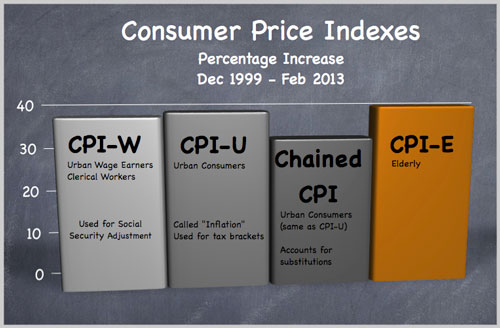
There actually are several Consumer Price Indexes. Each measures the cost of living for different groups of people.
o CPI-U: This is a measure of how prices affect all urban consumers - about 88 percent of Americans. When you hear the term "inflation" being officially discussed, this index typically is what's being referred to. Adjustments to income tax brackets are based on this index.
o Chained CPI: This measures prices for the same people as CPI-U. The difference is that it assumes consumers can switch to less expensive alternatives. Therefore, its dollar value rises slower - though consumers might not enjoy the same standard of living.
o CPI-E: This shows how the cost of living has changed for people 62 and older.
This chart shows how each of the measurements of the cost of living has changed since 2000...
Consumer Product Safety Commission (CPSC)
A government independent agency that regulates the safety of most consumer products and informs the public of hazards and recalls.
The agency does not regulate products that are regulated by other agencies, such as...
o Guns (regulated by the Bureau of Alcohol, Tobacco, Firearms, and Explosives (ATF))
o Drugs (regulated by the Food and Drug Administration (FDA)).
Website: www.CPSC.gov
Continuing Resolution (CR)
Legislation that extends the funding of government functions and services for a limited period of time. Funding typically remains at the current levels.
Because federal money cannot be spent without first being budgeted, Continuing Resolutions keep the government running when both houses of Congress and/or the president cannot agree on a budget either at the end of a fiscal year or the expiration of the previous Continuing Resolution.
Contract With America
(Coming)
Cost of Living
A measurement of how much consumers pay for commonly used products such as food, housing, health care, and fuel.
It is measured by the Consumer Price Index (CPI).
Cost-Sharing Reduction Subsidies
Payments from the federal government to insurance companies used to make insurance more affordable to those earning 1 - 2.5 times the Federal Poverty Level (FPL) (those who make less than the FPL are eligible for Medicaid Expansion in states that have accepted it).
Cost Sharing Reduction Subsidies apply only for silver plans purchased on the insurance exchange their state uses.
They work by reducing deductibles, copayments, and out-of-pocket maximums.
In technical terms, they increase the actuarial value of silver policies for those who are eligible.
The law requires that companies provide this benefit. If the federal government does not make these payments to insurance companies, the companies will need to make up for the cost elsewhere - most likely through increased premiums. Without the payments, insurance premiums would increase by 20 percent, according to the Kaiser Family Foundation.
For more, visit ObamacareFacts.com or read this Commonwealth Fund explanation.
Referenced by...House will pay Obamacare subsidies it fought to withold (2017-Mar-30)
Trump passes on first real chance to end Obamacare (2017-Feb-21)
Council of Economic Advisors
Website: www.Whitehouse.gov/administration/eop/cea.
Court of Appeals, District of Columbia Circuit
The D.C. Circuit Court of Appeals is possibly the most powerful court in the United States, other than the Supreme Court. It decides cases regarding federal agencies - such as regulations they impose.
The court is made up 11 judges.
o Karen Henderson (appointed by George H.W. Bush)
o Judith Rogers (appointed by Bill Clinton)
o David Tatel (appointed by Bill Clinton)
o Janice Rogers Brown (appointed by George W. Bush)
o Thomas Griffith (appointed by George W. Bush)
o Brett Kavanaugh (appointed by George W. Bush)
o Sri Srinivassan (appointed by Barack Obama)
o Patricia A. Millett (appointed by Barack Obama)
o Cornelia T.L. Pillard (appointed by Barack Obama)
o Robert L. Wilkins (appointed by Barack Obama)
The court also is served by several part-time "senior" judges.
Several of this court's former judges later served on the Supreme Court, including John Roberts, Clarence Thomas, Ruth Bader Ginsburg, and Antonin Scalia.
Other notable people who have served on the D.C. Circuit Court include Robert Bork and Kenneth Starr.
Website: www.cadc.uscourts.gov.
Credit Report/Score
Your credit report and score estimate the risk of lending you money.
Your credit report contains a list of your accounts (such as credit cards and loans), including information such as your credit limit, your outstanding balance, and your payment history.
Your credit score is a number that is calculated based on the information in your report. It often is referred to as a FICO score - an acronym for Fair Isaac Company - the company that developed the algorithms that calculate your score for the agencies.
The higher your score the more a bank is likely to lend you, and the lower your interest rate may be. But it can be used in other ways. An apartment might charge a higher security deposit if your credit score is low. It might affect whether you are offered a job.
You have three credit scores - one from each of the main credit reporting agencies. You're entitled to a free copy of your credit report from each of the three agencies. To find out how, visit our Resources page.
Credit Reporting Agencies
Companies that monitor your credit history - including accounts you hold and your payment record. The three main companies that perform this function are...
o Experian
o TransUnion
If you fail to make payments on a loan or credit card, for example, the bank may report the delinquency to any of these agencies.
The information is used by companies you want to conduct certain types of business with, such as applying for a loan or credit card, renting an apartment, buying a cell phone under a contract, or even applying for a job.
Cuba: Wet Foot, Dry Foot Policy
1995 agreement with Cuba that allowed Cuban refugees who reached the United States to become permanent residents. Cubans caught in U.S. territorial waters before reaching the U.S. shore were returned to Cuba or to a third country. President Barack Obama ended the policy in 2017.
Referenced by...Trump reinstates Cuba travel restrictions (2017-Jun-25)
Obama ends Cuban immigration amnesty (2017-Jan-12)
Dark-Money
Money used by a political campaign to influence elections - the source of which is not known.
A candidate for elected office is required to disclose who has contributed money to their campaign - as well as how much. There also are limits to how much an individual is allowed to contribute.
To legally avoid these limits, donors can donate to special organizations such as Super PACs. Money donated to Super PACs still needs to be disclosed.
To give money anonymously, donors instead give to organizations known as 501(c) nonprofit. Donors can give to these nonprofits anonymously. The nonprofit then donates the money to the SuperPAC (the SuperPAC still must list a donor, but that donor is just the nonprofit).
As the source of the political contribution now is unknown, it is referred to as dark money.
For more about how dark money works, read this Center for Public Integrity story.
David-Bacon Act
1931 law requiring that workers on public works projects be paid local prevailing wages.
Debt (vs Deficit)
Debt is the amount of money owed at a particular point in time. It can be increased by borrowing more or simply by accruing interest on the existing debt. It can be decreased by paying part of it off.
Debt is different from a deficit, which is the how much more money was spent than received over a period of time, such as a year.
By law, the amount of the national debt may not exceed the debt limit.
To view the current amount of U.S. debt, visit www.USDebtClock.org.
Debt Limit (or Debt Ceiling)
The amount of money the U.S. is allowed to borrow in order to pay for its operations.
Practically speaking, however, it has nothing to do with managing the federal budget since spending and revenue are specified by Congress. If Congress allocates more money that exceeds the debt limit, increasing the limit merely allows the government to borrow enough to pay that extra money that was already spent.
Watch this 3-minute video to understand how this really works...
There are two ways Congress can set the debt limit...
o They can set a date, allowing the debt to increase by however much they exceed the previous limit until the specified date.
Declaration of Independence
The document that declared that the United States was its own country - no longer a part of England.
Its final wording was agreed on July 4, 1776 - which traditionally is considered to be the birthday of the United States. A more accurate birthday, however, is two days earlier - when the Second Continental Congress voted to declare independence.
You can read the Declaration of Independence at that National Archives.
Defense Intelligence Agency (DIA)
Website: www.DIA.mil.
Deferred Action for Childhood Arrivals (DACA)
Policy established by President Barack Obama in 2012 to allow undocumented immigrants categorized as DREAMers to remain in the country and legally work.
Applicants must pass a background check, have no criminal record, and either be in school, recently graduated, or have been honorably discharged from the military.
Their permission to remain in the country legally must be renewed every two years.
In 2017, President Donald Trump rescinded the policy. He delayed the recision through March, 2018, saying that Congress could enact legislation to continue it for those already eligible.
Senate fails to protect immigrants who arrived as children (2018-Feb-15)
Deficit (vs Debt)
A deficit occurs when you spend more money than you bring in over some period of time such as a year. (For the opposite situation, see surplus).
If the U.S. budget for a fiscal year creates a deficit, the amount of the deficit must be borrowed in order to pay for everything the money was spent on. That amount adds to the national debt.
Demand Response
A program for reducing energy consumption by offering consumers a lower price if they reduce their energy use during peak demand times.
This can help the utility company avoid power outages due to heavy demand and keep them from having to buy expensive power on spot markets.
For more, visit the Department of Energy website.
Democracy 21
Website: www.Democracy21.org.
Dept of Agriculture (USDA)
The federal agency responsible for administering policies related to food, farming, agriculture, and forestry.
For more, visit www.USDA.gov.
Dept of Commerce
(Coming)
Website: www.Commerce.gov
Dept of Defense (DoD)
Website: www.defense.gov.
Dept of Education
The Department of Education establishes general policies for education in the United States.
One of its missions is to prohibit discrimination and ensure equal access to education.
Website: www.Ed.gov.
Dept of Energy (DOE)
Cabinet-level department of the federal government that administers policies regarding energy and nuclear material.
Website: www.Energy.gov.
Dept of Health and Human Services (HHS)
The principal government agency for protecting the health of Americans. It is comprised of agencies that do research and provide services including public health, food and drug safety, and health insurance.
For more, visit www.HHS.gov.
Dept of Homeland Security (DHS)
Cabinet department that oversees the protection of United States' territories. This includes preventing and responding to terrorist attacks, and responding to natural disasters.
It was created in 2003 in response to the Sept. 11, 2001 terrorist attacks.
Agencies that make up DHS include...
o Transportation Security Administration (TSA)
o Coast Guard
o Secret Service
o Federal Emergency Management Agency (FEMA)
Website: www.dhs.gov
Dept of Housing and Urban Development (HUD)
Website: www.HUD.gov.
Dept of Justice (DOJ)
Website: www.Justice.gov
Dept of Labor (DOL)
Website: www.dol.gov
Dept of State (DOS)
The Department of State typically is referred to as the State Department.
It is the federal agency responsible for the country's foreign policy - including international relations and treaty negotiations.
Website: www.State.gov.
Dept of the Interior (DOI)
Federal lands make up about 1/5 of the United States. The Department of the Interior is responsible for managing this land - from maintaining national parks to leasing land for grazing or oil drilling to preserving cultural resources.
Agencies that make up the Department of the Interior include...
o Bureau of Indian Affairs
o Bureau of Ocean Energy Management (BOEM)
o Bureau of Reclamation
o National Parks Service
o U.S. Fish and Wildlife Service (FWS)
Website: www.DOI.gov
Dept of the Treasury
Cabinet-level agency responsible for ensuring the United States' financial security. Its functions include...
o Collecting revenue (such as taxes)
o Disbursing payments to Americans (such as tax refunds)
o Borrowing money needed to run the federal government
o Advising the President on economic and financial issues
o Helping to govern the country's financial institutions
Website: www.Treasury.gov.
Dept of Transportation (DOT)
Website: www.Transportation.gov.
Dept of Veterans Affairs (VA)
The Department of Veterans Affairs (most often referred as simply the VA) provides services to U.S. military veterans and their families.
One area of the VA - the Veterans Health Administration - is one of the country's main health care systems.
Website: www.va.gov
Deutsche Bank
A German bank (the name Deutsche Bank is literally german for German Bank). It is one of the largest banks in the world.
Deutsche Bank has been linked to money laundering schemes involving Russian oligarchs. It also was the only bank willing to lend money to Donald Trump at a time when nobody else would - and while Trump still owed the bank hundreds of millions of dollars and was suing the back to relieve that debt.
Website: www.DB.com.
DeVos, Betsy
Secretary of Education under President Donald Trump.
She had no prior professional education experience. She is a former chair of the Michigan Republican Party.
She chaired the American Federation for Children, a dark money group that supports school voucher programs and charter schools nationwide, funneling donations from undisclosed sources to candidates who support school privatization, mostly at the state level.
DeVos' father, Edgar Prince, co-founded the Family Research Council and the Edgar and Elsa Prince Foundation, major financial backers of the religious right. Her husband, Richard DeVos Jr., is heir to the Amway multi-level marketing company fortune. The couple founded the Windquest Group investment firm.
DeVos and her relatives - including her brother Erik Prince, co-founder of the Blackwater private security company - have been major donors to the Republican Party for decades.
For more about Betsy DeVos, read the Washington Post story.
For more on the DeVos family donations, see this Center for Responsive Politics report.
Trump cabinet members to speak at ALEC event (2017-Jul-19)
Senate confirms Betsy DeVos for Education Secretary (2016-Nov-23)
Issue: Trump's Ties to Russia
Director of National Intelligence
The principal advisor to the president on intelligence issues related to national security.
Website: www.DNI.gov.
Discharge Petition
A petition in the House of Representatives to force the House to consider a bill that has not been passed by a committee - even against the will of the House Speaker.
If 218 representatives (a majority of voting representatives) sign the petition, the bill becomes "discharged" from the committee and can be discussed and voted on by the full House.
DISCLOSE Act
The name of the DISCLOSE Act is an acronym for Democracy Is Strengthened by Casting Light On Spending in Elections.
(more to follow)
Disenfranchisement
To disenfranchise a person or group means to deprive them of a privilege, right, or power. For our purposes, it means to deprive them of a right of citizenship - especially the right to vote.
Disparate Impact
U.S. anti-discrimination laws protect from two forms of discrimination in areas such as employment or housing...
o Disparate Impact: The discrimination is not explicit or intentional, but it results in a disproportionate disadvantage for certain classes of people.
Disproportionate Share Hospital Program (DSH)
Money the federal government pays hospitals to offset their cost of treating people without insurance or the ability to pay.
Distressed Asset
Something that is offered for sale at a price significantly below value because the owner needs to sell it quickly.
District
Diversity Visa Lottery
A lottery administered by the State Department that attempts to diversify the immigrant population by selecting applicants from countries with low numbers of immigrants in the previous five years.
Referenced by...Senate fails to protect immigrants who arrived as children (2018-Feb-15)
DMCA: Digital Millennium Copyright Act
The 1998 law designed to protect copyrights on digital media. Among other things, the DMCA made it illegal to circumvent copy protection mechanisms built into electronics - a provision that has since been interpreted very broadly.
For more, read our discussion of the DMCA.
Dodd-Frank
The Dodd-Frank Wall Street Reform and Consumer Protection Act is a 2010 law intended to prevent a recurrence of the financial crisis that hit the nation in 2008.
Click here to read our explanation of the bill.
House passes bill to revoke consumer and financial protections (2017-Jun-08)
Bills would eliminate Consumer Financial Protection Bureau (2017-Feb-14)
Rule to disclose payments to foreign governments nullified (2017-Feb-14)
Senate confirms Jay Clayton to head SEC (2017-Jan-04)
Dogma
Positions or beliefs obtained from a figure of authority - such as a parent, religious leader, teacher, or book - which is contradicted by verifiable evidence or for which verifiable evidence does not exist.
Related term: scientific method
DOI Methane and Waste Prevention Rule
A 2016 rule issued by the Department of the Interior (DOI) requiring oil and gas producers to use currently available technologies and processes to cut flaring in half at oil wells on public and tribal lands.
This source of pollution is the second-largest industrial contributor to climate change in the United States, according to the Natural Resources Defense Council (NRDC).
The rule will result in a reduction of pollution equivalent to almost 1 million cars per year, and recover enough gas to supply about three-quarters of a million homes per year.
The full name of the rule is "Waste Prevention, Production Subject to Royalties, and Resource Conservation".
Click here to read the DOI announcement.
Click here to read the DOI fact sheet on the rule.
Click here to read an explanation of the rule by the NRDC.
DOI Stream Protection Rule
A 2016 rule issued by the Department of the Interior (DOI) requiring coal mining companies to avoid practices that permanently pollute streams, destroy drinking water sources, increase flood risk, and threaten forests.
Companies also would be required to monitor streams that could be affected by their mining operations.
In February 2017, Congress voted to prevent this regulation from taking effect.
Click here to read the Interior Department announcement.
Click here to read the Congressional Research Service analysis on the effects of the rule on the environment and on jobs .
Donald Trump Dossier
A document that was the result of a private investigation into Russian connections to Donald Trump.
Political research company Fusion GPS - which in turn hired Christopher Steele - to perform the research.
Click here to view the dossier.
Referenced by...Testimony further debunks Trump dossier narrative (2018-Jan-11)
Issue: Trump's Ties to Russia
Doughnut Hole
A general term used to describe a gap in eligibility for a benefit.
For a simple hypothetical example, a prescription drug benefit might pay for drugs up to $2,000. But if it also pays for drugs in excess of $4,000, your maximum out-of-pocket expenses would be $2,000 (the amount over $2,000 but less than $4,000). This gap - where you would pay - is referred to as a doughnut hole.
Down Payment
When you take out a loan to buy something expensive such as a car or a house, you often will pay a small portion of the price up front, and then borrow the remainder.
The money you pay up front is what's called the down payment.
DREAM Act
Acronym for Development, Relief, and Education for Alien Minors, the DREAM Act is the name given to various attempts at legislation that would have provided legal residency to certain young people brought into the United States illegally by their parents.
Though they were brought here illegally, these children grew up in the United States, and their only life (home, school, etc) has been in the United States.
The various attempts to define those who would be helped by the DREAM Act differed, but in general, the person must...
o Have lived in the U.S. for a certain length of time.
o Have a certified completion of high school, or be admitted to college
o Pass background and criminal checks.
Because the bill was named the DREAM Act, those young people to whom it offered protection are referred to as DREAMers.
For more, read the American Immigration Council report.
Click here for details of the 2001 DREAM Act.
Senate fails to protect immigrants who arrived as children (2018-Feb-15)
Deportation plan would cost taxpayers more than $30 billion (2017-Feb-21)
Drone
An unmanned aircraft. Drones are used by the military, companies (for example filmmakers and surveyors), and individuals. They can be either autonomous - controlled by a computer program without human control or manned - remotely controlled by a pilot.
Drones also are referred to as UAVs (Unmanned Aerial Vehicle) and UASs (Unmanned Air Systems).
For more on how drones may be used in the United States, read the Federal Aviation Administration factsheet.
Drug War
Also referred to as the War on Drugs, the term was first used by President Richard Nixon to describe using federal resources to eliminate illegal drugs in the country.
For more, visit the Drug Policy Alliance website.
Due Process / Equal Protection
A key provision in the Constitution that protects people from arbitrary acts by the government.
The Fifth Amendment states...
"...nor shall any person ...be deprived of life, liberty, or property, without due process of law..."
The Fourteenth Amendment extends that to state governments, adding that protections must be the same for every person...
"...nor shall any State deprive any person of life, liberty, or property, without due process of law; nor deny to any person within its jurisdiction the equal protection of the laws. ..."
e-Cigarette
Short for electronic cigarette. E-cigarettes are small electronic devices used like a cigarette - in which the person inhales a vapor made from nicotine and/or flavored liquid. They differ from cigarettes in that e-cigarette vapor is produced electronically rather than by burning tobacco.
For more, read this National Institute on Drug Abuse publication.
Earned Income Tax Credit (EITC)
Annual cash assistance to low- and moderate-income families from the federal government. It is paid as a federal income tax refund.
To learn more about the Earned Income Tax Credit - including how to receive it - visit the Internal Revenue Service (IRS) website.
Economic Policy Institute (EPI)
The Economic Policy Institute is a non-partisan, non-profit think tank that studies public policies which affect low- and middle-income workers. They also propose public policies that would improve the economic conditions of American workers.
For more, visit www.EPI.org.
Election Assistance Commission (EAC)
The Election Assistance Commission is a four-member, non-partisan commission recommends voting system guidelines. It also maintains the national mail voter registration form. There currently are no commissioners assigned to this commission.
For more, visit www.EAC.gov.
Election Fraud
Corruption of the voting process by those in power, with the intent of influencing elections
Election fraud can take several forms, including...
Related term: Voter Fraud.
Election Integrity Commission
Officially the Presidential Advisory Commission on Election Integrity, the Election Integrity Commission was created by President Donald Trump to determine the extent of illegal voter registration and voting illegally.
This federal advisory committee was created in response to Trump receiving approximately 3 million fewer votes than Hillary Clinton - his Democratic opponent - in the 2016 presidential election.
Though Trump won the Electoral College - and therefore the election - he claimed his popular vote loss was due to illegally cast votes. There is no evidence that this is the case.
For more, read this Brookings Institution analysis.
Click here to read the executive order establishing the commission.
Voting fraud fabricator named to investigate voting fraud (2017-Jul-17)
Electoral College
(Coming)
Electronic Frontier Foundation (EFF)
The Electronic Frontier Foundation advocates on free speech and privacy concerns related to the Internet. You can learn more at www.EFF.org.
Emergency Extended Benefits (EB)
(Coming)
Emergency Unemployment Compensation (EUC)
(Coming)
Emoluments
In the Constitution, emoluments refers to benefits from holding office - such as compensation, privileges, or certain advantages.
Emoluments are mentioned twice in the Constitution...
Foreign Emoluments
Article 1, Section 9 states...
No Title of Nobility shall be granted by the United States: And no Person holding any Office of Profit or Trust under them, shall, without the Consent of the Congress, accept of any present, Emolument, Office, or Title, of any kind whatever, from any King, Prince, or foreign State.
Domestic Emoluments
Article 2, Section 1 states...
The President shall, at stated Times, receive for his Services, a Compensation, which shall neither be increased nor diminished during the Period for which he shall have been elected, and he shall not receive within that Period any other Emolument from the United States, or any of them.
End Rape on Campus (EROC)
An organization that works to end sexual violence on school campuses.
Website: www.EndRapeOnCampus.org.
ENDA: Employment Non-Discrimination Act
Legislation that would make it illegal for an employer to discriminate against someone because of their sexual orientation or gender identity.
For more, see our discussion of this issue.
Endangered Species List
A list of animal, bird, and plant species whose existence is considered at risk.
Species on the list are classified as either...
o Endangered: In danger of becoming extinct.
The list is maintained by the U.S. Fish and Wildlife Service (FWS) and the National Oceanic and Atmospheric Administration (NOAA), as specified in the 1973 Endangered Species Act.
Website: www.FWS.gov/endangered.
Enron
Energy company created in 1985 and dismantled due to bankruptcy in 2001. Before declaring bankruptcy, Enron used fraudulent accounting practices to make it appear to be profitable. Accounting firm Arthur Anderson helped enable the deception by approving Enron's financial reports.
The Enron case was one of the prime motivations for the 2002 Sarbanes-Oxley Act.
For more, read this Investopedia article.
Entitlement
Entitlement programs are those that receipients have a legal right to benefit from, provided they meet the program's qualifications. These programs include Social Security, Medicare, Medicaid, unemployment compensation, food stamps, and most Veterans' Administration programs. On a much smaller scale, they include things like the salaries of Congress and the President.
Spending for these programs is referred to as mandatory spending, as opposed to programs which are legislated each year and are referred to as discretionary spending.
Environmental Protection Agency (EPA)
Website: www.EPA.gov.
Environmental Working Group
A nonprofit, non-partisan organization that researches and reports on issues related to the environment.
Website: www.ewg.org.
EPA Clean Power Plan
A 2015 policy issued by the Environmental Protection Agency (EPA) to reduce pollution from power plants.
For more, see the EPA overview.
EPA Cross-State Air Pollution Rule
You can learn more about the Cross-State Air Pollution Rule at www.epa.gov/csapr.
EPA Mercury and Air Toxics Standards (MATS)
You can learn more about the Mercury and Air Toxics Standards Rule at www.epa.gov/mats.
EPA Regional Haze Rule
A series of regulations issued to lessen haze in national parks and wilderness areas.
You can learn more about the Regional Haze Program at www.epa.gov/visibility.
Click here to view the progression of these regulations over the years.
EPO: Exclusive Provider Organization
A type of health insurance plan similar to a Preferred Provider Organization (PPO) in that your plan provides a network of health care providers for you to use.
With an EPO, the network may be much smaller than with a PPO - giving you fewer choices of providers. Also, the insurance company may pay nothing if you use a provider not in your plan's network.
Equal Protection Clause
Part of the Constitution's 14th Amendment, which states
No State shall make or enforce any law which shall abridge the privileges or immunities of citizens of the United States; nor shall any State deprive any person of life, liberty, or property, without due process of law; nor deny to any person within its jurisdiction the equal protection of the laws.
For more, read the Legal Information Institute explanation.
Equitable Sharing Program
A 1984 program that allows property seized by state or local law enforcement agencies by Civil Asset Forfeiture to be turned over to the federal government.
The federal government then sells the property and returns part of the proceeds to the agency that confiscated the property.
ERISA
Acronym for the Employee Retirement Income Security Act, a 1974 law that helped ensure that retirees from a company would be able to receive the full pension promised them.
For more, read our discussion of the law.
Essential Health Benefits
Services that health insurance plans must cover under the Patient Protection and Affordable Care Act (Obamacare).
o Emergency services - including ambulance service. You cannot be penalized if the hospital is not in your provider network.
o Treatment you receive in a hospital, including room and board. Some plans limit coverage for care in a skilled nursing facility to 45 days.
o Maternity and newborn care
o Mental health services and addiction treatment
o Prescription drugs
o Rehabilitative services and devices. Plans must cover 30 visits a year for services such as physical or occupational therapy.
o Laboratory services
o Preventive services, including screening for colorectal and breast cancers, diabetes, and sexually transmitted diseases.
o Pediatraic services - including dental and vision care for those younger than 19.
For more, visit ObamacareFacts.org.
Estate Tax
When someone dies, the money and property they owned (i.e. their estate) is distributed among others - usually according to the owners' wishes. First, however, estate's value (over a certain amount) is taxed by the federal government.
Ethics in Government Act
1978 law that....
o Requires high-ranking government officials (elected and appointed) to provide a financial disclosure to the OGE
o Creates the requirement for a special prosecutor in certain situations.
Click here to read our discussion of the bill.
Ex Officio
An ex officio member of a board, committee, etc. is one who is part of it by virtue of holding another office.
Excise Tax
A tax paid when purchasing a specific product, such as gasoline airline tickets, etc.
The seller is responsible for paying the tax. However, sellers may include the tax in the cost of the product.
Execution
Usually referred to as capital punishment or the death penalty, it is the taking of the life of a person convicted of certain crimes (referred to a capital offenses) under certain circumstances.
Click here for a list of states that allow executions, those which don't, and those that technically do but there is a current moratorium.
Executive Order
An instruction by the president on how the federal government should operate - including how federal agencies should enforce laws.
They are published in the Federal Register.
Executive orders are similar to laws passed by the Congress in that they are fully enforceable and can be challenged for their constitutionality. They differ from laws passed by Congress in that they can be nullified or changed by a future president.
Externality
A term used in economics to describe a consequence to some party that did not cause - and had no choice in whether to incur - the effect.
An externality can be positive (external benefit) or negative (external cost).
One example would be a factory that dumps pollutants into a river, while a second factory downstream requires clean water for its operations.
A few things can happen...
o The upstream factory could mitigate the problem it caused, by either reducing the amount of pollutants it dumps into the river or paying to clean the water. In this case it would be internalizing the cost.
Fair Housing Act
1968 law that prohibits housing discrimination on the basis of race, color, religion, or national origin.
Other protections were added later...
1988: Disability and family status (such has having children).
The law is Section VIII of the 1968 Civil Rights Act.
Fair Labor Standards Act (FLSA)
The Federal law which sets certain standards for working conditions, including...
Click here to read more about the FLSA.
Fair Pay and Safe Workplaces
A 2014 Executive Order by President Barack Obama that federal contractors who do more that $500,000 of business with the government disclose any labor law violations against them in the prior 3 years. Violations would not preclude the contractor from getting hired - but the information would be used in the determination.
A 2010 report by the Government Accountability Office (GAO) found violations of environmental, wage, and safety laws in several companies that had large government contracts.
Just before the order was set to take effect in 2016, it was put on hold by a federal judge in Texas.
In March 2017, President Donald Trump signed a bill revoking the rules.
Click here to read the GAO report identifying violations by federal contractors.
Click here to read the executive order.
Click here to read rules from federal agencies to implement the executive order.
Family Research Council
(Coming)
For more on the American Federation for Children, read the Sourcewatch report.
Website: www.FRC.org.
Fannie Mae / Freddie Mac
Government Sponsored Enterprises that encourage home ownership by buying mortgages from banks.
Fannie Mae is short for the Federal National Mortgage Association (FNMA). Freddie Mac is short for Federal Home Loan Mortgage Corporation (FHLMC). The main difference between the two is that Fannie Mae typically buys mortgages from larger banks, while Freddie Mac buys mortgages mostly from smaller banks.
This is how it works...
When you take out a mortgage to buy a house, the bank has to pay that money to the house's seller. But a bank can only lend as much money as it has. To increase the amount of money available for loans, the bank sells the mortgage. Fannie Mae and Freddie Mac buy mortgages, most of which they bundle to resell as mortgage backed securities.
Websites:
Fannie Mae: FannieMae.com
Freddie Mac: FreddieMac.com
Farm Bill
(Coming)
Farm Service Agency (FSA)
The part of the USDA responsible for implementing laws regarding farms - especially the Farm Bill.
For more, visit www.FSA.USDA.gov.
Federal
The United States is a made up of multiple governments. There is one national government, consisting of...
o The President (and government agencies)
o The Supreme Court (and lower national courts)
Each state and territory also has its own government. Within each state, counties and cities have governments. So do school districts.
The national government is referred to as the federal government. Most things labeled as federal relate to the country as a whole.
Lobby99 typically addresses only federal government - only addressing state and lower issues when they might affect the country as a whole.
Federal Advisory Committee
Temporary committees established by the executive branch to provide expert advice on a particular subject.
They are required to follow guidelines specified in the 1972 Federal Advisory Committee Act, including transparency to the public and having a membership that is "fairly balanced in terms of points of view represented".
They must be disbanded once their mission has been completed.
For more, read this Congressional Research Service report.
Federal Aviation Administration (FAA)
Website: www.FAA.gov.
Federal Bureau of Investigation (FBI)
The prime federal law enforcement agency of the United States.
In addition to investigating federal crimes, the FBI also is the primary agency for domestic intelligence. The FBI director reports to both the Attorney General and the Director of National Intelligence.
Website: www.FBI.gov.
Federal Bureau of Prisons (BOP)
Website: www.BOP.gov.
Federal Communications Commission (FCC)
An independent federal agency that regulates interstate communications - including those by radio, television, wire, cable, and satellite.
It is directed by five commissioners who are appointed by the president and serve a 5-year term (unless filling an unexpired term). Commissioners may not have a financial interest in any commission-related business. No more than three can be of the same political party.
The FCC was created by the Communications Act of 1934.
Website: www.FCC.gov.
Federal Deposit Insurance Corporation (FDIC)
The FDIC is a Government Owned Corporation that protects the money you deposit in banks.
It was created by the 1933 Banking Act (Glass-Steagall) to prevent panicked withdrawals from banks - by assuring depositors that their money will be safe even if the bank goes out of business.
The FDIC is funded with premiums paid by member banks.
Federal Election Commission (FEC)
U.S. independent regulatory agency that administers and enforces laws regarding federal election financing.
Website: www.FEC.gov.
Federal Emergency Management Agency (FEMA)
(Coming)
Federal Energy Regulatory Commission (FERC)
An independent agency within the Department of Energy (DOE) that regulates interstate electricty sales, hydroelectric facilities, and pricing for electric and natural gas power.
According to its website, there are some things that are outside the commission's jurisdiction, including...
o Regulating nuclear power plants (managed by the Nuclear Regulatory Commission (NRC))
Website: www.FERC.gov
Federal Housing Administration (FHA)
The Federal Housing Administration (FHA) insures mortgages - protecting lenders in case the homebuyer defaults on their mortgage.
This typically is for buyers who can't afford a large enough down payment to qualify for a loan. A bank will lend to these borrowers because the FHA will insure the lender gets paid back.
This helps people who don't have much in savings buy a house.
In exchange, home buyers requiring an FHA guarantee pay a Mortgage Insurance Premium.
Website: www.FHA.gov.
Federal Housing Finance Agency (FHFA)
Website: www.FHFA.gov.
Federal Insurance Office
Office under the Treasury Department that monitors the insurance industry to identify problems that could contribute to a financial crisis.
It also monitors the availability of insurance (except health insurance) to traditionally underserved communities and consumers.
It was created by the 2010 Dodd-Frank Wall Street Reform and Consumer Protection Act.
Federal Lands
Land owned by the federal government (in other words, American citizens). Federal lands make up about 1/5 of the United States.
Different types of federal lands are managed by various agencies of the Department of the Interior.
Federal Office
In terms of election law, generally means the presidency, vice presidency, Senate, or House of Representatives.
Federal Register
A daily government publication that contains regulations, proposed rules, executive orders, and other government documents.
You can view the Federal Register at www.FederalRegister.gov.
Federal Reserve (The Fed)
(Coming)
Federal Reserve Dividend
A bank wanting to be a national bank (which would exempt it from state usury laws) must become part of the Federal Reserve.
In order to do that, they must buy stock (i.e. partial ownership) in Federal Reserve district banks. These stocks are effectively risk free since the Federal Reserve's debts are backed by the U.S. government. The bank cannot sell or trade these stocks. However, they receive a dividend on the stock. The dividend rate currently is 6 percent (it hasn't changed in more than a century).
Federal Trade Commission (FTC)
The Federal Trade Commission is the fedaral agency that protects consumers against deceptive unfair business practices. The FTC also maintains a website (www.consumer.ftc.gov) that provides alerts on products and scams, and services such as the national
You can learn more about the FTC at FTC.gov.
The FTC consists of three organizations...
Federalist Papers
A collection of 85 essays written in 1787 and 1788 to persuade Americans to ratify the Constitution. They explain the reasoning behind certain parts of the Constitution.
They are generally assumed to have been written by James Madison, Alexander Hamilton, and John Jay.
Click here to learn more about the Federalist Papers and to read them.
Felony
A serious crime (as opposed to less serious crimes such as misdemeanors and infractions).
Different jurisdictions define felonies differently. Federal laws that are punishable by more than a year in prison are classified as felonies. Each state has its own definition.
Fiduciary Rule
2016 regulation from the Department of Labor (DOL) that requires financial planners recommending investments for retirement accounts to provide advice in your best interest, rather than theirs.
For example, while an advisor is required to recommend investments suitable to your goals, he can suggest an investment that will earn him a higher fee - rather than one that would provide you with the best return. This rule prevents that.
It also is known as the Conflict of Interest Rule.
Click here to read the White House fact sheet for the rule.
Referenced by...House passes bill to revoke consumer and financial protections (2017-Jun-08)
Rule protecting retirement will take effect in June (2017-May-23)
Fiduciary Rule will protect those investing for retirement (2016-Apr-04)
Filibuster
Senate rules allow for a senator to speak for as long as he or she wants when debating a bill. When a senator (or group of senators) knows they are a minority in opposiing a bill, they can utilize this rule to kill the bill by speaking indefinitely. This tactic is called a filibuster.
A filibuster can be ended if three-fifths of all senators vote to end it - known as invoking cloture.
That is how filibusters used to work. Today, modern Senate rules allow a senator to merely threaten to filibuster (silent filibuster), rather than forcing him to actually speak (talking filibuster). In order for a bill to proceed under a silent filibuster, three-fifths of all senators then must agree to allow the bill to continue.
This means that it effectively takes 60 senators (out of 100) for any legislation to proceed.
For a deeper understanding, read our discussion of the filibuster.
While there is no similar procedure in the House of Representatives, House rules allow for the Speaker, majority leader, and minority leader to speak for unlimited amounts of time.
Related terms: Senate, Cloture
Financial Crimes Enforcement Network (FinCEN)
A bureau of the Treasury Department.
FinCEN collects and analyzes data about financial transactions to fight financial crimes.
Website: www.FinCEN.gov.
Financial Stability Oversight Council (FSOC)
The FSOC watches for risks in the U.S. financial system. It was created by the 2010 Dodd-Frank Wall Street Reform and Consumer Protection Act.
The council attempts to identify banks and other financial companies considered so large that their failure could pose a threat to financial markets (designated as too big to fail).
If nonbank financial companies get too big, the council can require they be regulated by the Federal Reserve. The council also can recommend that the Federal Reserve adopt stricter rules for factors such as liquidity and risk management as companies grow in size.
Members include the Secretary of the Treasury and the heads of nine federal financial regulatory agencies, including the Securities and Exchange Commission (SEC).
Website: www.treasury.gov/initiatives/fsoc/Pages/home.aspx.
FISA: Foreign Intelligence Surveillance Act
(Coming)
Fiscal Cliff
(Coming)
Fiscal Year
Organizations maintain their finances year to year, but those years can begin whatever month the organization chooses. It is not always January like the calendar year. The one-year period, starting with whatever month the organization has chosen, is known as its fiscal year. Once set, it is permanent for the most part.
The United States' fiscal year starts in October (of the previous year). So the 2017 fiscal year runs from October 1, 2016 through September 30, 2017.
Flat Tax
The term flat tax has been used to describe a tax policy in which everyone pays the same percentage on all of their income. The term is used to contrast it to our present graduated tax structure. But other than the numbers used, there is no real difference between the two. We explain why here...
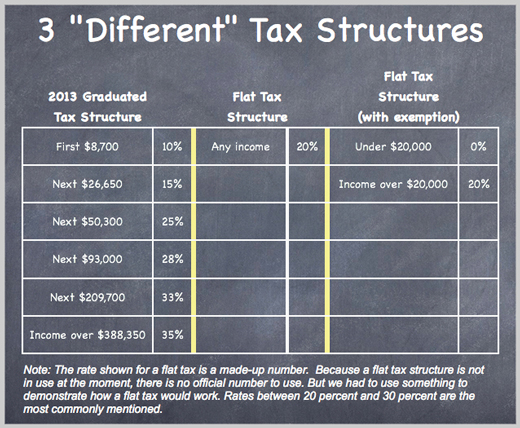
The section on the left shows present tax structure, followed by two variations of a flat tax. If you understand how marginal tax rates work, you'll see that all three structures simply are marginal tax structures. It's just that a flat tax has fewer graduations. (If you don't understand how marginal tax rates work, see our explanation and five minutes from now you will.)
So is one better than another? That depends on who you are. Let's look at an comparison between a low-wage earner and high-wage earner...
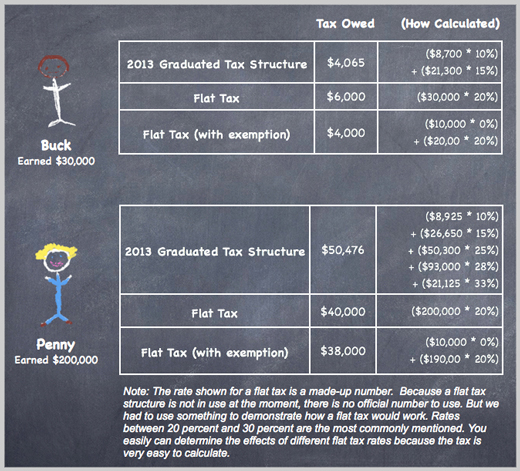
As you can see, the low-wage earner might end up paying higher taxes under a flat tax system. It is the high-wage earners who would pay significantly less in taxes.
For more on arguments for or against a flat tax structure, click here.
Flynn, Michael
President Donald Trump's first National Security Adviser.
Resigned less than a month into the administration after revelations that he discussed foreign policy with Russia before the Trump had taken office.
Click here to read more on Flynn's connections to Russia.
Referenced by...Flynn pleads guilty to lying to FBI, may testify against Trump (2017-Dec-01)
Bill limits president's power to lift Russian sanctions (2017-Aug-02)
Special Counsel to investigate Trump-Russia connection (2017-May-17)
Senate subpoenas documents on Russia (2017-May-10)
Trump fires FBI director leading probe against him (2017-May-09)
White House refuses Congress' request for Flynn documents (2017-Apr-25)
Rep. Nunes recuses self from Russia investigation (2017-Apr-06)
Info Nunes gave to White House came from White House (2017-Mar-30)
House Intel Committee cancels Trump-Russia public hearing (2017-Mar-27)
House Intelligence Committee to hold public hearing on Russia (2017-Mar-07)
Paul: Republicans shouldn't investigate Republicans (2017-Feb-14)
Nat'l Security Adviser Flynn resigns - what we know (2017-Feb-13)
Issue: Trump's Ties to Russia
Food and Drug Administration (FDA)
The FDA is the government agency that regulates several foods, drugs, and other products to ensure their safety and efficacy.
Website: www.FDA.gov.
Food Stamps
See Supplemental Nutrition Assistance Program (SNAP)
Foreign Corrupt Practices Act (FCPA)
1977 law enacted to prevent American companies from bribing foreign government officials in order to do business with them.
Click here for details of the bill.
Form 700
The Patient Protection and Affordable Care Act (PPACA) requires that companies with more than 50 employees provide health care coverage that includes contraception.
EBSA Form 700 is a form that religious nonprofit organizations can submit to their health insurance companies that allows the organization to refuse to provide certain forms of contraceptives to employees. The insurance company then would be required to provide these contraceptives to covered employees at no cost to the organization (or to employees).
Three days after the Supreme Court ruled in Burwell v. Hobby Lobby that the form was an acceptable alternative to requiring retailer Hobby Lobby to provide disputed contraceptives, the court issued a temporary injunction against requiring Wheaton College from having to fill out the form.
In Wheaton College v. Burwell, the religious college in Illinois claimed that filing the form with its insurance company made it complicit in providing the contraceptives. Until the court issues a final ruling, the school merely needs to send a letter notifying the government of its position.
It is unclear whether a letter without Form 700 can compel an insurance company to offer the contraceptives at its expense.
Click here to view the form.
Founding Fathers
A general term describing the leaders who created the initial mold for the United States - from the Declaration of Independence to the Constitution.
Historians typically include the following as among America's founding fathers...
o Benjamin Franklin
o Alexander Hamilton
o John Jay
o Thomas Jefferson
o James Madison
o George Washington
Fracking
Short for hydraulic fracturing.
(More coming)
Franklin, Benjamin
(Coming)
Free Trade Agreements
(Coming)
Freedom Caucus
A group consisting of some of the more conservative Republicans in the House of Representatives. Not all representatives who are believed to members of the group acknowledge their membership.
For more about the Freedom Caucus, read the Pew Research Center report.
Freedom Partners
A nonprofit organization that raises money for conservative candidates.
Website: FreedomPartners.org.
Fusion GPS
A company that performs opposition research for political candidates.
Website: www.FusionGPS.com
FWA Consultants
FWA Consultants books retired military officers to speak at events.
Website: www.flagofficers.us.
G20
Informal group of 20 countries (19 + the European Union), along with representatives of the International Monetary Fund (IMF) and the World Bank.
Combined, the G20 represents two-thirds of the world's population and 85 percent of the world's Gross Domestic Product (GDP).
G20 is short for Group of 20.
For more on what the G20 does, read this Telegraph story.
Garland, Merrick
In March 2016, President Barack Obama nominated Merrick Garland to replace Justice Antonin Scalia, who had died in February.
Garland is a justice on the District of Columbia Circuit Court of Appeals.
Republicans in the Senate refused to act on the nomination, stating it was too late in Obama's term and that Congress should wait for the next president to appoint Scalia's successor 10 months later.
For more, read the Lobby99 news section on the courts.
Gender
It is common in our culture to identify a person's gender by their body features. When someone is born, those features are used to assign that person a gender on their birth certificate. That is not always correct, however.
Research shows that the gender a person feels they are can differ from the gender their body makes them appear. A person's gender identity is which gender a person identifies themselves as, regardless of their physical attributes.
Those who identify themselves as a gender different than their assumed gender at birth are labeled transgender. They may appear to be the gender on their birth certificate, or they may appear to be the gender they identify as.
Several studies estimate there are approximately 700,000 transgender people in the United States, though neither the U.S. Census Bureau or Centers for Disease Control and Prevention (CDC) obtains this information.
For more, read the FiveThirtyEight.com story.
For a perspective of this complex subject by people who are transgender, read this article written by Lobby99 Director Barry Shatzman in 2005 after the killing of a transgender teen.
General Fund
When a government receives money from taxes or fees, some of that money might be designated for a specific use. For example, there is a tax on gasoline that goes directly into the Highway Trust Fund.
Other money is put into a fund that can be used for any purpose Congress decides to allocate money for (via a bill signed by the president). This fund is called the General Fund.
Gerry, Elbridge
Elbridge Gerry was one of the signers of the Declaration of Independence. He also was a member of the Constitutional Convention that created the U.S. Constitution, but was one of three who refused to sign it.
My principal objections to the plan are, that there is no adequate provision for a representation of the people; that they have no security for the right of election; that some of the powers of the legislature are ambiguous, and others indefinite and dangerous; that the executive is blended with, and will have an undue influence over, the legislature; that the judicial department will be oppressive; that treaties of the highest importance may be formed by the President, with the advice of two thirds of a quorum of the Senate; and that the system is without the security of a bill of rights.
Nevertheless, he was elected to the first two Congresses.
He then was elected governor of Massachusetts, where he manipulated the state's redistricting to benefit his Democratic-Republican Party. The practice would take on his name - and now is called gerrymandering.
Gerry later became President James Madison's second vice president.
Gerrymander
Each state defines the boundaries of its congressional districts.
Gerrymandering is when these districts are determined in a way intended to accomplish a politically biased goal. They often are oddly-shaped. It's been described as representatives choosing their constituents rather than constituents choosing their representative.
There are several common forms of gerrymandering. In the most common form, voters who would be expected to vote for the minority political party are packed into just a few districts, so more districts will more strongly favor the party in power. Another form is racial gerrymandering, in which black voters will be packed into a few districts - so even if they constitute a significant part of a state's population they will have just a small minority of representatives they would choose.
Supreme Court decisions typically have accepted gerrymandering for political reasons, while rejecting racially gerrymandered districts as a violation of the Constitution's Equal Protection Clause.
The name is a combination of salamander and former Massachusetts Gov. Elbridge Gerry. In 1812 members of Gerry's political party created a congressional district that supposedly resembled a salamander.
GI Bill
Originally a 1944 law (the Servicemen's Readjustment Act) to provide benefits to returning World War 2 veterans such as education and housing.
The 1984 Montgomery GI Bill (MGIB) changed the education benefits. To become eligible for benefits, service members optionally pay $100 a month in their first year of service ($1,200 total). In exchange, they can receive a monthly stipend to attend college (or a vocational school) after leaving the military.
In 2008, President George W. Bush signed the Post-9/11 GI Bill. It generally provides more generous financial benefits to veterans and does not require any contribution. However, it has more restrictions than the Montgomery GI Bill (for example it cannot be used to pay for a vocational school).
For an explanation of the differences between the two GI Bills, read this Inside Higher Ed article.
Ginsburg, Ruth Bader
Supreme Court justice since 1993
Girls Inc
An organization that provides education and other programs to girls to help them overcome gender, economic, and social barriers.
Website: www.GirlsInc.org.
Glass-Steagall
(Coming)
Global Positioning System (GPS)
A set of satellites in fixed positions about the earth that allow devices to track their location based on signals from them.
A device that can track its location based on signals from these satellites is said to be GPS-enabled.
Global Warming
This will be less of a definition than an explanation of how we discuss terms such as global warming and climate change.
First of all, those two terms often are used interchangeably. We differentiate them - referring to global warming as the rise in the earth's temperature and climate change as one of the consequences of global warming.
We will not argue whether these things are taking place. The overwhelming preponderance of evidence and concurrence among scientists makes a few things certain enough to not waste time continuing the argument in Lobby99 discussions...
o The cause is mostly due to human activity since the industrial revolution.
o The effects are tangible and will continue to become worse.
o Serious action is required to stop this trend before it becomes irreversible.
Any discussions we have involving the topic will assume the above points.
Image Source: Conserve-Energy-Future.com
To learn more about global warming and climate change, visit Climate.NASA.gov.
For a more in-depth analysis, see the 2013 Intergovernmental Panel on Climate Change report..
GLSEN
Organization that educates on and advocates for equal treatment for all students in kindergarten through 12th grade - especially LGBT students.
Website: www.GLSEN.org.
Government Accountability Office (GAO)
(Coming)
Government Owned Corporation
A corporation that is owned by the federal government and exists to provide services to the public.
They are more politically independent than federal agencies (such as the Environmental Protection Agency) or federal independent commissions (such as the Federal Communications Commission or Nuclear Regulatory Commission).
Government Owned Corporations include...
o Export-Import Bank
o Federal Deposit Insurance Corporation (FDIC)
o Gallaudet University
o Government National Mortgage Association
o Pension Benefit Guarantee Corporation (PBGC)
o Tennessee Valley Authority
Government Printing Office (GPO)
(Coming)
Government Shutdown
As with private companies, work done in government agencies is performed by employees who need to get paid.
The public money to pay government employees must be allocated yearly by Congress (though a continuing resolution can extend that).
Unless that money is appropriated (either by a budget or a continuing resolution), there would be no money available to pay government employees. Therefore, most would not be allowed to work.
What could happen during a government shutdown?
o Federal tax refunds could be delayed.
o Thousands of children could temporarily lose access to Head Start programs.
o National parks and historic sites would be closed.
What likely would not happen?
o Delivery of Social Security benefits would not be affected.
o Mail delivery would not be affected since the U.S. Postal Service operates as a self-funding corporation.
Government Sponsored Enterprise
Government Sponsored Entities are private companies created by Congress for the purpose of making it easier for consumers to borrow.
They essentially do this by buying loans such as mortgages and student loans from banks. This gives the banks money for new loans.
They also can receive support from the government, such as a line of credit from the U.S. Treasury.
The most well-know Government Sponsored Enterprises are mortgage resellers Fannie Mae and Freddie Mac.
GRACE Communications Foundation
The GRACE Communications Foundation is an organization that works to increase public awareness of issues related to food, water, and energy systems.
You can visit their website at www.GRACElinks.org.
Grassroots
Political movements organized by constituents - the ones affected by policies - are called grassroots movements.
Great Depression
(Coming)
Great Lakes
A group of five large freshwater lakes on the United States - Canada border. They contain a fifth of the Earth's surface fresh water.
The lakes are..
o Lake Superior
o Lake Erie
o Lake Ontario
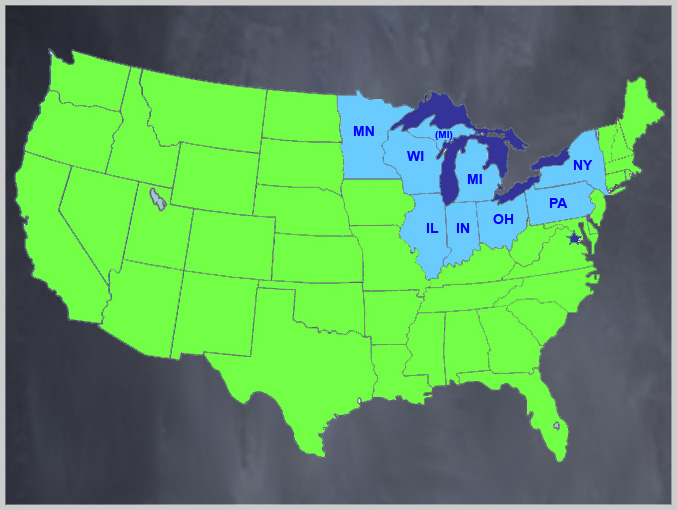
Great Lakes Water Compact
A 2008 agreement among the eight states bordering the Great Lakes that controls how water from the lakes can be used - with the goal being to preserve the lakes.
For more, visit www.GreatLakes.org/compact.
Great Recession
(Coming)
Green Card
An identification card for non-U.S. citizens showing they are allowed to permanently live and work in the country. They are issued by the Department of Homeland Security. Green card holders are referred to as permanent residents.
A few facts about green cards...
o They can be revoked
o They must be carried at all times
o They are not green (they used to be)
Greenhouse Gas
Gasses emitted into the earth's atmosphere that trap heat - increasing Global Warming.
Gross Domestic Product (GDP)
The Gross Domestic Product (GDP) is a measure of a country's overall economy. It is the total value of goods and services produced in the country over some time period (ex. in a year).
Two ways economists calculate GDP are...
o Expenditure Approach: Calculated by adding up total consumption, investment, government spending, and net exports (exports - imports)
The actual dollar amount isn't as important as the comparisons that can be made using GDP to help explain issues affecting the economy. For example...
o Because countries come in all sizes, a comparison often is made by dividing a country's GDP by its population. This is referred to as per-capita GDP
o Expenses (for things such as health care or defense) often are measured as a percentage of the GDP - in order to be compared with the amount other countries spend as a percentage of their GDP.
Guttmacher Institute
A nonprofit organization which works to advance reproductive health.
It was founded in 1968 as the Center for Family Planning Program Development, a division of Planned Parenthood. It became an independent nonprofit in 1977 and was renamed the Guttmacher Institute after the death of former Planned Parenthood president Alan Guttmacher.
Website: www.Guttmacher.org.
H-1B Visa
A temporary work permit that allows an immigrant to work in a specialty occupation. It requires a higher education degree.
Referenced by...Bill provides hard path to citizenship, easy path to tech companies (2013-May-23)
Hacking
An unauthorized attempt to exploit a computer system for an illicit purpose.
Hamilton, Alexander
The first U.S. Secretary of the Treasury, appointed by Pres. George Washington.
He also was one of the authors of the Federalist Papers.
Hard Money
(Coming)
Hate Crime
(coming)
Haze
Air pollution that obscures outdoor views.
Read more about haze at the Environmental Protection Agency website.
Head Start
A federal program that provides pre-school to children in low-income families.
You can found out more at the U.S. Department of Health and Human Services.
Health Care Provider
A person or organization that provides health care. Types of providers include doctors, clinics, and hospitals.
Health Resources and Services Administration (HHRSA)
Part of the Department of Health and Human Services (HHS). It is the primary federal agency for improving access to health care services for those with the least access.
HHRSA also is responsible for determining what types of preventive care should be covered in certain health plans under the Patient Protection and Affordable Care Act (PPACA).
Website: www.HHRSA.gov
Health Savings Account (HSA)
A Health Savings Account is a way for an individual (or family) to pay for their health care with money that is not taxed.
Here's how it works...
o The amount deposited can be deducted from the person's taxable income.... so they don't pay taxes on that part of their income.
o The money in the account can be used to pay for health care expenses. Though the money can only be used for health care expenses, the rules regarding what constitutes such an expense can be broad.
Health Savings Accounts provide the most benefits for those with the highest incomes, because those with the highest incomes...
o Pay the highest tax rates, meaning the tax savings would be much more significant to them.
Hedge Fund
Investment designed to make money regardless of whether the stock market rises or falls.
Hedge funds are made available to only wealthy investors. As a consequence, they are the least regulated by the Securities and Exchange Commission (SEC), under the presumption that these investors can handle the potential risks.
For more about hedge funds, read the Investopedia report.
Heritage Foundation
A think tank with the stated mission of "formulating and promoting conservative public policies based on the principles of free enterprise, limited government, individual freedom, traditional American values, and a strong national defense."
Website: www.Heritage.org.
High-Risk Pool
A health insurance plan available to those who cannot obtain health care insurance due to pre-existing conditions.
HIghway Trust Fund
A federal government fund that pays for approximately half of U.S. transportation projects, including roads, and bridges. It also helps pay to maintain public transportation systems. It was created in 1956 by the Federal-Aid Highway Act.
Most of the money for the Highway Trust Fund comes from a tax on each gallon of gasoline and diesel fuel.
For more on the Highway Trust Fund, see our discusion.
HIV
Human Immunodeficiency Virus - the virus the causes AIDS.
It can be transmitted through sexual contact, blood (transfusions, needle sharing), or from a mother to child - either in the uterus or through breast milk.
A person infected with the virus will have it for the rest of their life, though they might not develop AIDS.
HMO: Health Maintenance Organization
An organization that provides health care for its members. The providers (doctors, etc) are employed by the organization. The organization also owns the facililities such as hospitals that it uses.
Holman Rule
A rule of the House of Representatives allowing any representative to propose cutting any federal program or reducing any federal employee's salary to as little as $1.
The mechanism to do so would be propose an amendment to an appropriations bill. This means that even though it would require both House and Senate approval, it could avoid a filibuster in the Senate due to the budget reconciliation process.
Rep. William Holman proposed the rule in 1876 as a way to combat a system in which government jobs were given to supporters and family members of the winning party. That system was replaced by the 1882 Pendleton Civil Service Reform Act, though the Holman rule had intermittently remained in the House rules until 1983.
In 1946, the Supreme Court ruled an attempt to invoke the Holman rule unconstitutional.
For more, read the article in The Nation.
House of Representatives
The House of Representatives is one of two bodies of elected officials that comprise Congress (the other is the Senate). It is comprised of 435 voting members, divided among the states based on each state's population. A state has a minimum of 1 representative. With 53 representatives (each representing a congressional district), California has the most.
Representatives (also referred to as congressmen) are elected to a term of 2 years. Every 2 years, each House seat is up for re-election.
To create a law, each of these Houses of Congress (the Senate and House of Representatives) must approve identical bills (although most bills can originate in either House, the Constitution stipulates that bills involving appropriations must originate in the house). The bill then must be signed by the president to actually become a law.
Human Trafficking
An organized system of forced, fraudulent, or coerced subjugation of people, for the purpose of commercial sex or labor.
For more, visit the website for the Polaris Project
Hyde Amendment
Conditions attached to bills appropriating money for health care that prohibit the use of federal money to pay for abortions.
Most typically, the Hyde Amendment is used in bills that appropriate money for Medicaid.
It has taken several forms since first being introduced by former Rep. Henry Hyde in 1976. In its current form it allows federal money to be used for abortions only in the case where the mother's life is at risk, or where the pregnancy was caused by rape or incest.
Here is sample text of a Hyde Amendment from the 2014 budget bill...
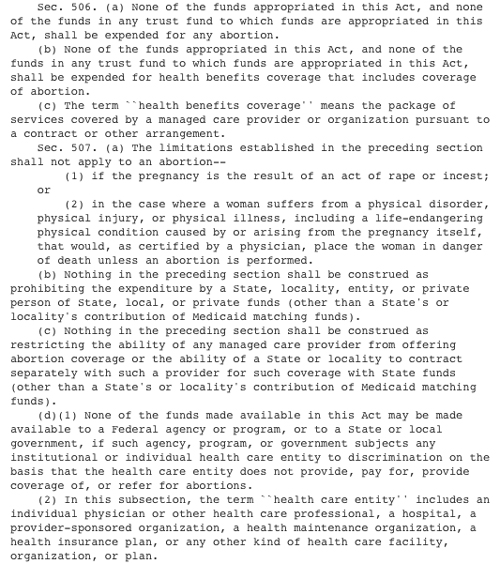
Identity Theft
The term identity theft has become the common term for when someone pretends to be you for criminal reasons.
Some of the fraudulent practices of identity thieves include...
o Filing a tax return using your Social Security Number, claiming a very large refund.
If someone does file a tax return as you, the following is likely to happen..
o When you file your return, the IRS will refuse to give you your refund - because they believe they already did.
o When the IRS does reconcile the fraudulent tax return with your income documents, they will demand that you reimburse them what they paid to the identity thief.
To learn more about the IRS's limited resources in fighting identity theft, read our discussion on IRS funding.
To learn more about identity theft, including what you should do if you think you're a victim, visit www.IdentityTheft.gov.
Immigration and Customs Enforcement (ICE)
Website: www.ICE.gov.
Impeachment
(Coming)
Income Tax Return
Each year by April 15 you must pay taxes based on your income in the previous year. You calculate the amount of your tax and report it Internal Revenue Service (IRS) on a form referred to as your income tax return.
The form helps you calculate your tax based on factors such as...
o How much you can deduct from that income in order to decrease the amount of your income tax.
That isn't when you actually pay your income tax though. If you're like most workers, you pay your taxes as a deduction from your regular paycheck (automatically done by your employer). The amount you pay is based on an estimate of how much income tax you'll owe at the end of the year.
When you fill out your tax return, what you actually are doing is reconciling the amount of your tax with the amount you paid throughout the year. This will determine whether you still owe money or are entitled to a refund.
Independence Day
(Coming)
Independence Hall
Building in Philadelphia, Pennsylvania where both the Declaration of Independence and the Constitution were debated and adopted.
Independent Agency
Federal agencies, commissions, and boards that are not controlled by the president or Congress.
Members are appointed by the president and approved by the Senate, but once appointed they usually can only be removed for good cause or when their term expires.
Independent agencies include...
o The Federal Elections Commission (FEC)
o The Environmental Protection Agency (EPA)
o The Federal Communications Commission (FCC)
Independent Payment Advisory Board (IPAB)
A government agency created by the Patient Protection and Affordable Care Act (PPACA) to reduce Medicare costs.
The agency would consist of 15 medical experts appointed by the president and confirmed by the Senate.
If Medicare spending exceeds predetermined thresholds, the board can act to reduce costs. The reduction cannot ration care, increase costs to recipients, or increase taxes. Congress can refuse the change - however it would need to come up with its own plan to cut those costs.
The IPAB would replace the Medicare Payment Advisory Commission (MedPAC), which can submit recommendations to Congress, but had no authority to enact changes on its own.
For more, read the The Hill story.
Click here to read the White House fact sheet.
Infrastructure
(Coming)
Initiative
A way in which citizens (usually at a state-level) can make laws that their elected representatives would not.
A typical process for an initiative is for a petition to collect enough signatures to place it on the ballot for an election. Citizens then vote for or against it. If the initiative passes, it becomes law.
Innocence Project
A nonprofit organization that works to exonerate wrongfully convicted people through DNA testing.
Website: www.InnocenceProject.org.
Inspector General
An official responsible for investigating an organization or activity.
Insurance Exchanges
Online (Web) marketplaces where you can compare and purchase health insurance policies that meet the requirements for the Patient Protection and Affordable Care Act.
The exchange lists the monthly premium for each policy. You might be eligible to have part of that premium subsidized (paid for) by the federal government. While on the exchange website, you can choose to provide basic information about your income to determine how much of a subsidy you are eligible for (many Americans will be eligible for at least some help).
The intent of the Affordable Care Act was that each state would set up its own exchange. While several states have done this, many have not. Residents of states without an exchange will be able to use one set up by the federal government. Also, a few states had technical difficulties with their exchange so they switched to the federal one.
If your state has its own exchange, you should use it. If not, you should use the federal site. Click here to find the site you should use.
Click here to understand more about the Affordable Care Act - including the health insurance exchanges.
Insurance Navigator
A trained person who helps consumers understand their options under the Obamacare, and helps them complete their eligibility and enrollment forms on their state's insurance exchanges.
Insurance: Actuarial Value
The percentage of a person's total healthcare costs that an insurance company expects to pay. As an example, for a policy with an actuarial value of 70, the insured person can expect to pay 30 percent of their healthcare costs.
Actuarial values are the basis for determining an insurance policy's metal level.
It's important to note that it is not an exact determination of how much you would pay. It's an average of what policyholders with that policy likely would pay. As a rule though, a plan with a higher actuarial value likely will have more expensive premiums, but cost you less for actual expenses.
Insurance: Coinsurance
Even if you have health insurance that covers expensive treatments, your insurance company typically will pay only part of the bill. The amount you pay is referred to as coinsurance.
For example, if your plan specifies a 20-percent coinsurance and your bill is $1,000, you would pay $200 (20 percent of $1,000).
Insurance: Copayment
A copayment is the amount you pay (typically $5 - $50) for a doctor's visit or some other health care service.
For example, if your insurance plan allows four office visits for routine care in a year with a $20 copayment, then you will pay $20 for each of the first four times you visit the doctor for routine care. After the fourth visit - or if you need something other than routine care - you will pay the full cost until you have spent the amount of your deductible.
Insurance: Cost-Sharing
The portion of the cost of your health care that insurance doesn't cover, such as deductibles and copayments.
The quality of a health insurance policy is measured by what percentage of the cost of your health care the policy would pay on the average. This is referred to as the policy's actuarial value.
Insurance: Deductible
An insurance deductible is the amount of your own money you will need to pay before your insurance begins paying for most services.
For example, if your plan has a $4,000 deductible and you get sick or injured, your insurance company will not pay the first $4,000 of your expenses. You will be responsible for that amount.
Insurance: Guaranteed Issue
Guaranteed Issue means you can't be denied a health insurance policy for reasons such as your health status (preexisting condition), gender, age, or other factors.
The 2010 Patient Protection and Affordable Care Act (Obamacare) requires guaranteed issue for any policy sold on the insurance exchanges.
Under Obamacare, insurance companies can charge more for some factors such as age, but not for others such as health status or gender.
For more on the relationship between guaranteed issue and Obamacare, visit ObamacareFacts.com.
Insurance: Lifetime Cap
The maximum amount an insurance company will pay to reimburse your health care over your lifetime.
Once the insurance company has paid that amount over your lifetime, they can terminate your policy. You then would be responsible for all of your health care expenses for the rest of your life.
Lifetime caps stopped being an issue in 2011, as the Patient Protection and Affordable Care Act (PPACA) prohibited them.
Insurance: Out-of-Pocket
The amount of something that you pay (i.e. out of your pocket).
Out-of-pocket expenses include deductibles and copayments.
For example, under the Patient Protection and Affordable Health Care Act, there will be $6,350 cap on out-of-pocket expenses for an individual's health care starting in 2015. That means that the most any individual will be required to pay of their own money for health care will be $6,350 in a year - regardless of how much their care (including prescription drugs) costs.
Note: Health care out-of-pocket maximums apply to money paid to health care providers, but not to premiums paid to insurance companies.
Related term: Cost-Sharing.
Insurance: Out-of-Pocket Maximum
The maximum amount of your own money you would need to pay for medical expenses covered by your insurance.
The amount usually is specified in terms of either a year or in a lifetime.
Insurance: Overhead
The amount of your health insurance premium that is not used to pay for health care benefits.
This includes company salaries, executive bonuses, advertising, lobbying, etc.
The premium you pay for a policy is based on the total benefits the company expects to pay out plus the overhead (typically 20 percent).
Insurance: Policy (or Plan)
An insurance policy or plan is a legal document that describes what your medical insurance will pay for, and how much it will pay.
A policy contains several components that determine how much of your own money you must pay for care you receive...
In addition, most policies restrict which providers you are allowed to visit in order to receive full benefits as described by the above terms. If you choose to use a provider not in your policy's network, the insurance company will pay less for your treatment (meaning you most likely will pay more).
Insurance: Premium
A premium simply is another word for what you pay for insurance.
For some types of insurance, premiums are paid yearly. For health insurance, premiums typically are paid monthly.
Determining health care insurance premiums
A health care insurance company calculates premiums by estimating the total benefits they expect to pay out, and then add an administrative overhead (typically 20 percent).
Insurance: Provider Network
A list of health care providers that are available to you under your health insurance policy.
Insurance: Recision
The practice by insurance companies of canceling an insurance policy after the insured person became seriously ill.
This was not supposed to happen, since this type of thing is exactly what insurance policies are meant to protect against. However, if a covered person did become seriously ill, the company would review the person's initial application, and use even the slightest error as justification for the cancellation.
The practice of recision was outlawed by the Patient Protection and Affordable Care Act (Obamacare).
Interest Rate
The primary cost of a loan.
In the simplest example, if you borrow $100 with a 5-percent interest rate, the cost of the loan would be $5 (you would pay back a total of $105).
Internal Revenue Service (IRS)
The agency responsible for collecting taxes, interpreting tax laws, and enforcing those laws. It is part of the Treasury Department.
For more, visit www.IRS.gov
International Court of Justice
(Coming)
International Franchise Association (IFA)
A trade association that advocates favorable laws and policies for large franchises.
The organization has...
o Fought to delay the employer mandate of the Patient Protection and Affordable Care Act (PPACA), and repeal the provision requiring businesses to provide health insurance for employees who work 30 hours a week. Read the introductory letter of their 2014 Annual Report.
o Sued Seattle in 2014 to try to block the city from treating franchises as large businesses under its new $15-an-hour minimum-wage law.
The IFA also is a member of the American Legislative Exchange Council (ALEC).
Website: Franchise.org.
International Monetary Fund (IMF)
(Coming)
Internet Service Provider (ISP)
(Coming)
IRS Form 990
Tax form that all nonprofit organizations must file each year. Large nonprofits must provide information such as income and compensation of their highest paid executives.
Part of the form - Schedule B lists donors who contributed more than $5,000.
Nonprofits must make their Form 990s available to the public. Want to view Lobby99's? Click here.
IRS Oversight Board
An independent body created by Congress in 1998 to improve how the Internal Revenue Service (IRS) serves taxpayers.
It currently consists of nine members...
o The Commissioner of the IRS
o 7 members appointed by the president to 5-year terms.
Website: www.treasury.gov/IRSOB
Jay, John
The first Chief Justice of the Supreme Court, appointed by Pres. George Washington.
He also was one of the authors of the Federalist Papers.
Jefferson, Thomas
Third president of the United States.
Jefferson is generally recognized as the author of the Declaration of Independence.
Jim Crow laws
Laws passed in southern U.S. states that established different rules for blacks and whites. They affected most aspects of life, including voting and where people of color could live, eat, and use public facilities such as transportation, schools, and parks.
The Jim Crow era began in the late 1800s. This type of explicit discrimination ended with a succession of Supreme Court decisions and laws, including...
o The 1964 Civil Rights Act
o The 1965 Voting Rights Act
For more on Jim Crow laws, read this article.
Johnson, Lyndon
Lyndon Johnson was the 36th president of the United States.
Joint Committee on Taxation (JCT)
A Congressional committee made up of members of both the House of Representatives and Senate that researches issues regarding taxation.
Website: www.JCT.gov.
Joint Resolution
A proposed law similar to a bill.
A joint resolution typically is not used to enact a law that will be incorporated into the U.S. Code. Rather, it usually is used to...
o Enact a continuing resolution (CR)
o Create temporary commissions
o Provide a temporary exception to an existing law
o Declare war
o Propose an amendment to the Constitution
The procedure for passing a joint resolution is virtually identical to that for passing a bill. Identical versions must be passed by both the House of Representatives and the Senate, and it must be signed by the president.
Joint Select Committee on Deficit Reduction
(Coming)
Justice in Aging
A nonprofit organization that fights poverty of senior citizens through legal advocacy.
Website: www.JusticeInAging.org.
Kaiser Family Foundation
A non-partisan nonprofit organization that researches issues focusing on U.S. health care policy. It is not associated with health care provider Kaiser Permanente.
Website: KFF.org
Kantar Media
An company that analyzes advertising in the media. Their Campaign Media Analysis Group analyzes advertising for political campaigns.
Kennedy, Anthony
Supreme Court justice since 1988.
Keystone XL Pipeline
(Coming)
King v. Burwell
2015 Supreme Court case to decide whether the intent of the Patient Protection and Affordable Care Act (PPACA) was to provide subsidies only to people in states that provide their own health insurance exchange.
Click here to read our discussion of this case.
Kislyak, Sergey
Russian ambassador to the United States.
Referenced by...Dozens of Trump aides lose top-secret clearances (2018-Feb-28)
Flynn pleads guilty to lying to FBI, may testify against Trump (2017-Dec-01)
Kushner omits Russian meetings on clearance application (2017-Apr-06)
House Intel Committee cancels Trump-Russia public hearing (2017-Mar-27)
House Intelligence Committee to hold public hearing on Russia (2017-Mar-07)
AG Sessions recuses self from Russia investigation (2017-Mar-02)
Nat'l Security Adviser Flynn resigns - what we know (2017-Feb-13)
Issue: Trump's Ties to Russia
Know Your IX
An organization that works with students and sexual-abuse survivors to eliminate sexual and dating violence in schools.
Its name comes from Title IX - the 1972 law guaranteeing equal protections in public education from all genders.
Website: www.KnowYourIX.org.
Kobach, Kris
Kansas Secretary of State 2011-present.
In 2017, Kobach was named by President Donald Trump to be vice chair of his Election Integrity Commission.
Kobach was one of the prime architects of Arizona SB-1070 - the 2010 Arizona law requiring police to determine the immigration status of someone arrested or detained when there is "reasonable suspicion" they are not in the U.S. legally.
Koch Brothers
Charles Koch and David Koch are the owners of Koch Industries.
The Kansas-based company makes much of its money in energy production, but subsidiaries also manufacture products with mainstream name brands, including Quilted Northern, Dixie, Brawny, Zee, Sparkle, and Stainmaster.
In 1980, David Kock was the Libertarian Party's vice-presidential candidate. The party's platform included abolishing...
o Medicare, Medicaid, and Social Security.
o The Occupational Safety and Health Act
o Minimum-wage laws
o Compulsory insurance or tax-supported plans to provide health services
o Laws requiring the use of "self-protection" equipment (safety belts, air bags, helmets).
o Welfare programs and other services to those with children and in poverty.
o Compulsory education
o Usury laws
The platform called for privatizing all public schools, roads, railroads, inland waterways, and "the distribution system that brings water to industry, agriculture and households."
It also called for eliminating these agencies...
o Environmental Protection Agency (EPA)
o Department of Energy (DOE)
o Department of Transportation (DOT)
o Federal Aviation Administration (FAA)
o Food and Drug Administration (FDA)
o Consumer Product Safety Commission
o U.S. Postal Service (USPS)
The Koch brothers have continued that mission of achieving those goals by contributing and raising billions of dollars for conservative organizations and to help the campaigns of Republican candidates for law-making offices. They were expected to spend almost $1 billion in the 2016 presidential election.
They also are strong supporters American Legislative Exchange Council (ALEC). A Koch Industries rep has served on ALEC's Private Enterprise Advisory Council for more than 20 years, and the company is believed be on of ALEC's biggest funders (although the group is not required to disclose its donors).
For more understanding about the Koch brothers, read this BillMoyers.com story.
The company's website is www.KochInd.com.
Ku Klux Klan (KKK)
(Coming)
Kushner, Jared
Ivanka Trump's husband.
Donald Trump made Kushner a senior adviser when Trump became president.
Dozens of Trump aides lose top-secret clearances (2018-Feb-28)
Trump attorney asked for Kremlin help on deal (2017-Aug-29)
Trump's son met to get Russian government info on Clinton (2017-Jul-10)
House Intelligence Committee to hold public hearing on Russia (2017-Mar-07)
Labor Day
(Coming)
Labor Force
The Labor Force is is made up of all people age 16 and over who are employed or unemployed.
League of Conservation Voters
A 501(c)(4) nonprofit organization that advocates for sound environmental laws and policies.
Among the ways it does this are working with the federal and local governments and supporting candidates who will support policies that protect the environment.
Website: www.LCV.org.
Leaking Underground Storage Tank Trust Fund
A fund that provides money to address petroleum releases from underground storage tanks that are regulated by the federal government. It is paid for by a 1-cent tax on each gallon of fuel.
Its functions include...
o Paying for emergency cleanups or cleanups where the owner or operator is unable to.
o Preventing leaks
To learn more about the Leaking Underground Storage Tank Trust Fund, visit www.epa.gov/oust/ltffacts.htm.
Legislation, Legislature
A legislature is a group with the power to make laws. In the United States, this can be Congress, or each house (Senate or House of Representatives) individually. At the state level, it can be state senates, assemblies, etc.
Legislation is a law that is passed by a legislature.
LGBT
Acronym for Lesbian, Gay, Bisexual, and Transgender. Other initials often are added for various alternative labels of sexuality.
A term generally used when referring to those seeking civil rights on the same level as those who are heterosexual.
Libertarian Party
A U.S. political party that advocates to minimize government involvement in public policy areas such as consumer protections and social programs.
Website: www.LP.org
Library of Congress
Website: www.loc.gov/
Logan Act
A law established in 1799 making it illegal for a U.S. citizen to negotiate policy with foreign governments without authorization.
The law reads...
Any citizen of the United States, wherever he may be, who, without authority of the United States, directly or indirectly commences or carries on any correspondence or intercourse with any foreign government or any officer or agent thereof, with intent to influence the measures or conduct of any foreign government or of any officer or agent thereof, in relation to any disputes or controversies with the United States, or to defeat the measures of the United States, shall be fined under this title or imprisoned not more than three years, or both.
This section shall not abridge the right of a citizen to apply, himself or his agent, to any foreign government or the agents thereof for redress of any injury which he may have sustained from such government or any of its agents or subjects.
Flynn pleads guilty to lying to FBI, may testify against Trump (2017-Dec-01)
Low-Income Home Energy Assistance Program
(Coming)
Madison, James
James Madison was the forth U.S. president.
Also...
o Was one of the authors of the Federalist Papers.
Manafort, Paul
Former campaign manager for Donald Trump. He left the campaign in August, 2016 due to his connections with Russia.
Referenced by...Former Trump campaign aides indicted for Ukraine deals (2017-Oct-30)
Campaign aide told Trump about Russian connections (2017-Oct-30)
Trump attorney asked for Kremlin help on deal (2017-Aug-29)
Trump's son met to get Russian government info on Clinton (2017-Jul-10)
Senate subpoenas documents on Russia (2017-May-10)
House Intel Committee cancels Trump-Russia public hearing (2017-Mar-27)
Paul Manafort proposed influence plan to Russia 10 years ago (2017-Mar-22)
Issue: Trump's Ties to Russia
Mandate
The Mandate is a term for the provision of the Patient Protection and Affordable Care Act that requires most Americans to have at least a minimum level of health care insurance.
Although a vital component of the health care law, the mandate has become such a controversial issue that we have devoted an an entire page to explain it.
Marginal Tax Rate
Different portions of your taxable income are taxed at different percentages. These were the income tax rates that you paid on your 2012 taxable income...
| 10% : | Only on the first $8,700 of taxable income |
| 15% : | Only on the portion higher than $8,700 and lower than $35,350 |
| 25% : | Only on the portion higher than $35,350 and lower than $85,650 |
| 28% : | Only on the portion higher than $85,650 and lower than $178,650 |
| 33% : | Only on the portion higher than $178,650 and lower than $388,350 |
| 35% : | Only on the portion higher than $388,350 |
To see how it actually works, watch this short video...
The highest tax rate someone pays (i.e. the percentage on the chunk of their income above a certain level) is known as their marginal tax rate.
Again, keep in mind that nobody pays the marginal tax rate on all of their income. So when someone mentions a top (i.e. marginal) tax rate, they're talking about the rate paid only on the top portion of income.
McCain-Feingold Act
The Bipartisan Campaign Reform Act (usually referred to as McCain-Feingold) sets restrictions for contributions to campaigns for federal offices.
Click here to read our discussion of the law.
Medicaid
A program that provides health care for those with low income. Each state runs its own Medicaid program, which is funded by both federal and state taxes.
Related term: Entitlement
Medicaid Expansion
The provision of the Patient Protection and Affordable Care Act that provides virtually free health care to those who earn less than the Poverty Level.
It does this by having the federal government pay each state to expand its Medicaid program. The federal government would cover 100 percent of the states' costs through 2016 and at least 90 percent on a permanent basis.
In the 2012 Supreme Court decision National Federation of Independent Business v. Sebelius, the majority of justices ruled that the federal government could not force states to accept expanded Medicaid.
As of 2016, more than 14 million people in just over half of the U.S. states receive health care due to Medicaid Expansion.
The rest of the states have rejected Medicaid Expansion - leaving many of their poorest residents without health care coverage.
For more about Medicaid Expansion and other parts of the Patient Protection and Affordable Care Act, see our discussion.
Medicare
The government-run health insurance program that serves primarily those 65-years-old and older.
Related term: Entitlement
Website: www.Medicare.gov.
Medicare For All
A term used to describe a single-payer health care system that would cover all Americans.
Medicare Payment Advisory Commission (MedPAC)
Website: www.MedPAC.gov.
Memorial Day
(Coming)
Metal Level
Health care plans available under the Patient Protection and Affordable Care Act are classified by the level of benefits they provide. The levels are determined by actuarial value. These classifications are..
o Silver (Actuarial Value at least 70 percent)
o Gold
o Platinum: The policies with the highest premiums. You will pay more up front, but if you require significant medical care, you will pay less out-of-pocket with these plans.
Because these classifications are named for metals, they often are referred to as metal levels.
Microbead
A tiny plastic particle (typically smaller than a millimeter) used in cosmetic products such as liquid soap and toothpaste - generally added for exfoliation.
Because most of their use is for personal cleansing, they end up in bodies of water.
They were banned in the United States starting in 2017.
For more about microbeads , read this Canadian government report.
For more about microbeads in cosmetics , read this United Nations report.
Microbeads in soaps and cosmetics banned (2015-Dec-31)
Microplastic
Tiny (smaller than 5 millimeter) bits of plastic that are the byproducts of other products containing plastic.
Some estimates have predicted there to be more than 200 thousand tons of microplastics in the world's oceans. Sources of this microplastic pollution include...
o Tire dust that gets washed into sewers.
o Paints, such as dust from road markings.
o Larger pieces of plastic such as forks, straws, bags, takeout containers, and beverage bottles in waters that break apart into smaller and smaller pieces.
o Microbeads from personal cleansing products.
To read about some of the harm that can come from microplastics, read this National Geographic story.
Mine Safety and Health Administration
Agency of the Department of Labor (DOL) that works to prevent illness, injury, and death from mining.
Website: www.MSHA.gov.
Minimum Wage
The minimum amount that an employee must be paid for an hour of work.
There are some employees who are not required to be paid the minimum wage, such as restaurant workers who receive tips.
The federal minimum wage has been increased several times over the years. See this chart for a list of all the changes.
Note: When Lobby99 discusses policies concerning the minimum wage, we are referring to the federal minimum wage. Individual states may enact laws that set a minimum wage higher than the one set by the federal government.
For more about the minimum wage, read the our discussion of the issue.
Money Laundering
Taking money obtained from criminal activity (dirty money) and "laundering" it to make it appear as though it were legally obtained (clean money).
Criminals use a variety of methods, including real estate purchases, cash smuggling to offshore banks, and deposits in businesses that deal in large amounts of cash. They often use shell companies and complicated layers of financial transactions to disguise the true source of the money.
Methods of money laundering have interesting names. They include...
Mirror Trades
The scheme requires the cooperation of the bank involved. Here's how it works...
o Almost immediately after, a non-Russian client sells the same amount of the stock in a branch outside of Russia - receiving payment in (clean) dollars.
In reality, the two clients are the same.
Global Laundromat
This scheme involves two shell companies and another cooperating company.
One shell company lends (dirty) money to the other. The loan is guaranteed by the third company. When the borrowing company defaults on the loan, the lending company sues. A court then orders the insuring company to pay the lending company the (clean) amount that was guaranteed.
Monopoly
A situation in which there is only one entity that provides a service or product - thus they have no competition.
For the purposes of our discussions here, there are two basic types of monopolies...
o Public monopolies (such as those run by a government) exist to serve the people. They have the opposite goal... to provide the best "product" at the lowest price.
Of course public monopolies don't always do the best job, but there's nothing to substantiate that professionals employed by a private company would do any better of a job than professionals employed by the government. They merely have different employers
Montana Voter and Candidate Pledge
A statement of policy written by conservative activists in Montana. They ask candidates for state office to sign it.
Among the policies that those signing the document agree to...
o Sell state lands... with the revenue used to reduce income and property taxes.
o Privatize entitlement programs and state pensions and remove them from the state budget.
o "Remove all Federal, U.N., and foreign influences from Montana public education", while moving toward charter schools, home schooling, educational savings accounts, and "alternate teacher certification".
o Oppose agencies of the Department of the Interior (DOI), including the Bureau of Land Management (BLM), "United States Park Service", and the U.S. Fish and Wildlife Service (FWS).
The pledge's first paragraph is an agreement to resign their office if they "fail to keep their promise of fidelity to the terms of this Pledge."
For more about the Montana pledge, read the Missoulian story.
Click here to read the document
Mortgage
A loan used to buy property such as a house. It typically is paid back over many years (for example, a 30-year mortgage used to buy a house).
Mortgage Backed Security
When an investment bank or Government Sponsored Enterprise buys a bundle of mortgages from a lender, they in turn sell shares of those mortgages to investors. These investments are backed by the value of the property the mortgages are for. They therefore are called mortgage backed securities.
Theoretically, they are safe investments because they are made up of many mortgages. If only a few borrowers defaulted, there still would be enough pay investors their profit.
A few things happened however, that contributed to 2006 mortgage crisis (this is not the complete story, but we're presenting a small slice of it here to help understand mortgage backed securities)...
o The bad loans were packaged into mortgage backed securities. Rating agencies (who are paid by the investment banks) rated the securities highly.
o Many borrowers whose mortgages were part of the security could not make their payments, while property values fell. Therefore the securities that investors bought became worthless.
Mortgage Insurance Premium (MIP)
An insurance premium on mortgages backed by Federal Housing Administration (FHA) insurance. The premium is paid by the homeowner.
Motion to Proceed to Consider
Usually called a motion to proceed, it is a proposal in the Senate to bring a bill up for consideration when there is opposition to the bill.
Because the motion to proceed is itself open to debate, it can be subject to a filibuster.
Mueller, Robert
Federal Bureau of Investigation (FBI) director from 2001 - 2013.
In May 2017, after President Donald Trump fired FBI Direct James Comey, Deputy Attorney General Rod Rosenstein appointed Mueller be special counsel overseeing the investigation into Russian influence in the 2016 presidential election.
Indictment: American demonstrators duped by Russians (2018-Feb-22)
Trump ordered Mueller fired. White House counsel refused (2018-Jan-25)
Senate bills would make it hard for Trump to fire Mueller (2017-Aug-03)
Special Counsel to investigate Trump-Russia connection (2017-May-17)
Must-Pass Legislation
A bill that if not passed will result in a significantly detrimental situation. These bills usually are those that fund large programs or agencies, so that if the bill does not pass funding for these programs or agencies would stop once the existing funding expired.
Often Congress will attach a rider to a must-pass bill as a way to enact a controversial provision that either would not pass Congress or be signed by the president on its own.
NAACP
The National Association for the Advancement of Colored People (NAACP) is a nonprofit organization whose stated mission is "to ensure the political, educational, social, and economic equality of rights of all persons and to eliminate race-based discrimination."
Website: www.NAACP.org.
National Aeronautics and Space Administration (NASA)
Government agency that manages the United States space program.
Website: NASA.gov
National Archives
Website: www.archives.gov
National Association of Realtors (NAR)
Website: www.nar.realtor.
National Center for Transgender Equality
Organization that works to end discrimination and violence against transgender people.
Website: www.TransEquality.org.
National Centers for Environmental Information
Website: www.NCEI.NOAA.gov
National Climate Assessment
You can learn more about the National Climate Assessment at the federal government's climate information website.
National Coalition for Men (NCFM)
Organization stating it is "dedicated to the removal of harmful gender based stereotypes, especially as they impact boys, men, their families and those who love them."
According to its website, the organization addresses issues such as pay inequality between genders, domestic violence against males, and false accusations of rape.
Website: www.NCFM.org.
National Conference of State Legislatures (NCSL)
A non-partisan organization that provides information to state legislators to help them evaluate policy options.
All state legislators and their staff members are members.
Website: www.ncsl.org.
Click here to read a comparison between the NCSL and the American Legislative Exchange Council (ALEC)
National Constitution Center
A nonprofit organization established by Congress to "disseminate information about the United States Constitution on a non-partisan basis in order to increase the awareness and understanding of the Constitution among the American people.".
The Constitution Center Museum is located in Philadelphia, Pennsylvania near Independence Hall.
Website: ConstitutionCenter.org.
National Consumer Assistance Plan
An agreement announced in March, 2015 between the three major credit reporting agencies to make credit reports more accurate and help consumers correct errors in their credit information.
National Do Not Call Registry
A list of phone numbers that telemarketers are not allowed to call. It was implemented in 2004 as a result of the 2003 Do-Not-Call Registry Bill.
Even if you register your phone number, some calls still are permitted...
o Calls which aren't trying to sell you something
o Calls by (or for) non-profit organizations.
The list is primarily for residential landline phones. Companies are not permitted to call mobile phones (though you still may add a mobile phone number to the list). Once you add your phone number to the list, it will remain there until you remove it or no longer have that phone number.
To add your phone number to the National Do Not Call Registry (or to register a complaint), visit www.DoNotCall.gov.
To learn more about the National Do Not Call Registry, read this Federal Trade Commission article.
National Economic Council
(Coming)
National Guard
A reserve force of the U.S. military. It is organized by state.
Members typically live as civilians, serving one weekend per month. But they can be called at any time (either by the president or their state's governor) to deal with domestic emergencies or overseas combat missions.
Also see Army Reserve.
Website: www.NationalGuard.com.
National Highway Traffic Safety Administration (NHTSA)
The NHTSA is the federal agency responsible for regulating cars and other motor vehicles. Issues the agency deals with include...
o Fuel economy
o Car-theft prevention
o Consumer information
The NHTSA was created by the 1970 Highway Safety Act, and is part of the Department of Transportation.
For more, visit their website at www.nhtsa.gov.
National Instant Criminal Background Check System (NICS).
(Coming)
National Institutes of Health (NIH)
An agency of the Department of Health and Human Services (HHS) that performs health-related research.
It is made up of more than 25 separate organizations called Institutes and Centers.
Website: www.NIH.gov.
National Labor Relations Act
1935 law that protects the rights of private sector employees to form or join a union and to bargain collectively.
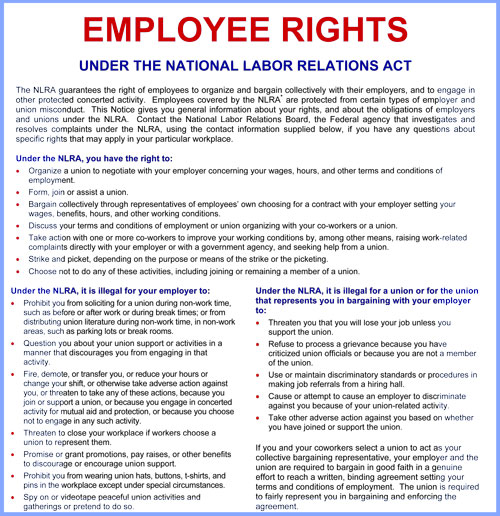
Graphic source: U.S. Dept. of Labor
Click on the above poster for a larger version.
National Labor Relations Board (NLRB)
Federal agency created to prevent unfair labor practices and resolve disputes between labor unions and companies. It ensures that employers follow the provisions of the National Labor Relations Act.
The agency is run by five members, each appointed to a 5-year term.
For more information, visit www.NLRB,gov.
National Monument
An area of land - considered to be of archeological, scientific, or historic interest - owned by and protected by the federal government.
The 1906 Antiquities Act gave the president the authority to designate federal lands as national monuments.
They are similar to national parks, except national parks are designated by Congress.
Lands designated as national monuments cannot be leased for activities such as mining, drilling, logging, or ranching. However, if these activities were taking place at the time a president declares the land a national monument, they normally can continue.
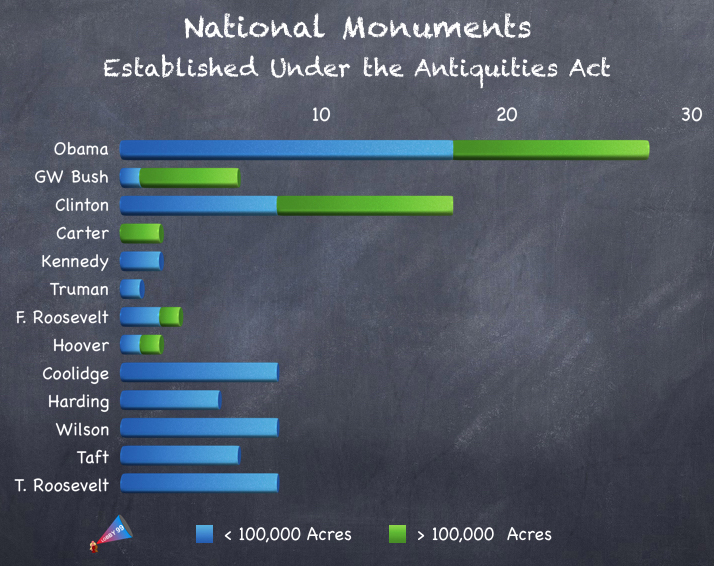
Data Source: National Parks Conservation Association (via fivethirtyeight.com)
National Monument: Bears Ears
A 1.35 million acre area in Utah. Indigenous people lived on the land for thousands of years, leaving artifacts that date back 5,000 years. It also is a recreational visitor attraction.
Bear Ears also leases land for grazing and oil and gas extraction.
In Dec. 2016, President Barack Obama invoked the Antiquities Act to designate it a national monument. That means existing leases can continue, but no new leases can be issued.
In 2016, Rep. Rob Bishop introduced an alternative plan that would allow for mineral extraction, energy development, and road construction at Bears Ears.
For a local look at Bears Ears National Monument, read this Telluride News story.
Referenced by...Trump orders review of National Monuments (2017-Apr-26)
National Monument: Grand Staircase-Escalante
A national monument in Utah.
It was established in 1996 by President Bill Clinton under the 1906 Antiquities Act.
Click here for a look at Grand Staircase-Escalante National Monument.
National Oceanic and Atmospheric Administration (NOAA)
Website: www.NOAA.gov
National Park
An area set aside by the federal government for conservation.
National parks are designated by Congress, as opposed to national monuments, which are designated by a president.
National Park Service
Website: www.NPS.gov
National Parks Conservation Association (NPCA)
A nonprofit whose mission is to protect U.S. national parks.
Website: www.npca.org.
National Registry of Exonerations
A project of the University of Michigan Law School that provides details of every known exoneration (a case in which a person was wrongly convicted of a crime and later cleared of all the charges based on new evidence) in the United States since 1989.
Website: www.law.umich.edu/special/exoneration/Pages/about.aspx.
National Rifle Association (NRA)
Website: home.NRA.org
Referenced by...Trump loosens restrictions on elephant hunting (2018-Mar-05)
National School Lunch Program
A federal program that reimburses public and non-profit private schools for providing nutritionally balanced meals to children.
Children from families with incomes less than 130 percent of the federal poverty level can receive free lunches. Those from families with slightly higher incomes can receive lunch for approximately a half-dollar.
For more, visit www.fns.usda.gov/nslp/national-school-lunch-program-nslp.
National Security Adviser
The senior advisor to the President on issues regarding national security.
The formal title of the position is Assistant to the President for National Security Affairs.
National Security Agency (NSA)
Website: www.NSA.gov
National Security Council
The President's primary forum for considering national security and foreign policy matters.
It is chaired by the President. Attendees include the...
o Secretary of State
o Secretary of Defense
o Secretary of the Treasury
o Chair of the Joint Chiefs of Staff
o Director of National Intelligence
o National Security Advisor
Website: www.whitehouse.gov/administration/eop/nsc.
National Taxpayer Advocate
(Coming)
National Trade Council (NTC)
A White House office created in 2017 by newly-elected President Donald Trump. It is unclear at this time what role the NTC will play.
National Women's Law Center (NWLC)
Organization that advocates for women's rights
Website: www.NWLC.org.
Natural Resources Conservation Service (NRCS)
Agency of the U.S. Department of Agriculture (USDA) that provides technical assistance to farmers and other land managers.
It formerly was called the Soil Conservation Service.
Website: www.NRCS.USDA.gov.
Natural Resources Defense Council (NRDC)
Website: www.NRDC.org
Net Neutrality
In simplest terms, net neutrality is your ability to reach any online service you want without interference from your internet provider.
New Deal
(Coming)
Nixon, Richard
(Coming)
Non-Governmental Organization (NGO)
A not-for-profit organization that operates independent of any country.
Many NGOs perform humanitarian work.
For more, visit www.NGO.org.
Nonprofit Organization
An organization that operates to work toward some cause, rather than to make a profit. To become a nonprofit, an organization must become certified by the IRS.
A few typical features of nonprofit organizations...
o All money they receive must be used in a way that's consistent with the organization's stated cause, including paying employees and consultants.
o Any money not spent cannot be distributed to executives or others. It must remain in the organization to be used toward the organizations's cause.
o They must file an annual report on their major expenses - including the salaries of their highest paid executives.
There are several categories of nonprofits - named for the section of the tax code that defines them. Common ones include...
Charities are 501(c)(3) nonprofits. Donations to these nonprofits usually are tax-deductible. They are restricted in the types of political activity they can engage in - which is typically limited to advocating causes directly related to their organization's mission.
o 501(c)(4)
A nonprofit organization whose major activities involve lobbying and advocacy. Although 501(c)(4) nonprofits are exempt from paying federal taxes, donations to them are not tax-deductible. A 501(c)(4) nonprofit organization is expected to operate primarily for promoting social welfare. Although influencing elections is not considered to be part of that, IRS rules are vague and enforcement has been minimal.
Lobby99 is a 501(c)(4) nonprofit. Lobby99 does not endorse or support any candidate or political party in any way. Rather, we advocate for policies that would benefit the overwhelming majority of Americans and explain issues. We also make it easy to see how well your elected representatives are actually representing your interests, in order to help you decide your vote. This is in accordance with the strictest definition of social welfare.
Nonprofits are surreptitiously used by some to channel anonymous campaign contributions to a Super PAC working toward a candidate's election. To understand how this happens, watch this 2-minute video...
Notice of Proposed Rulemaking (NPRM)
A notice that announces the intent of a federal agency to implement a new rule or regulation. The notice typically includes the opportunity for public comment.
NPRMs are published in the Federal Register. However, a simpler way to learn about them - as well as provide your comments during the allowed comment period - can be found at www.Regulations.gov.
If an agency decides to make significant changes to a rule before it becomes final, it will issue a Supplemental Notice of Proposed Rule Making (SNPRM). This will require an additional comment period.
Nuclear Option
Senate rules normally require 60 votes (out of 100 senators) to overcome a filibuster.
Senate rules also, however, can be changed with a simple majority vote. Therefore, one way the Senate can overcome a filibuster without the required 60 votes is to simply change the rules to require only 50 votes to overcome it.
This has become known as the nuclear option.
Although the rules change has been referred to as the nuclear option, it is a legal option that has been used several times in the past - including to eliminate the filibuster from the House of Representatives. Click here to read a detailed (yet easily readable) report that discusses both the tactics and how they have been used in the past.
To read more about the real consequences to American citizens from obstructing legislation and presidential appointments, read this report from the Center for American Progress.
Nuclear Regulatory Commission (NRC)
Website: www.NRC.gov
Obama, Barack
Barack Obama is the 44th United States president. He was elected in 2008, and re-elected in 2012.
Obamacare
Name given (originally meant to be derogatory) for the 2010 Patient Protection and Affordable Care Act
Occupational Safety and Health Act
1970 law enacted to provide a safe workplace environment for workers. It created the Occupational Safety and Health Administration (OSHA).
Click here for more details on the bill.
Occupational Safety and Health Administration (OSHA)
Agency of the Department of Labor (DOL) that sets and enforces workplace safety standards.
It was created by the 1970 Occupational Safety and Health Act.
Website: www.OSHA.gov.
Office of Compliance (OOC)
Federal agency created by the 1995 Congressional Accountability Act (CAA). The agency administers the workplace protections for Congressional offices that the act provides for.
Website: www.Compliance.gov.
Referenced by...TX Rep. Farenthold paid settlement with public money (2017-Dec-01)
Office of Congressional Ethics (OCE)
The Office of Congressional Ethics of the House of Representatives is an independent agency that reviews allegations of misconduct against representatives and their staffs.
If further investigation for possible charges is needed, the OCE refers the complaint to the House Ethics Committee. Even if the committee decides to take no action, the report from the OCE still is made public.
The is no such office for the Senate. The Executive Branch has a related office - the Office of Government Ethics (OGE).
Website: oce.house.gov.
Office of Government Ethics (OGE)
The Office of Government Ethics advises the president and his or her administration on issues in which there might be a conflict of interest.
The OGE has no investigative or enforcement authority. It acts mainly in an advisory role to help prevent conflicts of interests from arising.
It was created by the 1978 Ethics in Government Act.
This differs from the Office of Congressional Ethics (OCE) for the House of Representatives, which investigates ethics complaints against representatives and their staffs.
Website: www.oge.gov.
Office of Management and Budget (OMB)
Website: https://www.Whitehouse.gov/omb.
Office of National Resources Revenue (ONRR)
The Office of National Resources Revenue is part of the Department of the Interior (DOI).
When a company such as an energy or mining company leases land from the U.S. government, this is where they send the money.
Website: www.ONRR.gov.
Office of Personnel Management (OPM)
The government independent agency that oversees the recruitment and employment policies of the federal government.
Website: www.opm.gov
Office of the Inspector General (OIG)
Part of a government department or agency that monitors that agency for fraud, abuse, or other mismanagement.
Ombudsman
A representative of an organization (either public or private) who represents the interests of the organization's constituents (such as internally investigating a complaint about how the organization operates).
Omnibus Legislation
A bill that deals with several subjects and programs.
Open Enrollment
A period of time that anyone can enroll in or change their health care insurance. After an open enrollment period, it still may be possible to obtain insurance under certain conditions, such as a change in family or employment.
Opposition Research
Investigations against a political opponent to find information that can be used against them in a campaign.
Orb Media
A news organization that reports on global issues such as the environment, education, health, and governance.
Website: OrbMedia.org.
Organic Act
A law that establishes a U.S. territory or an agency to manage federal lands.
Outer Continental Shelf Lands Act (OCSLA)
1953 law the defines U.S. coastal waters and their management.
You can read more about the law at the the Bureau of Ocean Energy Management website.
Overtime
Hours worked in a week by an employee in excess of 40 hours.
The 1938 Fair Labor Standards Act (FLSA) requires most employees to be paid 1-1/2 times their regular rate for any overtime hours they worked....
"... no employer shall employ any of his employees... for a workweek longer than forty hours unless such employee receives compensation for his employment in excess of the hours above specified at a rate not less than one and one-half times the regular rate at which he is employed."
A 2013 Congressional Research Service (CRS) overview of the FLSA states that, "The purpose of the overtime provision is to reduce unemployment by encouraging employers to hire more workers, rather than requiring current employees to work more than 40 hours per week and pay the premium overtime rate."
Click here to read the CRS overview.
PAC: Political Action Committee
An organization that raises money for the purpose of electing (or defeating) candidates to a federal office (House of Representatives, Senate, President).
Election laws set limits on how much an individual can contribute to a PAC. Corporations and labor organizations cannot directly contribute to most PACs.
Page, Carter
Former member of Donald Trump's presidential campaign.
Referenced by...Dozens of Trump aides lose top-secret clearances (2018-Feb-28)
Testimony further debunks Trump dossier narrative (2018-Jan-11)
Senate subpoenas documents on Russia (2017-May-10)
Issue: Trump's Ties to Russia
Papadopoulos, George
Foreign policy adviser to Donald Trump's 2016 presidential campaign.
In Oct. 2017 he pleaded guilty to lying to the FBI about meetings he had with Russian contacts. He had said those meetings took place before his involvement with the Trump campaign.
He agreed to cooperate with the investigation into Trump's Russian connections.
Testimony further debunks Trump dossier narrative (2018-Jan-11)
Campaign aide told Trump about Russian connections (2017-Oct-30)
Paris Climate Change Agreement
The main product of a 2015 conference in which 195 countries agreed to limit greenhouse gas emissions in order to limit the Earth's temperature rise
It went into effect on November 4, 2016.
Parliamentarian
An official advisor to a governing body who interprets the rules of that body to ensure they are followed.
The parliamentarians of the Senate and House of Representatives are non-partisan. They act in an advisory role only, and can be overruled.
Click here to visit the official website of the House of Representatives Parliamentarian.
For more on the role of the House and Senate parliamentarians, read this Congressional Research Service report.
Pass-through Company
A company whose income is reported on the owner's individual income tax return.
In other words, the income is passed through from the company to the owner.
Patient Protection and Affordable Care Act
A 2010 law that allows millions of previously uninsured Americans to obtain health care coverage. Many were unable to afford insurance, many could not obtain coverage due to an existing illness. This law is often referred to as Obamacare.
Click here to read our discussion of the bill.
Payday Loan
A short-term loan typically used to cover a temporary need - such as an emergency car repair or a smaller than usual paycheck due to an irregular work schedule.
Payday loans also are referred to as cash advance loans, deferred deposit, and deferred presentment loans - depending on the laws in a particular state.
For a more in-depth explanation of payday loans, read our discussion of this issue
Payment Card
A plastic card that allows you to buy things without using cash. There are a few basic types of these cards. Transactions with them appear to work the same, but the ways they process your money differ.
Debit Card: A debit card uses money you already have in a bank account. When you pay for something using s debit card, the purchase amount is subtracted (debited) from the account associated with the card. You still may receive a monthly statement, but you won't owe any money because the amount of each purchase was taken out at the time of the purchase. The exception to this is that a bank may allow you to purchase more than you have in your account - in which case you will be charged a fee, as well as being required to pay interest on the amount the bank paid for you.
Prepaid Card: Similar to a debit card, a prepaid card has a certain amount of money associated with it. For example, you might use a prepaid card for money you receive from the government. Instead of sending you a payment, the government simply adds the amount to the balance on your card. When you buy something, the value of the card is reduced by the purchase amount. You can learn more about prepaid cards at the Consumer Financial Protection Bureau website.
In recent years, cashless purchases do not necessarily require an actual card. You can, for example, pay for something with a credit card linked to your mobile phone. You simply hold the phone over an electronic reader, and the transaction is processed as if you had used a physical credit card.
Pell Grant
A federal subsidy for low-income students to attend college.
Pell Grants formerly were called Basic Educational Opportunity Grants (BEOG).
For more, visit ed.gov/programs/fpg/.
Pendleton Civil Service Reform Act
1882 law that created the Civil Service System and prohibited government jobs from being dependent on political support.
Click here for our discussion.
Pension
A pension is money paid in regular intervals (monthly, for example) to someone who retires from a company (if the provides a pension).
Pensions effect those who receive them, but they also can affect the average American in obscure ways. Therefore, it's important to have a basic understanding of where the money to pay pensions comes from.
Companies that provide pensions to their employees create a separate fund that will pay when they retire...
o They don't need to pay the full amount that will be needed, because the money they pay will earn interest to make up the difference. The higher the interest rate the company assumes the money will earn, the less it actually needs to put in.
o If the actual interest earned is less than the company anticipated (meaning they didn't put enough money into it), there might not be enough money in the fund to pay retirees the amount promised. Such pensions are labeled underfunded.
Companies are required to pay the full amount of pensions unless they go bankrupt. Congress passed the Employee Retirement Income Security Act in 1974 and the Pension Protection Act in 2006 to protect pensions of retirees.
Pensions do not require a contribution by employees. In recent times, many companies have switched to retirement plans such as 401-K plans that are based on contributions by the employee.
Pension Benefit Guarantee Corporation (PBGC)
A Government Owned Corporation that takes over the paying of pensions to retirees when a company's pension fund is inadequate to pay the pensions it owes to retirees. One way this can happen is the pension is underfunded and the company becomes bankrupt.
It was created in 1974 by the Employee Retirement Income Security Act (ERISA).
There are limits to the the amount a retiree may receive. Therefore a retiree whose pension has been taken over by the PBGC might lose part of their pension.
The PBGC is funded by the companies it insures - through premiums and the money left in pensions it takes over. However, if it should run out of money because it is paying more in pensions than it has, there would be two options...
o Make up the difference with money from the federal government. In other words, your tax dollars.
* Bonus Material: You might read about two different funds the organization maintains. The single-employer fund guarantees pensions from individual companies. The multiemployer fund guarantees pensions sponsored by unions which can involve several companies.
Website: www.PBGC.gov
Pension Smoothing
When a company puts money into a pension that eventually will pay its retirees, it doesn't put in all the money it will need. That's because it is assumed that the money will earn interest, so that by the time the pension needs to pay retirees, it will have grown into the needed amount.
The amount a company needs to put in is determined by the interest rate the company expects to earn on the money. If it assumes it will receive a higher interest rate, it can put less into the pension. To ensure that a company puts enough into a pension to cover its future obligations to retirees, the government determines the maximum interest rate a company can assume.
Pension Smoothing is a government policy that effectively allows a company to assume a higher interest rate for a certain number of years, so it does not need to put as much into its pension. It makes up for this by requiring greater contributions in later years, so theoretically the amount contributed eventually would be sufficient.
Why is this done?
Congress has used pension smoothing twice in recent years to pay the federal government's portion of transportation projects. Because companies pay less into their pensions, they have higher profits and therefore pay more in taxes.
Who else benefits?
Higher profits for a company can mean greater compensation for that company's executives.
So what's the problem?
There are several problems associated with Pension Smoothing. One problem is that even though tax revenues increase in the early years of a Pension Smoothing program, they decrease in later years as companies must make up the difference by paying more into pension plans - therefore lowering their taxable income (and taxes). If those reduced revenues aren't made up by some other means (for example by higher corporate or individual tax rates), government services will need to be reduced.
This chart shows the estimated effect of pension smoothing as called for in the 2014 Highway and Transportation Funding Act.
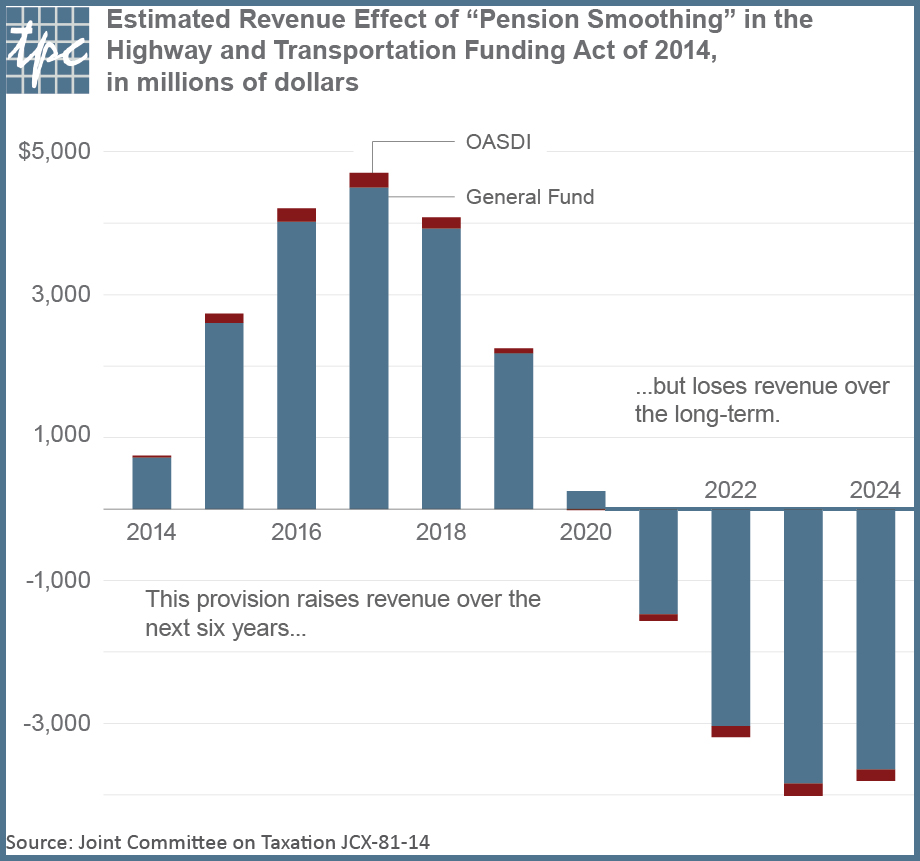
Another problem comes up if the company becomes bankrupt before it can pay the higher contributions. Its pension fund will not have enough to pay the pensions it owes. See our discussion of the Pension Benefit Guaranty Corporation for more on how this would be resolved (hint... it may be you who pays for it).
People-to-People
A way for individuals to plan their own trips to Cuba.
Even after President Barack Obama legalized travel to Cuba in 2015, travel for tourism still was prohibited. But an U.S. citizen can plan people-to-people visits - ostensibly to learn about Cuban life and discuss American life with Cubans. Though there is an expectation that the traveler would keep logs of their business activities and who they talk with there, there is no indication that this requirement would be enforced.
For more, read this Washington Post article.
Referenced by...Trump reinstates Cuba travel restrictions (2017-Jun-25)
Americans now allowed to visit Cuba (2015-Jan-15)
Per Capita
For each person
In terms of government programs, it could mean for each person eligible for that particular program.
Petroleum classifications
Crude oil is classified as either sweet or sour, depending on how much sulfur it contains.
Sweet crude oil - which contains less than 1/2 percent sulfur - is easier to refine and safer to transport. It costs more than sour petroleum.
The sulfur in sour crude oil can cause health problems. At low concentrations, it gives the oil the smell associated with "rotten eggs". At larger concentrations, it can be fatal.
Pew Charitable Trusts
Website: www.PewTrusts.org.
Physician Payments Sunshine Act (PPSA)
A section (6002) of the Patient Protection and Affordable Care Act (Obamacare) requiring drug and health care device makers to disclose money or gifts they provide to health care providers.
Health care providers also are required to disclose any ownership interests they have in these companies.
For more, read the Health Affairs brief.
Website to view disclosures: www.cms.gov/openpayments
Planned Parenthood
A nonprofit organization that provides information and services relating to reproductive issues and children's health.
Website: www.PlannedParenthood.org
Plessy v. Ferguson
1896 Supreme Court ruling that racial segregation did not necessarily constitute unlawful discrimination.
The ruling allowed states to enforce laws that provided separate accommodations for blacks and whites. This included education, public transportation, and recreational facilities.
For more, read our discussion of the case.
Political Action Committee (PAC)
An organization that solicits contributions and uses the money to campaign for or against candidates or proposed laws.
Political Party
(Coming)
Pollution sources
The Environmental Protection Agency (EPA) classifies air pollution by its source...
o Mobile (i.e. cars, trucks, planes)
POTUS
Acronym for President Of The United States
Poverty Level
The federal poverty level is an estimation of what it would cost in a year to meet basic needs such as food and housing.
It is used to determine eligibility for programs such as the Supplemental Nutrition Assistance Program (SNAP), Head Start, the National School Lunch Program, the Low-Income Home Energy Assistance Program, and the Children's Health Insurance Program (CHIP).
An individual or family is considered to be living below the poverty level if their income is less than the level specified for the size of their family. It is updated each year by an amount based on the Consumer Price Index (CPI).
The government actually maintains two separate poverty levels...
o Poverty Threshold: Set by the U.S. Census Bureau. It is used mostly to calculate statistics.
Click here to see the poverty guidelines for 2016.
PPO: Preferred Provider Organization
A type of health insurance plan in which you pay less if you use health care providers that are in your plan's provider network.
You have the option of using providers outside of your plan's network, but the insurance company will compensate you less.
Pre-existing Condition
A medical condition someone had before being accepted under a health insurance plan.
Approximately half of all non-elderly Americans and 80 percent of those over the age of 55 have at least one health condition that would qualify as a pre-existing condition, according to the Department of Health and Human Services (HHS).
Prior to 2014, this limited people's ability to obtain insurance coverage for health care. For example, an insurance company could refuse to insure someone with a genetic disease. This changed in 2014 under the Patient Protection and Affordable Care Act (Obamacare), which required insurance companies to accept everyone - regardless of their health situation. An insurance company also could not charge someone more because of their health.
This not only made health care insurance more accessible to the less healthy, it made the application process and comparing costs easier for everyone.
Allowing insurance companies to set premiums based on pre-existing conditions requires an application process that involves filling out many details about your health - some of which might require verification or an explanation by your doctor.
Aside from the inconvenience and possible cost of a doctor visit, comparing policies would be more complicated because you would not know how much each would cost until you submitted your application and it was reviewed. This process would need to be completed for each policy you would consider.
Click here to read the 2017 HHS study on Americans with pre-existing conditions.
For more on what the application process was like prior to Obamacare, read this New York Times article.
Preclearance
Under the 1965 Voting Rights Act, jurisdictions that have shown a pattern of voting discrimination cannot make changes to their election practices until the proposed changes are approved by the federal government.
This requirement is referred to as preclearance.
Without preclearance, voters' only recourse would be to challenge the new rules in court. This is impractical for several reasons, states a Brennan Center for Justice report...
o Even if an injunction can be obtained, a jurisdiction can try again with a similar new tactic, resulting in additional costs to challenge. Pre-clearance requirements prevent this from happening.
"Without a system of pre-clearance, the public might not even know about such changes sufficiently in advance of an election to seek relief from the courts," the report states.
For more, see...
Our discussion of voting rights
Our discussion of the 1965 Voting Rights Act
Our discussion of the Supreme Court decision that cripples preclearance.
President's Council of Economic Advisers
(Coming)
President's Daily Brief (PDB)
An intelligence and analysis report the President receives each day from the Director of National Intelligence.
For more, read the New York Times story.
Presidential Records Act (PRA)
1978 law that governs presidential and vice presidential official records created or received after Jan. 20, 1981. It changed the official records of the president to be public records.
For more, read the National Archives description.
Presidents' Day
(Coming)
Price, Tom
Representative from Georgia from 2005 - 2017.
Secretary of the Department of Health and Human Services (HHS) in 2017 under Pres. Donald Trump. Price resigned in Sept. 2017.
Prison Sentence
The amount of time a person convicted of a crime must serve in prison.
If a person is convicted of multiple crimes, the sentences can run concurrently (at the same time) or consecutively (one sentence begins after the other ends).
Privatization
(Coming)
Pro Forma Session
A session of Congress in which no business is conducted.
One of the more controversial uses of pro forma sessions has been their use by the Senate, during what otherwise would be a recess, to prevent a president from making a recess appointment.
Problem Solvers Caucus
A group of Republican and Democratic representatives who have agreed to seek bipartisan solutions to issues for which the parties tend to present incompatible proposals.
For more, read The Hill story.
Progressive Tax
A progressive tax is one in which someone with a higher income pays a greater percentage of whatever is being taxed.
Income taxes in the United States are an example of a progressive tax. To see how it works, read our explanation of marginal tax rates.
All of this might seem obvious - after all if someone earned more they should pay more. But it isn't always the case. To see an example of the opposite situation, read our explanation of regressive taxes.
Provisional Ballot
When someone tries to vote and their voter registration can't be verified, they are given a provisional ballot rather than a regular one.
If the voter then verifies their registration within a specified time period, their ballot then is counted as if it had been a regular one. If they do not verify their eligibility, the provisional ballot is not counted.
Public Citizen
Website: www.citizen.org.
Public Comment Period
Before a government agency implements proposed rules or regulations, members of the public are given the opportunity to tell the agency their thoughts about the new rules.
Comments can come from both organizations and individuals. The amount of time allowed for comments (typically 90 days) is called the public comment period.
For more about regulations and how you can provide comments, visit www.Regulations.gov.
Public Domain
A term generally used for a work (such as a book or song) which nobody legally can deny permission to use.
Public Funding of Election Campaigns
The government pays campaign expenses such as media advertisements, with the intent of limiting the influence of large private donors.
Financing may be...
o Full, in which the government provides a set amount to all candidates to cover most of their campaign expenses.
In either case, the money is provided with restrictions on how much the candidate can raise from private sources.
Public Money
Money controlled by the government. The only way for a government (federal, state, local) to obtain money is through a tax or fee, and that money is meant to be used only in the public's best interests.
Public Option
A government-run insurance plan that would compete with private health insurance companies.
It was considered for inclusion in the Patient Protection and Affordable Care Act (Obamacare), but was dropped in the final version of the bill.
For more, read this FactCheck article.
Public Policy
Government policies (such as laws and regulations) that affect the general public.
Congress, the president, the Supreme Court, and federal agencies all create or define public policies for the United States.
Public vs. Private
In terms of policy, public and private differentiate who pays for and manages something.
For example, in public sector jobs, employees are paid with public money. In a private sector job, employees are paid from a company's money.
The differences become less clear in other areas.
Public schools are run and paid for by governments (i.e. public money). Private schools are companies and are paid for by students' families. However, charter schools are privately owned, yet are paid for with public money.
Public colleges are run by governments, but are partially paid for by students' tuition.
Public prisons are run and paid for by governments. Private prisons are run by corporations, but are paid for by governments.
Public Works Projects
Projects that create infrastructure or public benefit - such as roads, parks, water supplies - paid for with public money.
Rand Corporation
Website: www.rand.org.
Reagan, Ronald
Ronald Reagan was the 40th president of the United States.
Recess Appointment
Normally, the Senate must approve appointments to key positions in a president's administration. But what if the Senate is not in session?
According to Article 2, Section 2 of the Constitution...
"The President shall have Power to fill up all Vacancies that may happen during the Recess of the Senate, by granting Commissions which shall expire at the End of their next Session."
Presidential appointments made during a Senate recess are called recess appointments. They do not require Senate approval and may remain in effect throughout the next session.
Presidents have used recess appointments to bypass a Senate that is blocking a nomination. The Senate has responded by holding pro forma sessions to keep the Senate in session.
The scope of a president's ability to make recess appointments is questionable, however. Before the Constitution was ratified, Alexander Hamilton wrote in the Federalist Papers (No. 67) that...
The ordinary power of appointment is confined to the President and Senate JOINTLY, and can therefore only be exercised during the session of the Senate; but as it would have been improper to oblige this body to be continually in session for the appointment of officers and as vacancies might happen IN THEIR RECESS, which it might be necessary for the public service to fill without delay, the succeeding clause is evidently intended to authorize the President, SINGLY, to make temporary appointments "during the recess of the Senate, by granting commissions which shall expire at the end of their next session."
During the early days of the country, Congress might be in session for less than half of the year, leaving long periods when critical positions could not otherwise be filled.
Regressive Tax
A regressive tax is one in which someone with less money pays a larger percentage of their money than someone who has more. Though it sounds counterintuitive, there are many such regressive taxes.
A sales tax is an example of a regressive tax. Take two mothers buying diapers and baby food. If the sales tax comes to $5, the mom with $50 in the bank has just paid ten percent of her savings in taxes. The mom who has $50,000 in savings has paid only one hundredth of a percent of her savings.
Regulation (or Rule)
After the president signs a bill into law, federal agencies create regulations on how the law should be implemented.
Creating a regulation is a lengthy and detailed process specified in the Administrative Procedures Act (APA) and other laws.
Among other requirements, proposed rules must be published in the Federal Register and a public comment period must be provided.
For more about regulations and how you can provide comments, visit www.Regulations.gov.
Click here for a chart laying out the rule-making process.
Regulatory Right-to-Know Act
Law enacted in 2000 directing the Office of Management and Budget (OMB) to prepare an annual report of the costs and benefits of federal regulations.
Click here to read the law.
Rehabilitation Act
1973 law to make workplaces more accessible to those with disabilities.
Click here to read more on what the Rehabilitation Act does.
For more details on the law, visit GovTrack.us.
Religious Freedom Restoration Act (RFRA)
Click here for more information on the Religious Freedom Restoration Act.
Representative
An elected member of the House of Representatives.
The House of Representatives consists of 435 representatives - from all 50 states plus U.S. territories. You are represented by the representative elected by your Congressional District.
Representatives are elected to two-year terms.
Republican National Committee (RNC)
The organization that sets the official platforms for the Republican Party and funds Republican candidates' campaigns.
Website: www.gop.com.
Restore Our Water International
An alliance of American and Canadian environmental groups that addresses water issues on the Great Lakes.
Website: www.RestoreOurWater.com.
Rhodium Group
A consulting company that analyzes "disruptive global trends".
Website: www.rhg.com.
Rider
An additional provision of a bill that usually has nothing to do with the purpose of the bill.
Once a bill is approved by both houses of Congress, the president must either sign or veto the bill as an entirety. The Constitution does not allow for line-item vetoes. Therefore, riders generally are added to bills for two opposite reasons...
o To add a "poison pill" to a bill that would compel the president to veto it. This would allow the majority party in Congress to claim they passed popular legislation and it was the president who killed it.
Right-to-Work
In workplaces where unions represent a specific group of workers, the union negotiates wages, benefits, and working conditions for them using a process referred to as collective bargaining.
In many of these workplaces, all workers in that group are required to pay union dues. The requirement is specified in a Union Security Agreement.
Many states have adopted laws prohibiting union security agreements, meaning that employees cannot be compelled to join the union. These laws are referred to as right-to-work laws (and the states are referred to as right-to-work states). More than half of U.S. states have adopted right-to-work laws.
Even when employees aren't required to join a union, those that don't join still often obtain the benefits of collective bargaining - because it would be costlier for the company to negotiate separate packages for each non-union worker. If too many employees become "free riders", the union might not have enough income to continue representing employees. That would end collective bargaining for the group of employees - which typically leads to lower wages.
Roberts, John
Chief Justice of the Supreme Court since 2005.
Robocalls
Phone calls made by an automated dialer which play a recording when you answer.
They most often are used by telemarketers and political campaigns, but also are used for public service or emergency announcements.
Roosevelt, Franklin D.
(Coming)
Russia: FSB
The Federal Security Service of the Russian Federation (FSB) is Russia's primary security agency.
It is the agency that succeeded the KGB.
Russia: KGB
The main internal security and intelligence agency (as well as secret police) of the former Soviet Union.
It operated from 1954 - 1991.
Russia: Magnitsky Act
2012 law enacted to punish Russian officials believed responsible for the death of lawyer Sergei Magnitsky in a Moscow prison. Magnitsky had uncovered a scheme involving the laundering of millions of dollars into New York luxury properties by Russian mobsters.
The law prohibits these officials from entering the United States or making use of the nation's banking system.
For more, read the Washington Post story.
Click here for more information about the bill.
Russia: Ministry of Internal Affairs
Russian national police force that maintains the country's labor camps.
For more, read the U.S. Marines report.
Russia: Oligarchs
A group of well-connected businessmen who made their fortunes largely through the privatization of natural resources and other state-owned assets after the collapse of the Soviet Union.
Some oligarchs lost their influence in a power-struggle with Russian President Vladimir Putin in the early 2000s, others reached bargains with the president, and a new group of oligarchs allied to Putin emerged.
Safari Club International
Organization that advocates for the freedom to hunt.
Website: www.SafariClub.org.
Referenced by...Trump loosens restrictions on elephant hunting (2018-Mar-05)
Sanctuary City
When someone is arrested, their identifying information is shared with U.S. Immigration and Customs Enforcement (ICE).
If an inmate is determined to be in the country illegally, ICE may request that the jail detain them after they would otherwise be released, in order to begin deportation proceedings.
A sanctuary city (or other jurisdiction) is one that refuses such requests.
For more, read this Washington Post explanation and this America's Voice primer.
Sarbanes-Oxley Act
2002 law enacted to prevent companies from providing fraudulent information to investors.
Click here to read or discussion of the law.
Sater, Felix
(Coming)
Referenced by...Trump attorney asked for Kremlin help on deal (2017-Aug-29)
Issue: Trump's Ties to Russia
Saturday Night Massacre
(Coming)
Scalia, Antonin
Supreme Court justice from 1986 to 2016. He died in office on Feb. 13, 2016.
Schiller, Keith
President Donald Trump's former personal bodyguard.
Referenced by...RNC pays rent for Trump campaign - in Trump Tower (2018-Feb-23)
Trump may keep private security while president (2016-Dec-20)
SCHIP: State Children's Health Insurance Program
State Children's Health Insurance Program - another way to refer to the Children's Health Insurance Program (CHIP).
School Choice
Generic term for programs that would allow public money to pay for a child's education at a school other that a public one (which they can attend for free).
One way to provide this money could be through school vouchers.
These programs effectively siphon money from the public school system into private companies.
For more, read this Washington Post story.
School Voucher
Public Money that parents can use to offset the cost of sending their children to a private school, rather than a public one (which they can attend for free).
The money for vouchers typically comes from funds that otherwise would have gone to public schools.
For more, read the NPR story.
Scientific Method
A way of arriving at positions or theories by verifying or rejecting hypotheses based on reproducible evidence.
Related term: dogma
SCIF
A building (or part of a building) designated for working with secure compartmented information.
SCIFs are protected from electronic and other surveillance, Access to one is extremely restricted and controlled.
SCOTUS
Acronym for Supreme Court Of The United States
Secret Service
The Secret Service is a federal law enforcement agency.
It is known mostly for its role in protecting the president and others associated with the president, but it has several roles in protecting the country's infrastructure (including financial).
It was established in 1865 to suppress counterfeiting. In 2003 the Secret Service became part of the Department of Homeland Security
Website: www.SecretService.gov.
Securities and Exchange Commission (SEC)
The Securities and Exchange Commission is a government agency that regulates the stock market and other securities in order to protect investors from fraudulent practices. It is comprised of five commissioners, appointed by the president and approved by the Senate.
For example, SEC rules prohibit insider trading of stocks - in which someone (such as a company executive) uses confidential information to buy or sell a stock before the public has access to that information.
For more, visit www.SEC.gov.
Security Clearance
A security clearance (or just clearance) is a certification by the government that a person is allowed access to information considered potentially damaging to national security.
Potential damage can take many forms, such as...
o Exposing the identity of an undercover agent
o Revealing operational plans
For more, see this State Department fact sheet.
Security Clearance Level
Sensitive government information is classified according to the amount of damage exposure might cause. A person must have a security clearance of at least that classification in order to be allowed to access it.
There are 3 main levels of security clearances...
Secret: Access to information that could cause serious harm to national interests if revealed.
Top-Secret: The most restrictive clearance - with access to information that could cause grave damage. Access to Top-Secret information is further restricted to only those with a "need to know". This information may be further classified as Special Access Program or Secure Compartmented Information(SCI). The use of secure compartment information is almost always restricted to a Secure Compartmented Information Facility (SCIF).
Selective Service
(Coming)
Senate
The Senate is one of two bodies of elected officials that comprise Congress (the other is the House of Representatives). It is comprised of 100 members - 2 senators from each state.
Senators are elected to a term of 6 years. The terms are staggered every 2 years, so that every 2 years one-third of the Senate seats will be up for re-election.
To create a law, each of these Houses of Congress (the Senate and House of Representatives) must approve identical bills. The bill then must be signed by the president to actually become a law.
Senator
An elected member of the Senate.
The Senate consists of 100 senators - two from each of the 50 states. The senators from each state often are referred to as the senior senator (the one who has been in the Senate the longest) and the junior senator. However, the Constitution makes no such distinction, and both Senators are considered to be equals.
Senators are elected to six-year terms.
Senior Citizen
Typically someone 65 years of age or older.
The exact age might vary based on who is using the term. However, the term usually is used to classify people with common issues or who are eligible for certain benefits.
Sequester
A set of across-the-board budget cuts implemented in March 2013 as the culmination of a series of congressional actions and inactions.
For more, read our discussion of this issue.
Sessions, Jeff
Jeff Sessions was a U.S. senator from 1997 - 2017.
In 2017 he left the Senate to become Attorney General.
Issue: Trump's Ties to Russia
Shell Company
A company that has no real underlying business, but rather serves only as a vehicle for financial transactions.
While not necessarily illegal, shell companies often are created to cover up illegal activity - such as for disguising who the participants are of financial transactions.
Sherman Antitrust Act
A law passed in 1890 that prohibits monopolies from from being created by unfair business practices.
Signing Statement
(Coming)
Sine Die
A term used to describe an adjournment of Congress when no day is specified to reconvene.
The most common use is when Congress adjourns for the last time in a year to end a Congressional session.
The name sine die is Latin for "without a day".
For more on the effects of a sine die adjournment, read the Congressional Institute report.
Single-Payer Health Care
A single-payer system is one method of paying health care providers for services they provide. Various ways include...
o An insurance company pays them.
o The government pays them (single-payer).
Under a single-payer system, all providers would be reimbursed from a single source, rather than from one of a multitude of insurance companies (that is where the name single-payer comes from).
One example of a single-payer system is Medicare. For the most part, only those older than 65 are eligible for Medicare. This is why creating a single-payer system for all U.S. citizens is referred to as Medicare for All.
Watch this 2-minute video for a clearer understanding...
Skinny Repeal
Term used to describe a Senate amendment to the American Health Care Act.
The 8-page amendment - that would have replaced the entire bill - would have eliminated key components of the Patient Protection and Affordable Care Act (Obamacare).
Small Business Administration (SBA)
The Small Business Administration helps American small businesses obtain loans, counseling, and other types of assistance.
Website: www.SBA.gov.
Smog
A form of air pollution resembling a smoky fog. It is a combinations of the words smoke and fog.
SNAP: Supplemental Nutrition Assistance Program
A government program that helps make food affordable to those with very low incomes.
This program formerly was known as Food Stamps.
Social Media
An interactive environment (such as a website) that allows someone to share content (such as writings and photos) and allows others to respond.
Social Security
Generally used as the term for the federal program known as the Old-Age, Survivors, and Disability Insurance (OASDI) program. It provides guaranteed payments for retirees, the disabled, and certain survivors.
It's a type of program referred to as an entitlement.
It's paid for by a separate tax on salaries...
o Self Employed Contributions Act tax (SECA)
These taxes are imposed only on the first $117,000 of income (in 2014). In other words, if you earn less that that, you pay the tax on your entire income. If you earn more, then you pay tax only on that amount.
For more, visit www.SocialSecurity.gov.
Social Security Administration (SSA)
The government independent agency that administers the Social Security program.
Website: www.SSA.gov.
Social Security Number
A nine-digit number that identifies you to the U.S. government.
Social Security numbers originally were intended to merely identify you to the Social Security Administration, but now are used to identify you to the government for everything from taxes to background checks.
They also are used by private businesses, such as insurance and credit card companies and banks.
In many cases when dealing with companies on the phone, you will be asked for "the last four digits of your social" in order to confirm your identity.
As the uses of Social Security numbers have become more widespread, the number of potential targets has increased for those trying to steal them for identity theft.
Socialism
A way of organizing a society so that major industries are owned and controlled by the government (i.e. common ownership).
The United States contains a mixture of privately owned and socialized industries.
o Housing, gasoline, energy, internet, and the media are predominantly run by private corporations, though there might be government oversight. Most health care in the United States (other than the VA) is provided by private companies.
Soft Money
(Coming)
Solid Waste Disposal Act
1965 law enacted to help deal with new types and increased amount of discarded materials from consumer packaging, industry, construction, and agriculture.
Click here for more about the law.
Southern Poverty Law Center (SPLC)
A nonprofit organization that investigates and educates the public about people and organizations that advocate violence against others based on bigotry.
They sue organizations on the behalf of victims of hate crime. In several cases, the organizations found liable for the hate crimes were required to turn over all of their assets (including property) to the victim.
The SPLC also runs Teaching Tolerance - a program that provides free materials to teachers who want to educate their students on ways to reduce prejudice and improve relations between various ethnic groups.
Website: www.SPLcenter.org.
Speaker of the House
The leader of the House of Representatives.
The House Speaker is elected by representatives each Congressional term. Because each member of the House has a vote, the Speaker effectively is guaranteed to be of the same political party as the majority of members.
The 1947 Presidential Succession Act specifies that if both the president and vice president become unable to serve, the Speaker of the House will become the president (assuming he or she is able to serve).
One interesting note. Although the Speaker of the House always has been a member of the House of Representatives, the Constitution does not require that.
Special Counsel
(Coming)
SSI (Supplementary Security Income)
(Coming)
Statute of Limitations
A limit to how long after you commit a crime that you can be held responsible for it.
For example, if you understate your income on your tax return by more than 25 percent, the current law has a 6-year statute of limitations - meaning that after six years the Internal Revenue Service (IRS) can no longer reassess your tax liability.
Steele, Christopher
(Coming)
Stewardship of Ocean, Coasts, and Great Lakes
2010 Executive Order issued by Pres. Barack Obama establishing a national policy to ensure the health of ocean, coastal, and Great Lakes ecosystems and resources.
Click here to read Executive Order 13547.
Stone, Roger
Friend of Donald Trump and part of Paul Manafort's lobbying firm.
Referenced by...Senate subpoenas documents on Russia (2017-May-10)
Issue: Trump's Ties to Russia
Stop Abusive and Violent Environments (SAVE)
Organization whose website states its mission as "Working for policy reform to protect all victims and stop false allegations."
SAVE states as its position that a definition of rape that includes alcohol- or drug-facilitated rape, as well as attempted rape, is "overly broad".
Website: www.SaveServices.org.
Strategic Petroleum Reserve (SPR)
The nation's emergency fuel storage.
The crude oil is stored in four storage facilities in Louisiana and Texas - in deep underground caverns. The total capacity is more than 700 million barrels. Both sweet and sour crude oil is stored.
it is maintained by the Department of Energy (DOE).
You can click here to see how much crude oil currently is being stored.
Subprime Loan
A type of loan offered to someone who might be considered too much of a risk for a traditional loan - whether due to a low credit score, low income, or other factors.
Because of the added risk, subprime loans are provided at a higher interest rate than traditional loans.
For more about subprime loans, read the Investopedia story.
Subsidy
Financial assistance used to help pay for something considered desirable (by whoever is providing the subsidy).
For example, under the Patient Protection and Affordable Care Act (Obamacar) the federal government provides subsidies to help those with low enough incomes pay for health care insurance.
Super PAC
A Political Action Committee that may raise unlimited amounts of money from individuals, corporations, and unions.
Super PACs are required to report who their donors are, though donors can shield their identities by giving to a 501(c)(4) nonprofit organization instead, which in turn donates the money to the Super PAC. These nonprofits are not required to list donors.
The main restriction on a Super PAC is that it may not coordinate with the candidate it is supporting. In fact, the official name for this type of organization is Independent Expenditure Committee
Watch this 2-minute video to see how SuperPACs combine with nonprofit organizations to allow for unlimited anonymous campaign contributions.
Super PACs are a type of 527 Organization.
Supercommittee
See Joint Select Committee on Deficit Reduction
Superfund
Federal program to clean up sites that have been contaminated with hazardous substances.
Originally, most of the money for the fund came from a tax on the industries that were at risk for creating the contamination. However, most of the funding since 2001 comes from public money.
It was created by the 1980 Comprehensive Environmental Response, Compensation, and Liability Act.
Click here for more about the Superfund.
Supreme Court
As specified by the Constitution, the United States' government consists of three branches...
o Executive (President): Approves and enforces laws
o Judicial: Determines if a law violates any provision of the Constitution.
The judicial branch consists of the U.S. federal court system. The Supreme Court is highest court in that system. It consists of nine justices (judges) . Justices are appointed by the president, and must be confirmed by the Senate.
When a lower court's decision is appealed to the Supreme Court, the court may...
o Agree to hear the appeal, in which case the Supreme Court will decide the final outcome.
For a list of Supreme Court justices - present and past - click here.
For a list of Supreme Court decisions that Lobby99 has discussed, click here.
Website: www.SupremeCourt.gov.
Surplus
A surplus occurs when you bring in more money than you spend over some period of time such as a year. (For the opposite situation, see deficit).
If the U.S. budget for a fiscal year creates a surplus, the amount of the surplus may be used pay off (i.e. reduce) some the national debt. Alternatively, it can be used for whatever Congress and the President agree to, such as rebating the money to taxpayers or paying for additional programs.
SurvJustice
Nonprofit organization that supports survivors of sexual violence through legal assistance, policy advocacy, and education.
Website: www.SurvJustice.org.
Tax
Taxes are the way a government gets money to pay for services that benefit its constituents. Taxes are collected by the federal government, states, and cities.
A government is not the only way to obtain these services, as the following diagram shows...
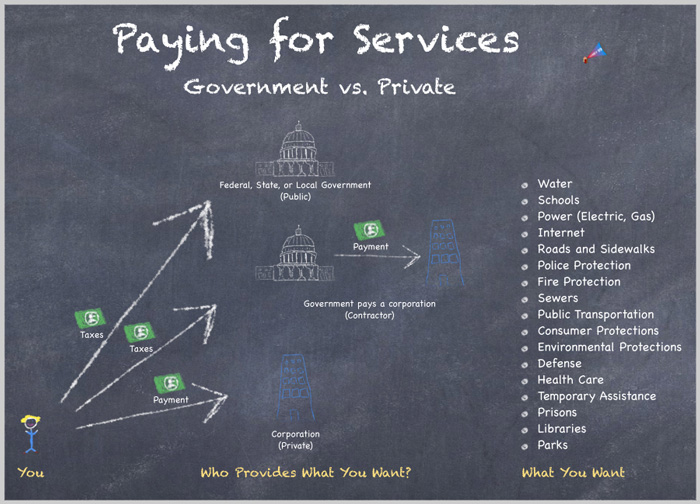
Click on the diagram for a clearer understanding
Taxes are collected in several ways. For example, you might pay...
o A percentage of the cost of things you buy
o A fee for using a road, bus, public park, etc.
For a more in-depth look some of the issues involving taxes, read our discussion of this issue
Tax Audit
(Coming)
Tax Deduction vs Credit
When you earn money, you pay an income tax based on the amount you earned.
For various reasons, such as to encourage you to buy certain things or to help those in need, the government enacts various deductions and tax credits.
A deduction allows you to calculate your tax on an amount lower than you actually earned. For example, if you earned $100,000 but paid $10,000 in medical expenses, a deduction would allow you to pay taxes as if you had earned only $90,000 ($100,000 - $10,000).
A tax credit allows you to directly reduce the amount of tax you owe. For example, if you owe $3,000 in taxes, a $1,000 tax credit would mean you actually owe only $2,000 ($3,000 - $1,000).
A credit generally is worth more than a deduction. For example...
o A $1,000 tax credit would save you $1,000.
A tax credit can be refundable or non-refundable. A non-refundable credit can reduce your taxes only up to the amount that you owe. With a refundable credit, you always get the full amount - meaning that you can receive it as a refund if it is worth more than the tax you owe.
Tax Policy Center
The Tax Policy Center is a nonpartisan organization that analyzes the effects of tax policies. It is a joint project of the Brookings Institution and the Urban Institute.
For more, read this New York Times article.
Website: www.TaxPolicyCenter.org.
Tax Refund
Each year by April 15 you file an income tax return based on the amount you earned in the previous year.
When you fill out your tax return, what you actually are doing is reconciling the amount of your tax with the amount you paid throughout the year.
o If you paid more than the amount of your tax, the IRS returns the amount you overpaid. This is your tax refund.
Note: In some cases your refund may be more than the what you paid, due to credits from programs such as the Earned Income Tax Credit.
Tax: Medical Device
The Medical Device Tax is a 2.3 percent tax on medical devices (such as artificial knee joints). It was created by the Patient Protection and Affordable Care Act (Obamacare).
Implementation of the tax has been repeatedly delayed. It now is not set to take effect until 2022.
You can read more on the tax, including arguments both for and against it, at ObamacareFacts.com.
Referenced by...Senate giving Obamacare repeal big final push (2017-Sep-19)
Bipartisan group seeks to fix Obamacare problems (2017-Aug-05)
Issue: Repealing (and Replacing?) Obamacare
Tax: Medicare
A separate tax on wages that is used to pay for Medicare. It also is known as the Medicare Hospital Insurance (HI) tax.
As part of the Patient Protection and Affordable Care Act (PPACA), high-income individuals pay about one percent more.
Tax: Net investment
A tax on investment income on those with investment profits exceeding $200,000 in a year.
It is part of the Patient Protection and Affordable Care Act (PPACA).
The official name of the tax is the Unearned Income Medicare Contribution Tax. In spite of that name, revenue from this tax goes into the nation's General Fund.
Tea Party
(Coming)
Temporary Assistance for Needy Families (TANF)
(Coming)
Term Limit
A law that limits the number of terms a representative can serve in an elected office.
The Constitution's 22nd Amendment limits the president to two terms. There are no limits to the number of terms representatives or senators can serve.
Read Lobby99's perspective on term limits.
Terrorism
A term generally used to describe illegal acts that are politically-motivated and that cause harm of some sort.
Often the harm is to people who are not specifically targeted by the perpetrator. But it can be against property.
It is not necessarily violent, for example in the case of an internet attack on a computer system (cyber terrorism) or a financial system.
For more on the difficulty of defining what exactly constitutes terrorism, read this ABC News story.
Texas A&M Transportation Institute (TTI)
The Texas A&M Transportation Institute studies problems associated with all aspects of transportation.
You can learn more about them at tti.tamu.edu.
The Wireless Association (CTIA)
An organization that lobbies for the wireless industry. You can visit their website at www.CTIA.org.
Think Tank
An organization that studies, reports on, and advocates for public policies. They can be non-partisan or they can subscribe to some political agenda. They also are referred to as policy institutes, research institutes, or advocacy groups.
When evaluating a policy reported on by a think tank, it is important to understand the political leanings of the organization.
ThinkProgress
A news website that provides reporting and analysis from a self-described "progressive perspective". It is a project of the Center for American Progress (CAP)
Website: ThinkProgress.org.
Thomas, Clarence
Supreme Court justice since 1991
Tillerson, Rex
Secretary of State under President Donald Trump from February 2017 to March 2018.
For more, read the New York Times story.
At the time of his nomination, Tillerson had no government or diplomatic experience. He spent his entire career at ExxonMobil - starting as an engineer in 1975 until being named Chief Executive Officer (CEO) in 2006.
He does, however, have strong business ties to leaders around the world, most notably Russian President Vladimir Putin. The two first met in 1999, while Tillerson was responsible for Exxon's holdings in Russia.
In 2011 the company signed an agreement to explore and drill in the arctic and Siberia with oil company Rosneft, which is majority owned by the Russian government. The deal - which could generate up to $500 billion for Exxon - was put on hold because of U.S. and European Union sanctions against Russia for its invasion of the Ukraine.
The State Department helps decide on and administer sanctions.
ExxonMobil has given nearly $2 million to the American Legislative Exchange Council (ALEC) since 1998.
Rule to disclose payments to foreign governments nullified (2017-Feb-14)
Trump fires Sec. of State Tillerson (2016-Dec-12)
Issue: ALEC in the Trump White House
Issue: President: Donald Trump
Tip Credit
Most restaurant employees who traditionally receive tips - such as servers - may be paid a lower minimum wage than that for other workers (though if the employee's tips are less than the minimum wage, the restaurant must make up the difference).
The difference between the normal minimum wage and the lower amount the restaurant actually pays the employee is referred to as the tip credit.
Title IX
Part of the 1972 amendment to the Higher Education Act of 1965, it prohibits gender discrimination in publicly funded higher education.
It begins...
"No person in the United States shall, on the basis of sex, be excluded from participation in, be denied the benefits of, or be subjected to discrimination under any education program or activity receiving Federal financial assistance..."
Click here to read the text of Title IX.
Click here to read the 1972 Education Amendments (Title IX starts on page 373).
Title X
1970 addition to the 1944 Public Health Service Act that funds family-planning and other preventive health services for low-income individuals.
Click here for more information about the law.
Trans-Alaska Pipeline
(Coming)
Transportation Security Administration (TSA)
Website: www.TSA.gov.
Treasury Inspector General for Tax Administration (TIGTA)
The Treasury Inspector General for Tax Administration provides independent oversight of IRS activities - including the prevention and detection of fraud, waste, and abuse within the IRS and related entities. (www.Treasury.gov/tigta)
TRICARE
Health care program for members of the United States military.
Trump, Donald
Donald Trump is the 45th United States president.
Trump, Donald Jr.
Donald Trump's oldest son.
Referenced by...Campaign aide told Trump about Russian connections (2017-Oct-30)
Trump attorney asked for Kremlin help on deal (2017-Aug-29)
Trump's son met to get Russian government info on Clinton (2017-Jul-10)
Issue: Trump's Ties to Russia
Trump, Eric
Donald Trump's son.
Referenced by...Issue: Trump's Ties to Russia
Trump, Ivanka
Donald Trump's daughter.
Referenced by...Trump attorney asked for Kremlin help on deal (2017-Aug-29)
TSA PreCheck
(Coming)
Tuesday Group
(Coming)
A social media organization that allows users to broadcast messages of up to 140 characters.
Twitter messages are referred to as tweets.
President Donald Trump was famous for using Twitter as a medium to vent personal anger and to make policy declarations (not all of which he acted on).
Website: www.twitter.com.
U.N. Framework Convention on Climate Change
1992 international treaty for working toward limiting greenhouse gas levels in the atmosphere.
The framework does not set limits and there are no enforcement provisions. Instead, it works as a guideline for for future environmental treaties (often referred to as agreements or protocols).
U.N. General Assembly
(Coming)
U.N. Green Climate Fund (GCF)
An international fund that helps poor countries...
o Develop clean energy technologies
Website: www.greenclimate.fund.
U.N. Security Council
The UN Security Council is one of the six main organs of the United Nations.
Its primary function is to maintain international peace and stability.
The Security Council is comprised of 15 members - 5 permanent and 10 elected to 2-year terms. The permanent members are...
o Russian Federation (previously the Soviet Union)
o China
o United Kingdom
o France
Security Council resolutions are binding, and can be enforced by sanctions or a peacekeeping force. Passing a resolution requires a YES vote from at least 9 members. However, a NO vote by any of the permanent members is considered a veto and will cause the resolution to fail.
U.S. Board on Geographic Names
The U.S. Board on Geographic Names is responsible for ensuring that geographic names in the United States are consistent throughout the government.
Consistent naming eliminates misunderstanding and allows various government agencies to work together more easily.
It is part of the Department of the Interior, and was created in 1890 by an executive order from President William Harrison.
Website: geonames.usgs.gov
U.S. Chamber of Commerce
Website: www.USChamber.com.
U.S. Code
The laws of the United States.
When a bill becomes a law, it becomes part of the U.S. Code. The law might add a completely new section to the U.S. Code, or it might change an existing law.
U.S. Copyright Office
(Coming)
U.S. Customs and Border Protection (CBP)
Part of the Department of Homeland Security (DHS) responsible for processing travelers and goods entering the country.
It was known as the U.S. Customs Service until 2003, when it was merged with parts of other agencies.
Website: www.CBP.gov.
U.S. Fish and Wildlife Service (FWS)
Website: www.FWS.gov.
U.S. Forest Service
Agency of the U.S. Department of Agriculture (USDA) that manages and protects national forests and grasslands in the United States.
Website: www.fs.fed.us
U.S. Mission to the United Nations
Website: usun.state.gov.
U.S. Postal Service (USPS)
Official organization that delivers mail in the United States.
Though regulated as a federal agency, the USPS effectively is a corporation whose operations are funded by its sales. It receives virtually no federal funding (other than funding for a few specific purposes).
For more, read our discussion of the US Postal Service.
Website: www.USPS.com.
U.S. Trade Representative
Website: www.USTR.gov.
Unemployed
The Bureau of Labor Statistics classifies someone as unemployed if they do not have a job, but have been actively searching for one in past 4 weeks.
After 27 weeks, if they still have not found a job they are considered long-term unemployed.
Unemployment Insurance (UI)
(Coming)
Union
Technically, a labor union (or simply union) is an organization of workers. However, it often is more useful to think of a labor union as an organization that represents a group of workers.
Labor unions have several functions, among which are...
o They support you in disputes with your employer.
o They lobby government for laws and regulations that protect and benefit workers.
o They support candidates whom they believe will best represent the interests of workers.
The money to do all this comes from members (workers in the group) paying dues.
Union Security Agreement
An agreement between a labor union and an employer that specifies whether all employees in the group represented by the union are required to pay dues to the union - even if the employee chooses to not become a member of the union.
These agreements are a way of ensuring that all workers who benefit from collective bargaining pay the union for negotiating on their behalf.
United Nations (UN)
An organization of approximately 200 of the Earth's nations. It was created in 1945 - after the Second World War - to promote international cooperation.
The UN consists of 6 main organs...
o Security Council
o Economic and Social Council (ECOSOC)
o Trusteeship Council
o International Court of Justice
o Secretariat
The leader (Secretary-General) of the U.N. is Ban Ki-moon of Korea, who has served since 2007.
Previous Secretary-Generals have been:
o 1992-1996 Boutros Boutros-Ghali (Egypt)
o 1982-1991 Javier Perez de Cuellar (Peru)
o 1972-1981 Kurt Waldheim (Austria)
o 1961-1971 U Thant (Myanmar)
o 1953-1961 Dag Hammarskjold (Sweden)
o 1946-1952 Trgve Lie (Norway)
Website: www.UN.org
Universal Health Care
A policy of guaranteeing health care to citizens or residents of a country, state, or city.
It can be implemented in a number of ways, including...
o A socialist system in which the government owns the facilities and directly employs the doctors and other health care providers. Health care provided by the Veteran's Administration (VA) is an example of a socialist system.
The United States is the only industrialized nation in the world that does not provide some type of universal health care to all of its citizens.
Uranium extraction
These are the primary ways uranium is obtained for use in nuclear fuel and weapons...
o In situ recovery: A solution is injected into the ground to dissolve the uranium. Then the solution (containing the dissolved uranium) is collected and pumped to a processing plant where the uranium is extracted. This is similar to fracking, but shallower, which can affect groundwater.
The product of uranium extraction is known as yellowcake.
Urban Institute
A non-partisan think tank that studies, reports on, and advocates for social programs and policies.
The Urban Institute was created in 1968 under President Lyndon Johnson.
For more, visit their website at www.Urban.org.
Usury laws
Laws that govern the amount of interest that can be charged on a loan. Usury laws are enacted to protect consumers by preventing a bank from charging excessively high interest rates.
Veteran
The standard definition of a veteran is someone who has a long experience in any particular field.
However, we typically use the term to refer to someone who has served in the U.S. military (including those still serving).
Veterans Health Administration
The Veterans Health Administration (most often referred as simply the VA) is the part of the Department of Veterans Affairs that provides health care to U.S. military veterans.
The VA health care system is separate from other health care systems in the U.S. Unlike the other systems, the VA is a socialized system in that its doctors and other providers are employees of the government, and its facilities are government-owned.
Website: va.gov/health.
Veterans of Foreign Wars
A nonprofit organization that provides services for veterans who have served in overseas conflicts and advocates for policies that serve their interests.
Website: www.VFW.org.
Veto
Once Congress passes a bill, it then is up to the president as to whether it actually becomes a law. He can sign the bill, making it an official law. Or he can reject it by vetoing it.
Though that is the essence of how a bill becomes a law (or doesn't become one), there are a few variations that can come into play...
o If the president does not sign or veto the bill within 10 days, it automatically becomes law.
o If the president does not sign or veto the bill within 10 days, but Congress adjourns during that 10 days and is no longer in session, the bill is automatically vetoed. This is referred to as a pocket veto
Virtual Private Network (VPN)
Technology that allows someone to communicate over the internet - which is public - as if they were using a private network.
This allows their communications to be encrypted, as well as masking their internet identity.
Volcker Rule
A federal regulation, part of the Dodd-Frank Wall Street Reform and Consumer Protection Act, that prohibits banks from engaging in certain speculative investments.
For more, read the Investopedia explanation.
Referenced by...House passes bill to revoke consumer and financial protections (2017-Jun-08)
Voter Caging
A form of election fraud designed to revoke the registration of legal voters.
Voter caging consists of mailing letters to registered voters that cannot be forwarded. If the letter is returned for some reason, the recipient's voter registration is challenged on the grounds that they do not legally reside at that address.
If these mailings are targeted to areas with a high concentration of voters likely to support an opposing party, the practice can affect the outcome of the election in the favor of the organization sending them.
The term caging also can apply to similar practices that challenge a legal voter's eligibility.
For more, read the Project Vote article.
Voter Fraud
The intentional corruption of the voting process by voters.
This can involve someone casting a vote who is not legally allowed to vote, or someone casting multiple votes in an election.
Related term: Election Fraud.
Voter ID
(Coming)
Voter Suppression
Generic term for tactics used to disenfranchise a segment of the population considered likely to vote for candidates of a particular political party.
Voting Rights Act
1965 law that prohibits racial discrimination in voting.
Main provisions include...
o Jurisdictions that had used discrimination in the past can not change their voting rules without having the changes pre-cleared by the federal government.
For more, read our discussion of the law.
Wage and Hour Division (WHD)
Part of the Department of Labor (DOL) created by the 1938 Fair Labor Standards Act (FLSA).
Among the laws enforced by the WHD are those enacted in the FLSA, including...
Website: www.dol.gov/whd
Warren, Earl
Supreme Court justice from 1953 to 1969. Warren was Chief Justice.
Washington Examiner
An explicitely conservative newspaper. It is owned by Phil Anschutz, who also owns the conservative magazine The Weekly Standard.
For more, read this Politico.com story.
Washington Free Beacon
A conservative website. It was founded by Paul Singer - a major Republican donor.
Website: www.FreeBeacon.com.
Washington, George
George Washington was the first president of the United States.
Watergate
(Coming)
Weapon of Mass Destruction
A term used to describe a weapon capable of killing many people at once and causing widespread destruction.
Examples would be nuclear, chemical, and biological weapons.
Whistleblower
A person who exposes illegal or unethical actions of an organization (typically one they work for).
White House
The White House (which really is white), is the official residence and office of the president.
The term also is used as a general way to refer to the president's administration. For example, "The White House announced that..."
Website: www.WhiteHouse.gov.
White House Chief of Staff
(Coming)
World Bank
Website: www.WorldBank.org.
World Health Organization (WHO)
Website: www.who.int.
World Intellectual Property Organization (WIPO)
An agency of the United Nations (UN) created in 1967 to protect intellectual property across nations.
For more, visit www.wipo.int.
Write-In
A vote for someone whose name is not listed on their ballot.
Rules for write-in votes vary both by state and by the office being voted for.
Zinke, Ryan
Representative from Montana from 2015 - 2017. He previously had served in the Montana state Senate.
In 2017 he became Secretary of the Interior under President Donald Trump.
His previous record runs counter to the goals of the department he was named to run.
As a candidate for Montana Lt. Governor in 2012, Zinke is said to have signed the Montana Voter and Candidate Pledge. The pledge, among other things, demands opposition to Department of Interior agencies. Zinke has not acknowledged or denied signing the pledge. He has claimed that he doesn't remember signing it.
The oil and gas industry has contributed more than $345,000 to Zinke, who supports opening up public lands to oil and gas drilling.
The League of Conservation Voters has given Zinke a lifetime score of 3 percent.
Zinke has supported...
o Limiting the president's ability to protect public lands by declaring them national monuments.
o Weakening protections for endangered species.
o A balanced budget Constitutional amendment.
o Prohibiting funding for a Department of Defense directive that would require the DoD to consider climate change in its plans.
His actions on climate change contradict his 2010 position in which he cosigned a letter to President Obama and Congress calling for "comprehensive clean energy jobs and climate change legislation." The letter also stated...
"Our nation's most respected military leaders recognize that climate change is a threat multiplier for instability in the most volatile regions of the world. The climate change threat presents significant national security challenges for the United States - challenges that should be addressed today, because they will almost certainly get worse if we delay."
He now claims to be skeptical of Global Warming. In a 2014 Congressional debate, he said "It's not a hoax, but it's not proven science either."
Zinke is a retired Navy SEAL.
For more, read the Los Angeles Times story.
Referenced by...Trump cabinet members to speak at ALEC event (2017-Jul-19)
Senate confirms Rep. Ryan Zinke for Secretary of Interior (2016-Dec-15)