



Trump's Ties to Russia
WE NEED YOUR HELP!
Lobby99 is a nonprofit that depends on the support of our readers.
If you found this useful, could we ask you to chip in a dollar or three to help us provide even more like this? Thanks!
It's secure and takes under a minute.
Zero spent of allocated $120M to stop election interference
| 2018-Mar-04 (Updated: 2018-Mar-15) | By: Barry Shatzman |
Since late 2016, the State Department has had $120 million to investigate foreign attempts to influence U.S. elections. It has used none of it.
It has 23 analysts whose job it is to counter Russia's disinformation activities in the United States. None of them speaks Russian.
The lack of a Trump administration investigation comes in spite of...
o An indictment by special counsel Robert Mueller
Still, Trump has supported no actions to counter Russian activities.
He expressed doubt over the agencies' report, going as far as saying he believed Putin's denials.
After Mueller's indictments, his first response was not to express concern that elections were interfered with by a foreign government, but rather merely to claim in a Twitter posting that the Russian efforts started in 2014 - before Trump began his presidential campaign.
Regardless of the significance or insignificance of Trump's comparison - it is factually incorrect. He applied to patent his Make America Great Again campaign slogan in 2012.
Now-departing Secretary of State Rex Tillerson said in a Fox News interview that Russia is already attempting to interfere in the 2018 Congressional elections, but "if it's their intention to interfere, they are going to find ways to do that. We can take steps we can take but this is something that, once they decide they are going to do it, it's very difficult to preempt it."
On March 15, Trump did impose sanctions on Russia, but he stated they were in response to the killing of a former Russian spy in Britain. He did not mention election interference.
For more, read the New York Times story.
Indictment: American demonstrators duped by Russians
| 2018-Feb-22 | By: Rob Dennis |
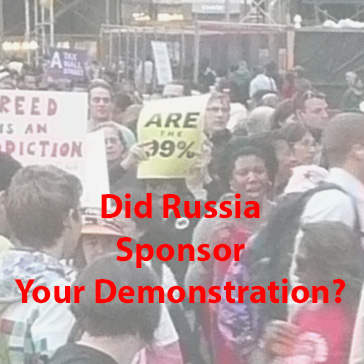
In August 2016, grassroots groups supporting presidential candidate Donald Trump helped coordinate Florida Goes Trump rallies in the sunshine state.
One man was paid up to $1,000 to build a cage on a flatbed truck for the events, to be occupied by an actress in costume depicting Democratic candidate Hillary Clinton in a prison uniform. Another shared information about the rallies with contacts on social media.
The individuals and groups were American, but their instructions came from Russia.
These are among the claims in a 37-page indictment released Feb. 16 by Special Counsel Robert Mueller. The indictment accuses 13 Russians and three Russian businesses of conspiring to sow discord in the 2016 U.S. presidential election, including operations to support Trump, Clinton's Democratic primary challenger Bernie Sanders, and Green Party candidate Jill Stein.
What was in the indictment
The Internet Research Agency - one of the companies charged in the indictment - employed hundreds and had a monthly budget of up to $1.25 million (including money spent on projects aimed at a Russian audience). They tracked and studied social media dedicated to U.S. politics and issues starting in 2014.
The project was set up by Yevgeniy Prigozhin, a businessman with close ties to Russian President Vladimir Putin. These close ties - as well as his profession as a caterer - earned him the nickname Putin's chef.
They operated by setting up group pages on social media tackling issues ranging from immigration to Black Lives Matter, garnering hundreds of thousands of followers. It created hundreds of social media accounts, developing fictitious U.S. personas into "leaders of public opinion."
From April through November 2016, the operation bought online ads supporting Trump or opposing Clinton, using the stolen identities of real Americans and virtual private networks to conceal their origin. The ads also accused Clinton of voter fraud and encouraged minorities not to vote.
The operation organized rallies posing as U.S. grassroots activists, soliciting the unwitting support of genuine activists and low-level members of the Trump campaign. The rallies attracted anything from a handful to thousands of people.
The Russian operation influenced a host of actions by Americans...
o The operation used the Facebook group United Muslims of America to promote a rally called Support Hillary. Save American Muslims in Washington, D.C., in July 2016. It also recruited a U.S. citizen to hold a poster attributing a fabricated quote to Clinton: "I think Sharia Law will be a powerful new direction of freedom."
o The operation organized and ran Facebook ads for a series of October 2016 rallies in Pennsylvania called Miners for Trump.
o After the election, the operation organized and coordinated dueling rallies supporting and protesting Trump in New York on Nov. 12, 2016. Up to 10,000 people attended the anti-Trump rally.
Facebook has deleted 470 accounts linked to the Internet Research Agency, which purchased 3,000 political ads. Up to 126 million people may have seen content posted by the group.
For more, read the New York Times story.
Click here to read the indictment against the 13 Russians and 3 Russian businesses.
Trump won't impose required Russia sanctions
| 2018-Feb-02 | By: Rob Dennis |
The Trump administration won't implement new sanctions against Russia that were mandated by Congress in July. The decision appears to be based on a provision in the law that allows for delays if individuals scale back business with Russian defense and intelligence entities.
The Countering America's Adversaries Through Sanctions Act codified into law existing sanctions punishing Russia for its invasion of Ukraine and interference in the 2016 U.S. presidential election.
The bill also gave the Trump administration six months to impose new sanctions on people who do business with Russian military and intelligence organizations.
When Trump signed the bill into law, he claimed it contained "clearly unconstitutional provisions" that he might choose not to enforce. The bill passed overwhelmingly, and Congress had indicated it would have overridden Trump had he vetoed it.
On Jan. 29, the deadline for imposing the new defense and intelligence sanctions, State Department spokeswoman Heather Nauert said in a statement that the administration would not comply because the legislation itself is deterring Russian defense sales. State Department officials refused to disclose examples, but reportedly did provide Congress with a list of 10 such deals in a classified briefing.
Deterring Russian defense sales was not the aim of the sanctions, which were imposed by Congress to punish Russia for its interference in the presidential election. However, the law allows Trump to delay new sanctions on individuals if the targets are "substantially reducing the number of significant transactions" with Russian military and intelligence entities. Any delays must be reauthorized every six months
The administration did meet one provision of the law, as the Treasury Department met its deadline to issue a report naming 114 Russian senior political figures and 96 oligarchs.
Compiling that list likely didn't take much effort. The members of Russia's presidential administration on the list appear to have been copied directly from the Kremlin's website, and the oligarchs list is an exact replica of the Russians on Forbes' 2017 list of the world's billionaires.
For more, read the Washington Post story.
Click here to read a Lawfare analysis of the legality of the administration's decision.
Trump 2017 real estate profit mostly from secretive buyers
| 2018-Jan-16 | By: Rob Dennis |
President Donald Trump's companies sold more than $35 million in real estate in 2017 - most of it to secretive shell companies, USA Today reported.
The use of shell companies in Trump's real estate deals increased dramatically around the time he secured the Republican nomination in mid-2016. In the two years before the nomination, only 4 percent of buyers used shell companies. In the year after, it was 70 percent.
Meanwhile, an investigation by BuzzFeed News found that more than a fifth of Trump condo buyers since the 1980s have used shell companies and paid in cash - two factors that can indicate money laundering.
One Trump project in particular stood out. At the Trump SoHo hotel in New York, more than three out of every four condo sales were to buyers using shell companies who paid cash.
The Trump SoHo deals, first reported by Lobby99 in August, included seven condos sold to Russian buyers. Moscow addresses on four of those deeds were crossed out, and replaced with the address of the buyer's attorney.
Profits from Trump's real estate deals go to a trust run by the president's sons. Trump is the sole beneficiary.
Testimony further debunks Trump dossier narrative
| 2018-Jan-11 | By: Rob Dennis |
Congressional testimony by the founder of the company hired to investigate President Donald Trump's connections to Russia has further debunked a false narrative attempting to discredit the findings of that investigation.
The testimony of Fusion GPS co-founder Glenn Simpson was released this week by Sen. Dianne Feinstein.
Trump, along with some Republican members of Congress and conservative media outlets, has been claiming that the FBI investigation into possible collusion between the Trump campaign and Russia was sparked by a "fake" dossier paid for by the campaign of 2016 presidential candidate Hillary Clinton.
There are three problems with the narrative, however...
o The opposition research by Fusion GPS into Trump that led to the creation of the dossier initially was paid for by the Washington Free Beacon, a conservative website. Once it became clear that Trump likely would clinch the Republican nomination, the Free Beacon ended that relationship with Fusion GPS. It was at that point that Clinton's campaign began to pay for the research.
o The dossier did not spark the FBI investigation. Simpson testified in August that when Steele approached the FBI with the information contained in the dossier, the bureau "believed Chris' information might be credible because they had other intelligence that indicated the same thing and one of those pieces of intelligence was a human source from inside the Trump organization."
Here's a timeline of how the investigation came about:
Late 2015
GCHQ, the British equivalent of the U.S. National Security Agency, alerts U.S. intelligence agencies about suspicious contacts between members of the Trump campaign and suspected Russian intelligence operatives. Over the next six months, other western intelligence agencies provide similar information.
2016, May
Trump campaign foreign policy adviser George Papadopoulos drunkenly brags to an Australian diplomat that Russia had political dirt on Clinton.
2016, May or June
Fusion GPS hires Steele to explore Trump's connections to Russia.
2016, June 20
Steele issues his first report to Fusion GPS. He will produce 16 more through December 2016.
2016, May or June
Fusion GPS hires Steele to explore Trump's connections to Russia.
2016, Early July
Concerned that he might have uncovered a national security threat and "a crime in progress," Steele shows some of his early findings to an FBI agent. However, the New York Times reported, Steele's information "was not part of the justification to start a counterintelligence inquiry."
2016, July 7
Trump campaign foreign policy adviser Carter Page travels to Moscow to speak at the New Economic School. Page, who handed over unclassified documents to a Russian spy in 2013, delivers a speech criticizing the U.S. and other western democracies. The Trump campaign approved the trip, which "caught the attention of U.S. intelligence agencies."
2016, July 22
Wikileaks publishes about 22,000 emails stolen from the Democratic National Committee.
2016, July 25
The Daily Beast reports that the FBI suspects Russian government hackers stole the DNC emails. In response to this revelation, Australian officials tell their U.S. counterparts about Papadopoulos' claim two months earlier.
2016, July 27
Trump appears to call on Russia to hack Hillary Clinton's missing emails.
2016, Late July
The FBI opens a counterterrorism investigation into the Trump campaign's ties to Russia.
2016, Early October
A team of FBI agents interviews Steele about the information he has uncovered.
Click here to read our discussion of the Trump campaign's ties to Russia.
Flynn pleads guilty to lying to FBI, may testify against Trump
| 2017-Dec-01 | By: Rob Dennis |
Former National Security Adviser Michael Flynn has pleaded guilty to lying to the FBI, and reportedly has agreed to testify against President Donald Trump.
He is the first Trump administration official to be charged with a crime by special counsel Robert Mueller.
Flynn was charged with making false statements to the FBI in January - when he lied about his conversations with then-Russian ambassador to the United States Sergey Kislyak during the presidential transition the previous month.
Flynn also will testify that Trump "directed him to make contact with the Russians," ABC News reported.
In addition, the president's son-in-law Jared Kushner instructed Flynn to contact foreign officials on the United Nations Security Council to influence their vote on Israeli settlements, Bloomberg News reported.
Kushner previously had been co-director of a foundation that funded an Israeli settlement, Newsweek reported. He did not disclose that relationship on financial records he filed with the Office of Government Ethics (OGE).
Trump repeatedly has denied having anything to do with Russia, despite overwhelming evidence to the contrary. In a February press conference, he specifically denied directing Flynn to speak with Kislyak about sanctions.
If Mueller can prove that Trump or Kushner directed Flynn to negotiate with the Russian government before taking office, they could be in violation of the Logan Act, which prohibits private citizens from conducting foreign affairs without the permission of the U.S. government.
Did Trump obstruct justice?
Flynn's testimony also could bolster an obstruction of justice case against the president.
Former FBI director James Comey wrote in a memo that Trump asked him to drop the Flynn investigation in February. After Comey refused to comply, Trump fired him. Trump acknowledged the firing was partly because of "this Russia thing."
Trump called Sen. Chuck Grassley the day after it was announced that the president's son Donald Trump Jr. would testify before Grassley's Senate Judiciary Committee. He pledged his support for one of the senator's key issues.
Trump reportedly was involved in drafting a misleading statement by Donald Jr. about a meeting during the campaign with a Russian lawyer with ties to the Kremlin.
Trump allegedly tried to persuade top Republican senators, including the chairman of the Senate Intelligence Committee, to end the Russia investigation, the New York Times reported.
In testimony before the House Intelligence Committee on Nov. 30, Attorney General Jeff Sessions refused to answer whether Trump ever asked him to obstruct the investigation.
For more on Flynn's possible violation of the Logan Act, read the Washington Post story.
Click here to read the charges against Flynn.
Click here to read the Statement of Offense against Flynn.
Click here to read Flynn's plea agreement.
Campaign aide told Trump about Russian connections
| 2017-Oct-30 | By: Rob Dennis |
A Trump campaign aide told Donald Trump in March 2016 that he had connections who could help arrange a meeting between Trump and Russian President Vladimir Putin.
That is according to a plea agreement by the aid, George Papadopoulos, who has pleaded guilty to lying to the FBI. The plea was unsealed Oct. 30.
Papadopoulos learned in April 2016 that the Russian government had "dirt" on Trump's opponent Hillary Clinton from "thousands of emails," according to the agreement.
About a month later, Trump's son Donald Trump Jr. met with a Russian lawyer tied to the Kremlin who promised him damaging information about Clinton. The following month, WikiLeaks released nearly 20,000 emails stolen from the Democratic National Committee by hackers. U.S. intelligence agencies have stated they believe the hackers are connected to the Russian government.
Here's a timeline of how we got here...
2016, March 24
After he had been named foreign policy adviser to the Trump campaign, Papadopoulos met a London-based professor with ties to the Kremlin and a Russian woman he believed to be Putin's niece (she turned out to not be related to Putin).
After the meeting, Papadopoulos emailed a campaign supervisor and several other foreign policy advisers about the discussion, which he said was "to arrange a meeting between us and the Russian leadership to discuss U.S.-Russia ties under President Trump."
The campaign supervisor replied that he would "work it through the campaign," but that no commitments should be made. He added, "Great work."
The "campaign supervisor" is unnamed in the records, but the Washington Post reports he is Sam Clovis - Trump's national campaign co-chairman who now serves as senior White House adviser to the U.S. Department of Agriculture.
2016, March 31
Papadopoulos attended a national security meeting with Trump and other foreign policy advisers. He introduced himself to the group by saying he had connections who could help arrange a meeting between Trump and Putin.
2016, April 26
The Kremlin-linked professor told Papadopoulos that the Russians had "dirt" on Clinton.
Over the next several months, Papadopoulos continued to try to set up a meeting between the campaign and the Russian government, and had multiple conversations with a man in Moscow who said he had connections to the Russian Ministry of Foreign Affairs. In addition to Clovis, Papadopoulos wrote to campaign manager Corey Lewandowski and campaign chairman Paul Manafort about his efforts, the Washington Post reported.
2016, August
Clovis encouraged Papadopoulos and another foreign policy adviser to take a trip to Russia for meetings, although the trip never happened.
2017, July 27
Papadopoulos was arrested on suspicion of lying to the FBI for claiming his Russian contacts happened before he joined the Trump campaign. He has since been cooperating with investigators. He pleaded guilty Oct. 5.
2017, Oct 30
Papadopoulos' plea agreement was unsealed.
Earlier the same day, indictments against Manafort and associate Rick Gates on charges of money laundering and conspiracy were announced.
For more, read the Washington Post story.
Click here to read the indictment against Papadopoulos.
Click here to read the description of the charge against Papadopoulos.
Click here to read the plea agreement between Papadopoulos and the Department of Justice.
Former Trump campaign aides indicted for Ukraine deals
| 2017-Oct-30 | By: Rob Dennis |
Former Trump campaign chairman Paul Manafort and another campaign aide have been indicted on charges including money laundering and conspiracy against the United States.
Both Manafort and his associate - Rick Gates - have pleaded not guilty to the charges, which stem from Special Counsel Robert Mueller's investigation into Russian interference in the 2016 presidential election and potential collusion between the Trump campaign and the Russian government.
The 12-count indictment alleges that Manafort and Gates failed to disclose to the Department of Justice (DOJ) they were acting as agents of a foreign principal when they were paid to lobby for former pro-Russian Ukrainian President Viktor Yanukovych and political parties allied to him. They also are charged with filing false statements with the Justice Department.
The indictment also charges Manafort and Gates with hiding that money - tens of millions of dollars - from the government, laundering it through U.S. and foreign corporations, partnerships and bank accounts.
If convicted on all counts, Manafort and Gates could face decades in prison.
For more, read the New York Times story.
For more about Manafort and his ties to Russia, read the Lobby99 report.
For more about Manafort's involvement with the Trump campaign, read the New York Times story.
Click here to read the indictment against Manafort and Gates.
Trump attorney asked for Kremlin help on deal
| 2017-Aug-29 (Updated: 2017-Aug-31) | By: Rob Dennis |
Felix Sater told Donald Trump's attorney in 2015 he could arrange a real estate deal with Russian President Vladimir Putin that would help Trump win the presidency.
Two months later, Michael Cohen - Trump's attorney and executive vice president for the Trump Organization - requested Putin's help developing a Trump Tower in Moscow, the Washington Post reported.
Cohen said in a statement to congressional investigators that he asked Putin's spokesman Dmitry Peskov for help at the recommendation of Sater - a longtime Trump associate who was convicted of assault and racketeering.
Sater also claims to have close relationships with the Russian government, and escorted Trump's children Ivanka and Donald Jr. on a 2006 Moscow trip to scout sites for a potential Trump-branded hotel. In emails to Cohen in late 2015, Sater wrote...
"Our boy can become president of the USA and we can engineer it. I will get all of Putins team to buy in on this, I will manage this process."
"I arranged for Ivanka to sit in Putins private chair at his desk and office in the Kremlin. I will get Putin on this program and we will get Donald elected."
Cohen wrote to Peskov using an email address for general press inquiries. He said in his statement that he did not recall receiving a reply, and that the Moscow project was dropped two weeks later.
Still, five months after that, Trump's son Donald Trump Jr., son-in-law Jared Kushner and campaign chair Paul Manafort met with Russians tied to the Kremlin in hopes of receiving damaging information about Hillary Clinton - his Democratic opponent in the election.
Investigators for Special Counsel Robert Mueller are "keenly focused" on what Trump knew about that meeting and whether he tried to conceal its true purpose, NBC News reported.
For more, read the Lobby99 summary of Trump's ties to Russia.
Bill limits president's power to lift Russian sanctions
| 2017-Aug-02 (Updated: 2017-Aug-10) | By: Rob Dennis |
President Trump has signed into law a bill that would toughen sanctions against Russia - and stop the president from unilaterally lifting them.
The Countering America's Adversaries Through Sanctions Act codifies into law existing sanctions punishing Russia for its invasion of Ukraine and interference in the U.S. presidential election. The bill also adds sanctions against key Russian officials, and imposes sanctions against Iran and North Korea for those countries' weapons programs.
Trump signed the bill, even though it restricts his power to remove the Russia sanctions. Had he not signed it, the overwhelming support in both the House and the Senate gave good reason to believe a veto would have been overridden.
Was Trump seeking to remove sanctions on Russia?
Trump reportedly explored lifting sanctions just days after taking office.
The New York Times reported in February that Michael Cohen, Trump's personal lawyer, hand-delivered a pro-Russia peace plan for Ukraine to then-National Security Adviser Michael Flynn, outlining a way for Trump to remove sanctions.
The Washington Post reported in May that the administration still was considering handing back two Russian diplomatic compounds seized in retaliation for interference in the presidential election.
Trump said he discussed "adoptions" during a private meeting July 7 with Russian President Vladimir Putin at the G20 summit in Germany. Putin had banned American adoptions of Russian children in response to sanctions imposed under the Magnitsky Act. Removing these sanctions has been a priority for Putin, and a Russian lawyer pitched the idea to top Trump campaign officials in a secret meeting at Trump Tower before the election.
Trump can't lift sanctions imposed by the Magnitsky Act, because it is a law passed by Congress. Other sanctions, though, were imposed by executive order, and could be changed or eliminated by Trump.
When Trump signed the bill, he also issued a signing statement claiming that parts of the law violate the Constitution.
For more, read the New York Times story.
For more about Trump's signing statement, read the New York Times story.
Trump's son met to get Russian government info on Clinton
| 2017-Jul-10 (Updated: 2017-Aug-29) | By: Rob Dennis |
President Donald Trump's son met during the presidential campaign with a Russian lawyer tied to the Kremlin - who promised him damaging information about Hillary Clinton.
The meeting between Donald Trump, Jr. and attorney Natalia Veselnitskaya took place at Trump Tower on June 9, 2016 - two weeks after Trump clinched the Republican nomination. Trump's son-in-law Jared Kushner and then-campaign chair Paul Manafort also attended the meeting.
Also attending the meeting were Irakly Kaveladze, a Soviet-born financier who once was the focus of a congressional probe into money-laundering; and Rinat Akhmetshin, a Russian-American lobbyist and ex-Soviet counterintelligence officer who was involved in two hacking-related cases after working for Russian businessmen tied to Putin. Akhmetshin denies being involved in hacking.
Veselnitskaya's clients include people and companies close to the Kremlin. She has campaigned against the Magnitsky Act, a 2012 law passed by Congress to punish Russian officials believed responsible for the death of lawyer Sergei Magnitsky in a Moscow prison. Magnitsky had uncovered a scheme involving the laundering of millions of dollars into New York luxury properties by Russian mobsters.
Veselnitskaya is the family lawyer for Denis Katsyv, the son of a senior Russian official and owner of Prevezon - the Cyprus-based company accused in the laundering scheme.
A four-year investigation into Prevezon was led by U.S. Attorney Preet Bharara, who was fired by President Donald Trump in March. In May, the case was settled right before the trial was set to commence.
When the New York Times reported the Veselnitskaya meeting on July 8, Trump Jr. said in a statement that it focused on the adoption of Russian children by Americans - which had been barred by the Russian government in response to the Magnitsky Act.
Trump Jr. changed his story the next day to align with what three White House sources had told the New York Times - that he met with Veselnitskaya because she had offered "information that individuals connected to Russia were funding the Democratic National Committee and supporting Mrs. Clinton."
An email to Trump Jr. proposing the meeting has since been reported by the New York Times, stating that information was coming from a senior Russian government official and was "part of Russia and its government's support for Mr. Trump."
Trump Jr. replied, "If it's what you say I love it."
For more, read the New York Times report.
For more on the Prevezon case, read the CNN story.
For more on the email to Donald Trump Jr. proposing the meeting, read the New York Times report
Special Counsel to investigate Trump-Russia connection
| 2017-May-17 | By: Rob Dennis |
The Justice Department has appointed former FBI Director Robert Mueller as special counsel to investigate possible collusion between President Donald Trump's campaign and Russia.
Mueller, a former prosecutor, served as FBI director from 2001 to 2013 under Presidents George W. Bush and Barack Obama. As special counsel, he will have the same powers as any U.S. attorney, including the authority to assign federal agents, issue subpoenas and prosecute crimes if needed.
The appointment was announced May 17 by Deputy Attorney General Rod Rosenstein, who has been overseeing the Russia probe after Attorney General Jeff Sessions recused himself.
Rosenstein announced Mueller's appointment the day after the New York Times reported that Trump had asked FBI Director James Comey in February to stop investigating former national security adviser Michael Flynn.
"I hope you can let this go," Trump told Comey, according to a memo written by the FBI director shortly after the meeting, the Times reported. The meeting took place in the Oval Office on Feb. 14, the day after Flynn was forced to resign.
Trump fired Comey on May 9. Initially, White House officials claimed Trump dismissed the FBI director on the recommendation of Sessions and Rosenstein.
However, in a subsequent interview on NBC Nightly News, Trump said he already had decided to fire Comey before he met with Sessions and Rosenstein. Trump also acknowledged that the firing was at least partly because of "this Russia thing."
For more, read the Washington Post story.
Trump discloses classified Israeli intelligence to Russia
| 2017-May-15 (Updated: 2017-May-22) | By: Barry Shatzman |
President Trump disclosed highly classified intelligence to Russian officials in a May 10 White House meeting with them.
The intelligence disclosed by Trump - concerning a terrorist threat - could expose intelligence sources and capabilities - hindering the United States' ability to detect future threats, the Washington Post reported.
It said to have come from Israel. The New York Times reports that Israel previously had warned the United States about the sensitivity of the intelligence.
Administration officials initially denied Trump's disclosure of the information, but Trump later confirmed it himself via Twitter.
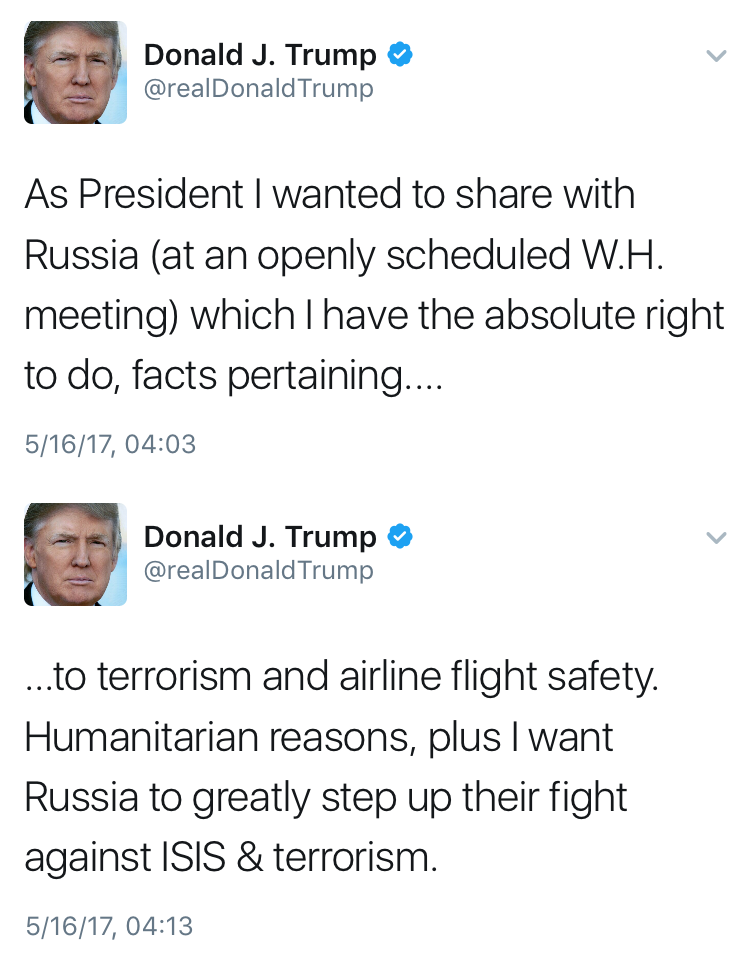
During a later visit to Israel, Trump also appeared to confirm the source of the intelligence as Israel.
For more on the disclosure, read the Washington Post story.
For more on Israel as the source of the disclosed intelligence, read the New York Times story.
Senate subpoenas documents on Russia
| 2017-May-10 | By: Rob Dennis |
The Senate Intelligence Committee has subpoenaed documents from former national security adviser Michael Flynn in connection with its investigation into Russian interference in the presidential election.
Flynn had refused the committee's initial request for the documents.
Flynn, who was forced to resign in February after his contacts with the Russian ambassador to the United States were made public, also is being investigated for accepting payments from Russia and Turkey.
The committee also has sent a series of document requests to other associates of President Donald Trump, including former Trump campaign chairman Paul Manafort and former campaign advisers Carter Page and Roger Stone. It has received only two responses - one of them from Page.
In addition, the committee has asked the Treasury Department for information related to Trump, his top officials, and campaign aides, Sen. Mark Warner told CNN.
The Treasury Department's criminal investigation division has been investigating allegations of foreign money laundering through U.S. real estate transactions.
o Numerous foreign buyers, including those from Russia, have purchased units at Trump properties in the United States. A Reuters investigation found that 63 Russians bought almost $100 million worth of property at seven Trump-branded towers in southern Florida alone.
Sen. Lindsey Graham, who is leading a Senate Judiciary Committee investigation, also said he wants to investigate business ties between Trump and Russia. In response, White House Press Secretary Sean Spicer said the president has "no connections to Russia," and that Trump has hired a law firm to write a letter to that effect.
For more, read The Hill story.
Click here to read our discussion of Trump's numerous political and business connections to Russia..
White House refuses Congress' request for Flynn documents
| 2017-Apr-25 | By: Barry Shatzman |
The White House is refusing a House Oversight Committee request for documents related to former National Security Adviser Michael Flynn.
The documents involve payments Flynn received for speeches and lobbying in Russia and Turkey.
For more, read the BBC story.
Kushner omits Russian meetings on clearance application
| 2017-Apr-06 (Updated: 2017-Jul-14) | By: Barry Shatzman |
President Trump's senior advisor and son-in-law Jared Kushner failed to disclose contacts with several Russians on his security clearance application, the New York Times has reported.
Kushner's contacts during the transition included Russian Ambassador Sergey Kislyak and Sergey Gorkov, head of the Russian state-owned bank.
The security clearance application requires the disclosure of all encounters with foreign officials in the past seven years, and warns that knowingly concealing material facts is a federal crime.
For more, read the New York Times story.
Update 2017-July-14: For an update, read this Business Insider story.
Rep. Nunes recuses self from Russia investigation
| 2017-Apr-06 | By: Rob Dennis |
House Intelligence Committee Chairman Devin Nunes has temporarily recused himself from the probe into Russian election interference while he is investigated for potential ethics violations.
The House Ethics Committee announced April 6 that it is investigating whether Nunes "may have made unauthorized disclosures of classified information, in violation of House Rules, law, regulations, or other standards of conduct" by speaking publicly about intelligence reports that he had viewed at the White House.
Nunes - a member of President Trump's transition team - becomes the third person associated with the president to relieve himself of authority related to the investigations into Russian influence in the administration. Attorney General Jeff Sessions recused himself from investigations, and National Security Adviser Michael Flynn resigned.
Rep. K. Michael Conaway now will head the Russia investigation, aided by Reps. Thomas Rooney and Trey Gowdy.
Nunes will continue to serve as chairman of the committee on matters unrelated to the Russia investigation.
For more, read the Washington Post story.
Info Nunes gave to White House came from White House
| 2017-Mar-30 (Updated: 2017-Apr-03) | By: Rob Dennis |
House Intelligence Committee Chairman Devin Nunes received classified information from White House officials - and then returned to the White House to brief President Donald Trump about it, the New York Times reported.
Nunes then held a press conference outside the White House - describing his sources as whistleblowers.
The sources for the material were Ezra Cohen-Watnick, the National Security Council's senior director for intelligence, and Michael Ellis, a White House counsel attorney, the Times reported.
The Times reported that the information Cohen-Watnick and Ellis gave Nunes came not from intercepts of Trump aides, but from intercepts of foreign officials "talking about how they were trying to develop contacts within Mr. Trump's family and inner circle before his inauguration."
Nunes had served on the Trump transition team. Ellis worked for Nunes before joining the Trump administration. Cohen-Watnick was hired by former national security adviser Michael Flynn, who resigned after it was revealed that he had discussed sanctions against Russia with the Russian ambassador to the United States before Trump took office.
Flynn's replacement, Lt. Gen. H. R. McMaster, tried to remove Cohen-Watnick from his position, but Trump overruled McMaster after Cohen-Watnick appealed to senior adviser Steve Bannon and Jared Kushner, the president's son-in-law.
For more, read the Vox.com story.
House Intel Committee cancels Trump-Russia public hearing
| 2017-Mar-27 | By: Rob Dennis |
House Intelligence Committee Chairman Devin Nunes has cancelled a March 28 public hearing in the investigation into Russian interference in the November presidential election.
Nunes, who served on President Trump's transition team, announced the postponement of the hearing on Friday, after a week of revelations about the investigation and bizarre behavior by the committee chairman.
During the first public committee hearing on March 20, Federal Bureau of Investigation (FBI) Director James Comey confirmed that the FBI has been investigating Russian efforts to interfere with the presidential election since July, and that the probe includes possible collusion between Trump campaign members and the Russian government.
On March 22, after Comey's revelation, and one regarding former Trump campaign manager Paul Manafort, Nunes claimed a source showed him "new evidence" of inadvertent surveillance of Trump aides during the transition.
Nunes told House Speaker Paul Ryan about the evidence, convened a press conference, and then went to the White House to brief the president, without telling his fellow committee members. He later held another press conference outside the White House.
A Washington Post editorial suggested that Nunes, who has railed against classified leaks to the media, himself leaked classified information in those public statements.
Nunes himself noted that the surveillance was routine and legal, the kind of "incidental collection" that tends to happen when a person in the U.S. speaks with a foreign target of surveillance. This is reportedly how former national security adviser Michael Flynn's conversations with Russian envoy Sergey Kislyak were uncovered.
Other committee members say they still haven't seen the evidence. On Monday, Nunes acknowledged that he met the source of the information at the White House, increasing suspicion that he was merely acting on behalf of the Trump administration to distract from the investigation and bolster Trump's baseless claim that he was wiretapped by President Barack Obama.
Paul Manafort proposed influence plan to Russia 10 years ago
| 2017-Mar-22 | By: Rob Dennis |
In 2005, President Trump's former campaign manager Paul Manafort secretly worked with a close ally of Russian President Vladimir Putin on a plan to "greatly benefit the Putin government" by influencing politics, business dealings and news coverage in the United States and elsewhere," the Associated Press (AP) has reported.
Manafort proposed the plan to Russian oligarch Oleg Deripaska, a close ally of Russian President Vladimir Putin.
U.S. officials also are investigating Manafort's financial transactions in Cyprus, a country "once known as a haven for money laundering by Russian billionaires," the AP reported.
Those revelations were in addition to Manafort's previously disclosed work with Ukraine's pro-Putin former president, as well as with oligarchs in the former Soviet state. Ukrainian prosecutors want to question Manafort about his dealings there as part of a corruption investigation.
For more on Manafort's plan with Putin's ally, read the Associated Press story.
For more on the investigation into Manafort's financial transactions in Cyprus, read this Associated Press story.
House Intelligence Committee to hold public hearing on Russia
| 2017-Mar-07 | By: Rob Dennis |
The House Intelligence Committee will hold its first public hearing later this month into alleged Russian interference in the November presidential election.
The initial witness list for the March 20 hearing includes...
o National Security Agency (NSA) Director Mike Rogers
o Former CIA director John Brennan
o Former acting Attorney General Sally Yates
o Former Director of National Intelligence James Clapper
It also will include representatives from CrowdStrike Services, the company that analyzed the hacking of the Democratic National Committee during the presidential campaign.
Absent from the list are current or former members of President Donald Trump's administration who met with Russian officials during the campaign or transition...
o Attorney General Jeff Sessions
o Jared Kushner - Trump senior advisor who is married to Trump's daughter Ivanka.
AG Sessions recuses self from Russia investigation
| 2017-Mar-02 | By: Barry Shatzman |
Attorney General Jeff Sessions has recused himself from investigations into whether Russia attempted to influence the 2016 presidential election.
During his confirmation hearings, Sessions testified that he had not met with Russian officials about Donald Trump's presidential campaign. It later was revealed that he had met with Russian Ambassador Sergey Kislyak.
For more, read the New York Times story.
Trump campaign aides had year-long contact with Russia
| 2017-Feb-14 | By: Barry Shatzman |
Associates of Donald Trump - including members of his campaign - had repeated contacts with senior Russian officials in the year before the 2016 election, the New York Times reported.
Phone records of the contacts were said to be obtained by U.S. intelligence agents.
There is no known evidence that the calls were used to cooperate in influencing the election, the Times states.
For more, read the New York Times story and this Guardian story.
Nat'l Security Adviser Flynn resigns - what we know
| 2017-Feb-13 (Updated: 2017-Feb-14) | By: Rob Dennis |
National Security Adviser Michael Flynn has resigned after it was revealed that he discussed Obama administration sanctions against Russia with the Russian ambassador before President Trump took office.
The Logan Act makes it a felony for unauthorized citizens to interfere in negotiations between the United States and foreign governments.
The Obama administration announced sanctions on Dec. 29, 2016 in retaliation for what intelligence officials said was Russian interference in the 2016 election to help Trump win the presidency.
The same day, Flynn discussed the sanctions with Russian ambassador to the United States Sergey Kislyak, according to the Washington Post. Officials who "routinely monitor the communications of Russian diplomats" said Flynn "urged Russia not to overreact" to the sanctions and made it clear that "the two sides would be in position to review the matter after Trump was sworn in as president."
The next day, Russian President Vladimir Putin announced he wouldn't immediately respond to the sanctions.
Over the next three weeks, White House officials, including Press Secretary Sean Spicer and Vice President Mike Pence, repeatedly denied that Flynn had discussed sanctions with Kislyak.
On Jan. 26, 2017, then-acting Attorney General Sally Yates informed White House Counsel Don McGahn that Flynn had in fact discussed sanctions with the Russian ambassador, contrary to the administration's denials. Trump was "immediately" informed of the issue. Still, Flynn retained his position for 17 days.
On Feb. 10, the day after the Post broke the story about Flynn's discussion of sanctions with Kislyak, Trump told reporters he was "unaware" of the report but would "look into that."
Just hours before Flynn resigned Feb. 13, Trump senior adviser Kellyanne Conway said the president had "full confidence" in his national security adviser.
For more, read The Guardian story.
U.S. Intel - Russia tried to influence election
| 2017-Jan-06 | By: Barry Shatzman |
U.S. intelligence agencies have determined that Russia conducted a deliberate attempt to influence the 2016 presidential election.
A report released by the U.S. intelligence community concludes that Russian President Vladimir Putin ordered the action - in an attempt to damage Hillary Clinton's campaign while helping Donald Trump's.
For more, read the New York Times story.
Click here to read the unclassified version of the intelligence community assessment.