



Administrative Procedures Act (APA)
Law enacted in 1946 that governs how federal agencies propose and enact regulations.
It applies to both executive departments and independent agencies.
Affirmative Action
(Coming)
Antiquities Act
Law enacted in 1906 allowing the president to designate national monuments on land controlled by the federal government.
When a president designates land as national monument, new uses of the land (such as mining, drilling, logging, and ranching) are prohibited. However, if those activities already had been taking place, they likely would be able to continue.
Chevron Doctrine
A guideline for determining how much flexibility a federal agency has in creating regulations.
It is the result of the Supreme Court case Chevron v. NRDC, in which the court ruled that...
o If the law doesn't specify how it should be implemented, the agency's actions may be a "permissible" interpretation of the law - and a court must allow it.
For more, read the Center for Effective Government description.
CISPA: Cyber Intelligence Sharing and Protection Act
A bill passed by the House of Representatives in both 2012 and 2013, which would allow companies to share personal information about their customers (or website users) with the government, while also allowing the government to share that information with other companies. Read our discussion of the bill.
Civil Rights Act
A series of federal laws to prohibit most forms of discrimination based on a person's skin color, religion, or national origin.
There were were several Civil Rights Acts over various years...
o The 1957 Civil Rights Act
o The 1964 Civil Rights Act
o The 1968 Civil Rights Act
Congressional Accountability Act (CAA)
1995 law that requires Congressional offices to provide the same employment and workplace protections that are required in rest of the federal government and in the private sector.
It created the Office of Compliance to administer the protections.
Click here for more information about the Congressional Accountability Act.
Congressional Review Act
1996 law that allows Congress to nullify a new rule from a federal agency.
Under the law, agencies must submit any new rule to Congress before the rule can take effect. Congress then has up to 60 days to pass a joint resolution to prevent the rule from taking effect. The resolution can only nullify the entire rule - it cannot modify just part of it.
The resolution is not subject to a filibuster. However, the presidential approval is required (if the president vetoes the resolution, the veto may be overridden by Congress).
If the rule is successfully nullified, the administration would not be allowed to issue a new one that is substantially the same.
The act is part of the 1996 Small Business Regulatory Enforcement Fairness Act, which in turn is part of the 1996 Contract With America Advancement Act.
For a more detailed understanding of how the Congressional Review Act works, read the Congressional Research Service report.
For more on effects of the Congressional Review Act, read our discussion.
Rule allowing class action suits against banks nullified. (2017-Nov-01)
Deadline to revoke Obama-era regulations expires (2017-May-11)
Methane Reduction Rule survives attempt to revoke it (2017-May-10)
Planned Parenthood protection revoked (2017-Apr-13)
Congress revokes Obama internet privacy protections (2017-Mar-29)
Trump signs bill to revoke Fair Pay & Safe Workplaces order (2017-Mar-27)
Rule to disclose payments to foreign governments nullified (2017-Feb-14)
Congress pulls rule keeping guns from mentally unstable (2017-Feb-08)
Congress revokes Stream Protection rule (2017-Feb-03)
House resolution would remove protections for prepaid cards (2017-Feb-03)
Congress proposes revoking protection from explosions (2017-Feb-01)
Arctic drilling banned through 2022 (2016-Nov-18)
DISCLOSE Act
The name of the DISCLOSE Act is an acronym for Democracy Is Strengthened by Casting Light On Spending in Elections.
(more to follow)
DMCA: Digital Millennium Copyright Act
The 1998 law designed to protect copyrights on digital media. Among other things, the DMCA made it illegal to circumvent copy protection mechanisms built into electronics - a provision that has since been interpreted very broadly.
For more, read our discussion of the DMCA.
Dodd-Frank
The Dodd-Frank Wall Street Reform and Consumer Protection Act is a 2010 law intended to prevent a recurrence of the financial crisis that hit the nation in 2008.
Click here to read our explanation of the bill.
House passes bill to revoke consumer and financial protections (2017-Jun-08)
Bills would eliminate Consumer Financial Protection Bureau (2017-Feb-14)
Rule to disclose payments to foreign governments nullified (2017-Feb-14)
Senate confirms Jay Clayton to head SEC (2017-Jan-04)
Due Process / Equal Protection
A key provision in the Constitution that protects people from arbitrary acts by the government.
The Fifth Amendment states...
"...nor shall any person ...be deprived of life, liberty, or property, without due process of law..."
The Fourteenth Amendment extends that to state governments, adding that protections must be the same for every person...
"...nor shall any State deprive any person of life, liberty, or property, without due process of law; nor deny to any person within its jurisdiction the equal protection of the laws. ..."
Emergency Extended Benefits (EB)
(Coming)
ENDA: Employment Non-Discrimination Act
Legislation that would make it illegal for an employer to discriminate against someone because of their sexual orientation or gender identity.
For more, see our discussion of this issue.
ERISA
Acronym for the Employee Retirement Income Security Act, a 1974 law that helped ensure that retirees from a company would be able to receive the full pension promised them.
For more, read our discussion of the law.
Ethics in Government Act
1978 law that....
o Requires high-ranking government officials (elected and appointed) to provide a financial disclosure to the OGE
o Creates the requirement for a special prosecutor in certain situations.
Click here to read our discussion of the bill.
Fair Housing Act
1968 law that prohibits housing discrimination on the basis of race, color, religion, or national origin.
Other protections were added later...
1988: Disability and family status (such has having children).
The law is Section VIII of the 1968 Civil Rights Act.
Fair Labor Standards Act (FLSA)
The Federal law which sets certain standards for working conditions, including...
Click here to read more about the FLSA.
Fair Pay and Safe Workplaces
A 2014 Executive Order by President Barack Obama that federal contractors who do more that $500,000 of business with the government disclose any labor law violations against them in the prior 3 years. Violations would not preclude the contractor from getting hired - but the information would be used in the determination.
A 2010 report by the Government Accountability Office (GAO) found violations of environmental, wage, and safety laws in several companies that had large government contracts.
Just before the order was set to take effect in 2016, it was put on hold by a federal judge in Texas.
In March 2017, President Donald Trump signed a bill revoking the rules.
Click here to read the GAO report identifying violations by federal contractors.
Click here to read the executive order.
Click here to read rules from federal agencies to implement the executive order.
Farm Bill
(Coming)
Federal Reserve Dividend
A bank wanting to be a national bank (which would exempt it from state usury laws) must become part of the Federal Reserve.
In order to do that, they must buy stock (i.e. partial ownership) in Federal Reserve district banks. These stocks are effectively risk free since the Federal Reserve's debts are backed by the U.S. government. The bank cannot sell or trade these stocks. However, they receive a dividend on the stock. The dividend rate currently is 6 percent (it hasn't changed in more than a century).
FISA: Foreign Intelligence Surveillance Act
(Coming)
Food Stamps
See Supplemental Nutrition Assistance Program (SNAP)
Foreign Corrupt Practices Act (FCPA)
1977 law enacted to prevent American companies from bribing foreign government officials in order to do business with them.
Click here for details of the bill.
Form 700
The Patient Protection and Affordable Care Act (PPACA) requires that companies with more than 50 employees provide health care coverage that includes contraception.
EBSA Form 700 is a form that religious nonprofit organizations can submit to their health insurance companies that allows the organization to refuse to provide certain forms of contraceptives to employees. The insurance company then would be required to provide these contraceptives to covered employees at no cost to the organization (or to employees).
Three days after the Supreme Court ruled in Burwell v. Hobby Lobby that the form was an acceptable alternative to requiring retailer Hobby Lobby to provide disputed contraceptives, the court issued a temporary injunction against requiring Wheaton College from having to fill out the form.
In Wheaton College v. Burwell, the religious college in Illinois claimed that filing the form with its insurance company made it complicit in providing the contraceptives. Until the court issues a final ruling, the school merely needs to send a letter notifying the government of its position.
It is unclear whether a letter without Form 700 can compel an insurance company to offer the contraceptives at its expense.
Click here to view the form.
GI Bill
Originally a 1944 law (the Servicemen's Readjustment Act) to provide benefits to returning World War 2 veterans such as education and housing.
The 1984 Montgomery GI Bill (MGIB) changed the education benefits. To become eligible for benefits, service members optionally pay $100 a month in their first year of service ($1,200 total). In exchange, they can receive a monthly stipend to attend college (or a vocational school) after leaving the military.
In 2008, President George W. Bush signed the Post-9/11 GI Bill. It generally provides more generous financial benefits to veterans and does not require any contribution. However, it has more restrictions than the Montgomery GI Bill (for example it cannot be used to pay for a vocational school).
For an explanation of the differences between the two GI Bills, read this Inside Higher Ed article.
Glass-Steagall
(Coming)
Head Start
A federal program that provides pre-school to children in low-income families.
You can found out more at the U.S. Department of Health and Human Services.
Holman Rule
A rule of the House of Representatives allowing any representative to propose cutting any federal program or reducing any federal employee's salary to as little as $1.
The mechanism to do so would be propose an amendment to an appropriations bill. This means that even though it would require both House and Senate approval, it could avoid a filibuster in the Senate due to the budget reconciliation process.
Rep. William Holman proposed the rule in 1876 as a way to combat a system in which government jobs were given to supporters and family members of the winning party. That system was replaced by the 1882 Pendleton Civil Service Reform Act, though the Holman rule had intermittently remained in the House rules until 1983.
In 1946, the Supreme Court ruled an attempt to invoke the Holman rule unconstitutional.
For more, read the article in The Nation.
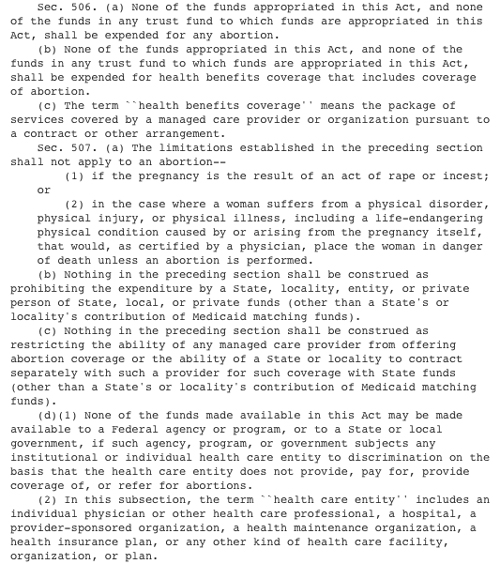
Hyde Amendment
Conditions attached to bills appropriating money for health care that prohibit the use of federal money to pay for abortions.
Most typically, the Hyde Amendment is used in bills that appropriate money for Medicaid.
It has taken several forms since first being introduced by former Rep. Henry Hyde in 1976. In its current form it allows federal money to be used for abortions only in the case where the mother's life is at risk, or where the pregnancy was caused by rape or incest.
Here is sample text of a Hyde Amendment from the 2014 budget bill...
Logan Act
A law established in 1799 making it illegal for a U.S. citizen to negotiate policy with foreign governments without authorization.
The law reads...
Any citizen of the United States, wherever he may be, who, without authority of the United States, directly or indirectly commences or carries on any correspondence or intercourse with any foreign government or any officer or agent thereof, with intent to influence the measures or conduct of any foreign government or of any officer or agent thereof, in relation to any disputes or controversies with the United States, or to defeat the measures of the United States, shall be fined under this title or imprisoned not more than three years, or both.
This section shall not abridge the right of a citizen to apply, himself or his agent, to any foreign government or the agents thereof for redress of any injury which he may have sustained from such government or any of its agents or subjects.
Flynn pleads guilty to lying to FBI, may testify against Trump (2017-Dec-01)
Low-Income Home Energy Assistance Program
(Coming)
National Climate Assessment
You can learn more about the National Climate Assessment at the federal government's climate information website.
National Consumer Assistance Plan
An agreement announced in March, 2015 between the three major credit reporting agencies to make credit reports more accurate and help consumers correct errors in their credit information.
National Do Not Call Registry
A list of phone numbers that telemarketers are not allowed to call. It was implemented in 2004 as a result of the 2003 Do-Not-Call Registry Bill.
Even if you register your phone number, some calls still are permitted...
o Calls which aren't trying to sell you something
o Calls by (or for) non-profit organizations.
The list is primarily for residential landline phones. Companies are not permitted to call mobile phones (though you still may add a mobile phone number to the list). Once you add your phone number to the list, it will remain there until you remove it or no longer have that phone number.
To add your phone number to the National Do Not Call Registry (or to register a complaint), visit www.DoNotCall.gov.
To learn more about the National Do Not Call Registry, read this Federal Trade Commission article.
National Labor Relations Act
1935 law that protects the rights of private sector employees to form or join a union and to bargain collectively.
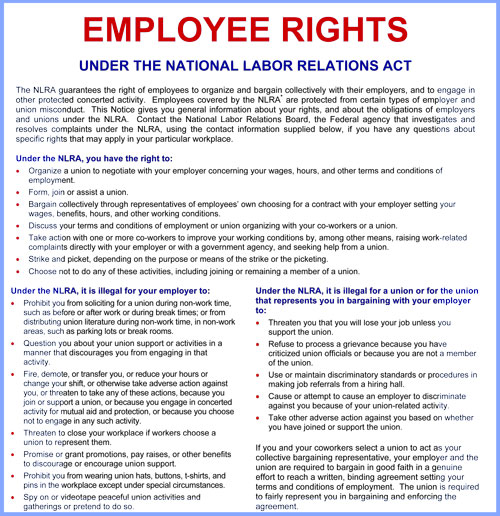
Graphic source: U.S. Dept. of Labor
Click on the above poster for a larger version.
National School Lunch Program
A federal program that reimburses public and non-profit private schools for providing nutritionally balanced meals to children.
Children from families with incomes less than 130 percent of the federal poverty level can receive free lunches. Those from families with slightly higher incomes can receive lunch for approximately a half-dollar.
For more, visit www.fns.usda.gov/nslp/national-school-lunch-program-nslp.
New Deal
(Coming)
Obamacare
Name given (originally meant to be derogatory) for the 2010 Patient Protection and Affordable Care Act
Occupational Safety and Health Act
1970 law enacted to provide a safe workplace environment for workers. It created the Occupational Safety and Health Administration (OSHA).
Click here for more details on the bill.
Organic Act
A law that establishes a U.S. territory or an agency to manage federal lands.
Outer Continental Shelf Lands Act (OCSLA)
1953 law the defines U.S. coastal waters and their management.
You can read more about the law at the the Bureau of Ocean Energy Management website.
Patient Protection and Affordable Care Act
A 2010 law that allows millions of previously uninsured Americans to obtain health care coverage. Many were unable to afford insurance, many could not obtain coverage due to an existing illness. This law is often referred to as Obamacare.
Click here to read our discussion of the bill.
Pendleton Civil Service Reform Act
1882 law that created the Civil Service System and prohibited government jobs from being dependent on political support.
Click here for our discussion.
Physician Payments Sunshine Act (PPSA)
A section (6002) of the Patient Protection and Affordable Care Act (Obamacare) requiring drug and health care device makers to disclose money or gifts they provide to health care providers.
Health care providers also are required to disclose any ownership interests they have in these companies.
For more, read the Health Affairs brief.
Website to view disclosures: www.cms.gov/openpayments
Presidential Records Act (PRA)
1978 law that governs presidential and vice presidential official records created or received after Jan. 20, 1981. It changed the official records of the president to be public records.
For more, read the National Archives description.
Regulatory Right-to-Know Act
Law enacted in 2000 directing the Office of Management and Budget (OMB) to prepare an annual report of the costs and benefits of federal regulations.
Click here to read the law.
Rehabilitation Act
1973 law to make workplaces more accessible to those with disabilities.
Click here to read more on what the Rehabilitation Act does.
For more details on the law, visit GovTrack.us.
Religious Freedom Restoration Act (RFRA)
Click here for more information on the Religious Freedom Restoration Act.
Sarbanes-Oxley Act
2002 law enacted to prevent companies from providing fraudulent information to investors.
Click here to read or discussion of the law.
Sherman Antitrust Act
A law passed in 1890 that prohibits monopolies from from being created by unfair business practices.
SNAP: Supplemental Nutrition Assistance Program
A government program that helps make food affordable to those with very low incomes.
This program formerly was known as Food Stamps.
Social Security
Generally used as the term for the federal program known as the Old-Age, Survivors, and Disability Insurance (OASDI) program. It provides guaranteed payments for retirees, the disabled, and certain survivors.
It's a type of program referred to as an entitlement.
It's paid for by a separate tax on salaries...
o Self Employed Contributions Act tax (SECA)
These taxes are imposed only on the first $117,000 of income (in 2014). In other words, if you earn less that that, you pay the tax on your entire income. If you earn more, then you pay tax only on that amount.
For more, visit www.SocialSecurity.gov.
Social Security Number
A nine-digit number that identifies you to the U.S. government.
Social Security numbers originally were intended to merely identify you to the Social Security Administration, but now are used to identify you to the government for everything from taxes to background checks.
They also are used by private businesses, such as insurance and credit card companies and banks.
In many cases when dealing with companies on the phone, you will be asked for "the last four digits of your social" in order to confirm your identity.
As the uses of Social Security numbers have become more widespread, the number of potential targets has increased for those trying to steal them for identity theft.
Temporary Assistance for Needy Families (TANF)
(Coming)
Title X
1970 addition to the 1944 Public Health Service Act that funds family-planning and other preventive health services for low-income individuals.
Click here for more information about the law.
TRICARE
Health care program for members of the United States military.
TSA PreCheck
(Coming)
Volcker Rule
A federal regulation, part of the Dodd-Frank Wall Street Reform and Consumer Protection Act, that prohibits banks from engaging in certain speculative investments.
For more, read the Investopedia explanation.
Referenced by...House passes bill to revoke consumer and financial protections (2017-Jun-08)
Voting Rights Act
1965 law that prohibits racial discrimination in voting.
Main provisions include...
o Jurisdictions that had used discrimination in the past can not change their voting rules without having the changes pre-cleared by the federal government.
For more, read our discussion of the law.